📊 Full opportunity report: Practice Camera Communication Skills Before Your Next Business Video on IdeaNavigator AI — validation score, market gap, and execution plan.

Get business pricing on monitors, keyboards and dev gear
- Business-only prices and quantity discounts
- Tax-exempt purchasing
- Multiple users, one account, clear invoices
TL;DR
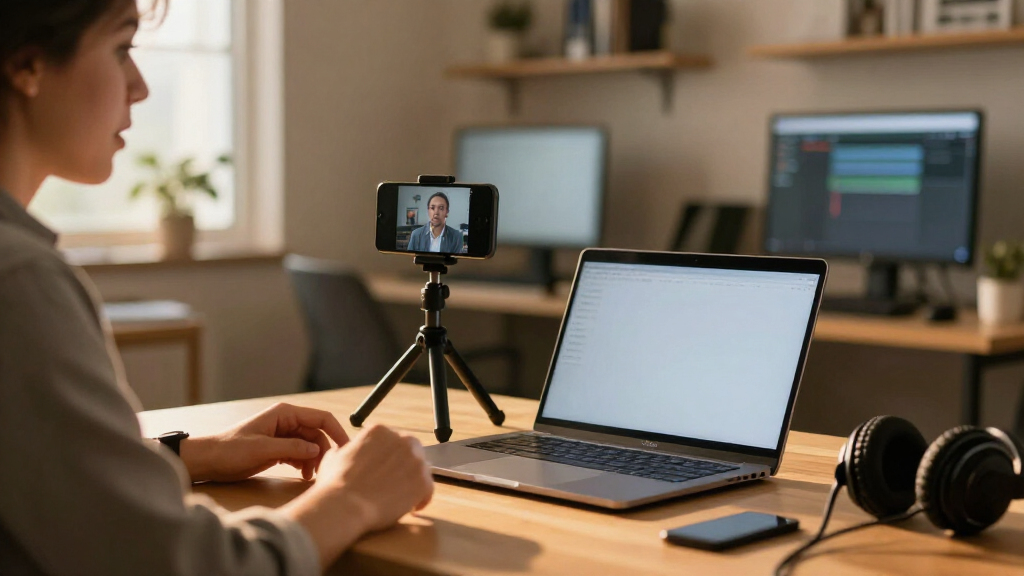
IdeaNavigator AI has outlined a proposed app to help business owners practice speaking on camera through short exercises and private feedback. The concept has not been reported as a launched product or validated service; a 30-day cohort is proposed to test whether it helps participants publish a real video.
IdeaNavigator AI has outlined a proposed practice app for business owners who know video could help their work but freeze when they try to record. The concept pairs two-minute daily speaking exercises with automated feedback, but it is a product proposal, not evidence of an app already available or proven to increase video publishing.
The proposed exercises would progress from reading prepared text to speaking more freely. The app would assess delivery features including pace, filler words, eye line and energy, then display progress over time. The idea is to let users practice privately before moving on to recording videos intended for their businesses.
The proposal also includes confidence streaks to encourage regular practice. Its suggested business model is a consumer subscription, with a separate team tier for agencies that coach clients. No pricing, product release date, technical details or operating company are specified in the concept.
To test demand and outcomes, the proposal calls for a 30-day cohort of 100 business owners, compared with a waitlist control group. The stated measure is how many participants publish their first real video by day 45. No cohort results are provided, and the proposal does not say that this test has begun.
Practice Camera Communication Skills Before Your Next Business Video
A proposed private practice app pairs short speaking drills with automated feedback for business owners who freeze when the camera starts. It remains an unvalidated concept; no launch or trial results are reported.
Short speaking exercises
Business owners to recruit
Compared with a waitlist group
First real video published
From camera hesitation to a real recording
The idea targets owners who see value in video but avoid recording because of stumbling, self-criticism, or repeated takes. The proposed exercises create a private, repeatable path from rehearsal to publishing.
Speak for two minutes
Daily prompts offer a low-pressure way to practice without a live audience.
Move beyond the script
Progress from reading prepared material toward speaking more naturally.
Track practice streaks
Confidence streaks are proposed to encourage a regular practice habit.
Private feedback, with progress over time
The concept describes automated, multimodal assessment of delivery. These are proposed capabilities: no working app, technical method, or accuracy testing is reported.
Record a short exercise
Practice privately with a daily prompt.
Review delivery cues
Feedback may cover pace, filler words, eye line, and energy.
See progress
Track practice patterns and build confidence over time.
Publish for business
The intended next step is a real video shared with an audience.
Publication is the proposed success measure
Did participants post?
The proposal compares a 30-day practice cohort with a waitlist control group. Its stated outcome is how many owners publish their first real business video by day 45.
Two audiences, open business questions
Business owners
For people who understand video’s potential but feel uncomfortable recording. The suggested model is a consumer subscription; no price is specified.
Agencies that coach clients
A separate team tier could support coaching workflows. Agency demand and willingness to pay remain untested.
Concept stage, with key details still unspecified
What the proposal can—and cannot—say today
Is the app available now?
No. The description presents a product concept and gives no release date.
Who is it designed for?
Business owners who feel uneasy recording, with a possible agency coaching tier.
What would users practice?
Two-minute daily exercises, progressing from prepared text to freer speaking, with proposed feedback on delivery.
Has it been shown to reduce camera anxiety?
No evidence or completed test is included. Whether practice reduces anxiety or increases publishing remains untested.
Testing Practice Against Publication
The concept focuses on a specific obstacle: some owners may accept that video matters but avoid recording because of stumbling, self-criticism and repeated takes. If practice helps users move from rehearsal to publishing, it could address a gap between knowing video is useful and actually making it. That outcome, however, remains a hypothesis to test.
The proposed day-45 measure is more concrete than tracking app engagement alone: it asks whether participants publish a real business video. Comparing a cohort with a waitlist could offer an initial indication of whether the practice routine is associated with that step. The description does not provide a study protocol or results, so it cannot yet show that the app would cause an improvement.
The agency tier would broaden the intended audience beyond individual owners, potentially making the product a coaching tool. Whether agencies would pay for it, and whether automated feedback is useful enough to justify a subscription, are also open commercial questions.
Products Worth Considering

Bose QuietComfort True Wireless Earbuds with Active Noise Cancellation, Bluetooth 5.3, USB-C Charging, IPX4, Black

Apple AirPods Pro (2nd Generation) Wireless Earbuds with USB‑C Charging, Up to 2X More Active Noise Cancelling, Transparency Mode, Adaptive

Logitech MX Mechanical Wireless Illuminated Keyboard, Tactile Quiet, Graphite
As an affiliate, we earn on qualifying purchases.
From Camera Anxiety to Short Rehearsals
The proposal places the idea in the communication skills training market. It argues that video marketing expectations now reach businesses of different sizes, while traditional public-speaking courses may not address the particular experience of recording alone, reviewing takes and deciding whether to publish.
Its suggested response is a private, repeatable practice loop. The concept says multimodal AI could assess delivery, including eye line and speaking pace, and provide feedback without a live audience. Those are proposed capabilities; the description does not identify a built system, explain how it would evaluate performance, or report tests of accuracy.
The plan therefore centers on validation rather than a documented product launch. A controlled comparison is proposed to check whether owners who practice are more likely to post a first video than people waiting to participate.
Product and Test Status
No launch, working app or test results are reported. The concept gives no information about a developer, release schedule, subscription price, data handling or which AI system would assess users. It also does not define how scores for eye line, energy or pace would be calculated or checked.
The proposed cohort’s recruitment process, waitlist assignment, participant characteristics and definition of a published video are not detailed. Until results are available, it is unclear whether short daily exercises would lead to more published videos, whether participants would keep using the app, or whether agencies would adopt a team plan.
The Proposed Day-45 Measure
The next step described in the concept is to recruit 100 business owners for a 30-day cohort and compare their video publishing with a waitlist control group. The proposed outcome is publication of a first real video by day 45, rather than progress scores alone.
No start date or completed trial is given. Any later report would need to explain how participants were selected, how the comparison was run and how many people in each group published. Until those details and results are available, the app remains an unvalidated product idea.
Source: IdeaNavigator AI
Key Questions
Is the on-camera practice app available now?
The description presents a product concept. It does not say that an app has launched or provide a release date.
Who is the proposed app for?
It is aimed at business owners who understand the value of video but feel uncomfortable recording. An agency coaching tier is also proposed.
What would users practice?
The proposed routine uses two-minute daily exercises, progressing from reading prepared material to speaking more freely. Automated feedback would cover pace, filler words, eye line and energy.
How would the idea be tested?
IdeaNavigator AI proposes a 30-day cohort of 100 owners and a waitlist comparison. The stated outcome is how many participants publish a first real video by day 45; no results are reported.
Has the app been shown to reduce camera anxiety?
No evidence or completed test is included in the proposal. Whether the exercises reduce anxiety or lead to more published business videos remains untested in the reported material.
Source: IdeaNavigator AI