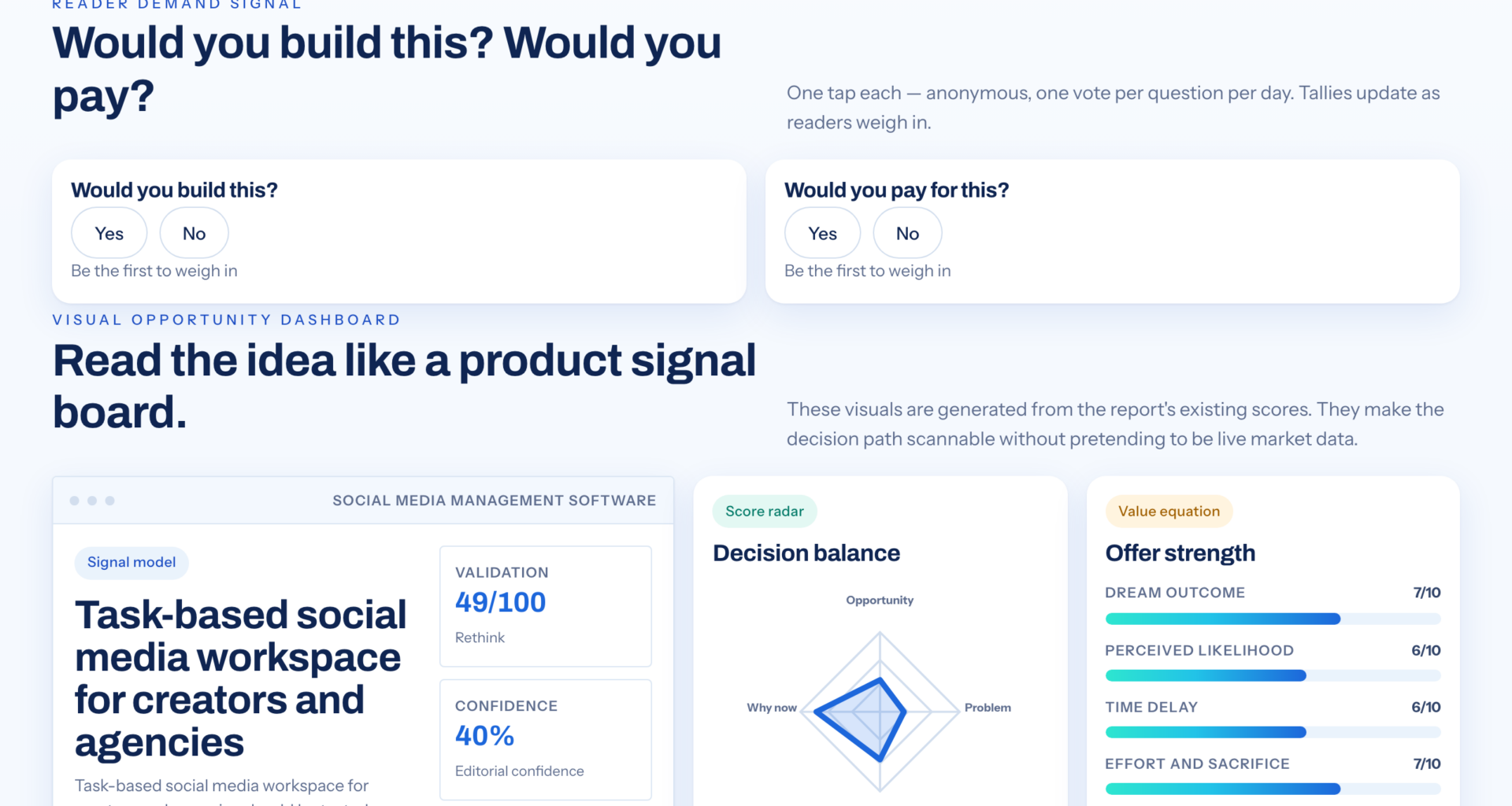

📊 Full opportunity report: A Task-Driven Workspace For Managing Social Media Work on IdeaNavigator AI — validation score, market gap, and execution plan.

Get business pricing on monitors, keyboards and dev gear
- Business-only prices and quantity discounts
- Tax-exempt purchasing
- Multiple users, one account, clear invoices
TL;DR
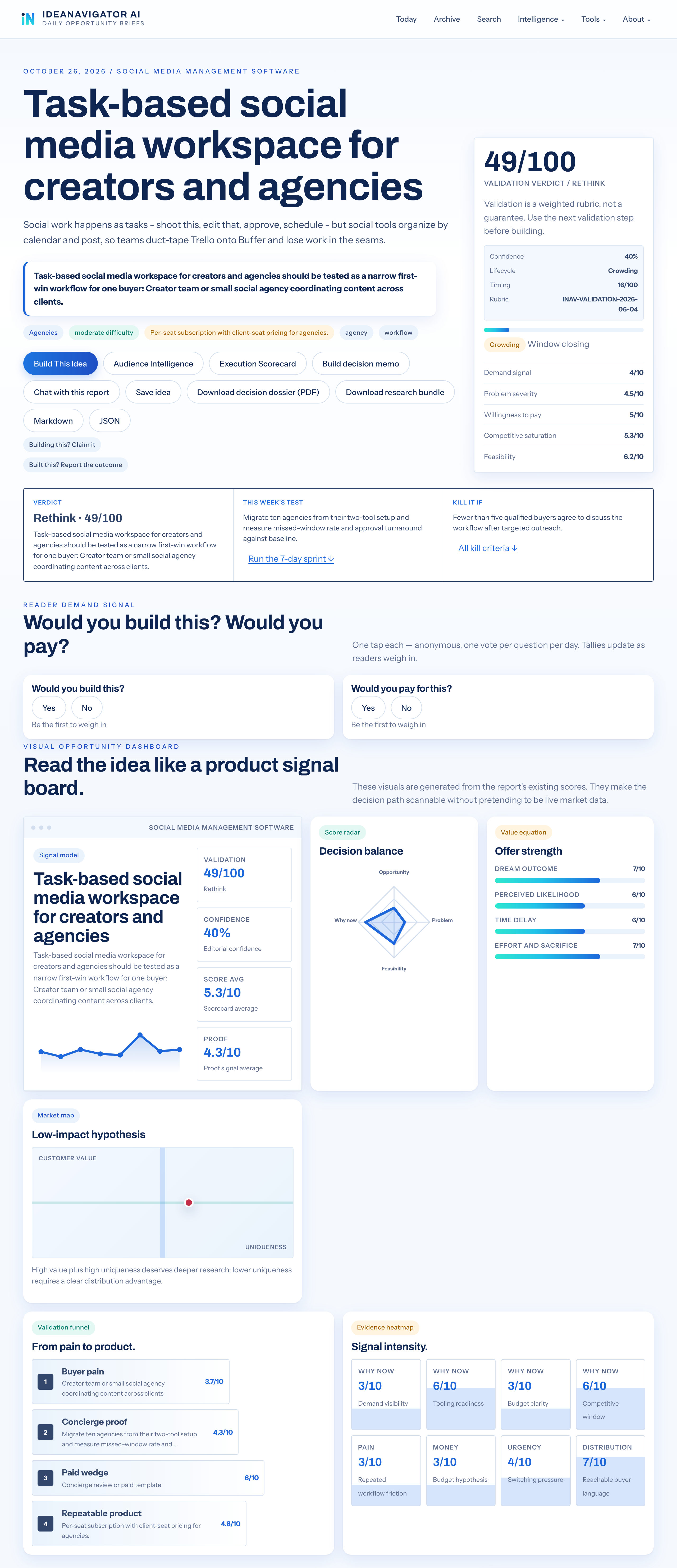
IdeaNavigator AI has outlined a task-driven social media workspace for creator teams and small agencies, bringing briefs, assets, edits, approvals and scheduling into one pipeline. The proposal is an early product concept, not a launched service; its impact would need testing with agencies against their current workflows.
IdeaNavigator AI has proposed a task-based workspace for creator teams and small social agencies, built to manage posts from an initial brief through editing, approval and scheduling. The concept addresses a coordination gap between social scheduling platforms and general project-management tools, but it remains a proposed product rather than a confirmed launch.
The proposed workspace would treat each social post as a task, rather than organizing work only around a publishing calendar. Its suggested stages are brief, asset, edit, approval and scheduled, creating one pipeline for teams coordinating content across clients. The product outline also calls for client-facing approval links and asset versioning.
Under the concept, a post would move into native scheduling after approval, connecting the work-management process to publication. The business model proposed is a per-seat subscription, with separate client-seat pricing for agencies. No pricing, platform integrations, supported social networks, product name or availability date were specified.
The proposal recommends testing the workflow with ten agencies migrating from their existing two-tool setups. The suggested measures are missed-window rates and approval turnaround compared with each agency’s baseline. These are proposed validation steps, not reported results; no agency trials or performance figures were provided.
The concept targets a practical source of friction for small teams: social content requires work between the initial idea and the scheduled post, often involving several people and client sign-off. A task-based system could make ownership, status and approvals easier to follow than a workflow split between a scheduler and a generic project tool.
For agencies, client approval links and versioned assets could reduce confusion over which creative is current and whether a post is ready to publish. However, those benefits are potential outcomes, not demonstrated results. The proposal’s suggested measures—approval turnaround and missed publishing windows—would help test whether bringing the steps together improves operations in practice.
The product would also enter a market where teams already use scheduling services alongside project-management software. Its relevance will depend on whether it can fit existing publishing routines and client relationships without adding another layer of work. Workflow adoption and measurable results, rather than the feature list alone, would determine whether the idea solves a meaningful problem.
Products Worth Considering

DJI Osmo Mobile 8 Gimbal with Mic Mini Transmitter, Infinity Black

Amazon Kindle Scribe Colorsoft 64GB (1st Generation)

Sony WH-1000XM4C Wireless Noise-Cancelling Headphones, Black
As an affiliate, we earn on qualifying purchases.
The Gap Between Calendars and Tasks
The proposal describes a mismatch between how social tools are organized and how teams carry out the work. Scheduling products tend to center on calendars and posts, while the work itself includes assignments such as shooting, editing, reviewing and securing approval. Teams may use a separate general-purpose project tool to track those steps, leaving information distributed across systems.
IdeaNavigator AI frames this as an opportunity for a tool designed specifically for social content workflows. It argues that rising content demands have increased coordination needs, while scheduling products have left much of the work-management layer to generic tools. Those points are the rationale behind the proposal; no market data or independent research was included to quantify the trend.
The suggested initial customer is deliberately narrow: creator teams and small social agencies handling content for multiple clients. Rather than claiming a product is ready for broad adoption, the outline recommends a limited agency test and a comparison with existing two-tool processes.
Product Scope and Test Results
There is no confirmed product launch, working prototype, customer deployment or test outcome in the proposal. It does not identify which social platforms the workspace would support, how native scheduling would operate, or whether client approval links would require clients to create accounts.
Pricing and implementation details are also unspecified, including what counts as a billable seat and how client seats would be priced. The proposal does not provide a baseline for missed publishing windows or approval times, so it is not possible to estimate the scale of the problem or the potential improvement. Whether agencies would replace existing tools or keep them alongside a new workspace remains open.
Agency Testing Would Be the Next Step
The next step set out in the proposal is to recruit ten agencies and move their work from existing two-tool arrangements into the task-based workflow. A useful evaluation would record each team’s current missed-window rate and approval turnaround, then compare those measures after migration over a clearly defined period.
No test schedule, participating agencies or launch timeline has been announced in the available details. Until those are established and results reported, the workspace should be understood as a product opportunity under consideration, not a proven solution. Any later update would need to clarify the product’s supported platforms, pricing and whether the proposed workflow improves the chosen measures.
Source: IdeaNavigator AI
Key Questions
Has the task-based social media workspace launched?
No launch is confirmed. The available details describe a product proposal and a suggested agency validation test, not a released service.
Who is the proposed workspace for?
The initial target is creator teams and small social agencies coordinating content for multiple clients.
What would the workspace include?
The proposal describes post-level tasks that move through brief, asset, edit, approval and scheduled stages, with client-facing approval links, asset versioning and scheduling after approval.
How would the concept be tested?
IdeaNavigator AI proposes migrating ten agencies from their current two-tool setups and comparing missed-window rates and approval turnaround with each agency’s baseline. No results have been reported.
What remains unknown?
The proposal does not specify a launch date, pricing, supported social platforms or participating agencies. It also provides no measured evidence that the workflow would reduce delays or missed publishing windows.
Source: IdeaNavigator AI