

The Outbox Pattern helps you achieve reliable event publishing by recording messages within the same transaction as your data updates, ensuring they aren’t lost if failures occur. This approach guarantees atomicity, so both data and messages are committed together, preventing inconsistencies. A separate process then reads from the outbox to send messages, allowing retries and minimizing errors. Keep exploring to discover how this pattern keeps your distributed systems consistent and dependable.
Key Takeaways
- Ensures atomicity by recording events in an outbox table within the same transaction as data updates.
- Decouples message dispatching from core transactions, enabling reliable and retryable message delivery.
- Maintains data consistency and prevents message loss during system or network failures.
- Facilitates integration with durable messaging systems for guaranteed event delivery.
- Enhances traceability by combining data changes and corresponding events in a unified process.
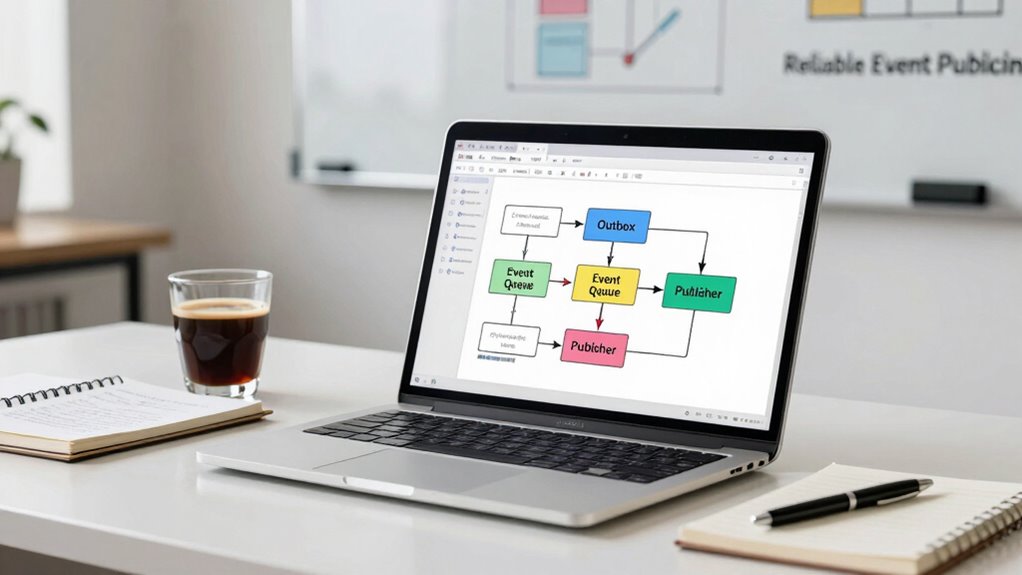
Ensuring reliable event publishing is essential for maintaining consistency across distributed systems, and the outbox pattern offers an effective solution. When you’re working with multiple services that need to share data or trigger actions, message durability becomes critical. If messages are lost or not delivered, your system’s state can become inconsistent, leading to errors or incomplete workflows. The outbox pattern helps safeguard against this by ensuring that messages are reliably stored and sent, even if failures occur.
Reliable event publishing ensures system consistency by securely storing and sending messages, even amid failures.
At its core, the outbox pattern manages transaction boundaries carefully. When you update your database, you simultaneously record any events or messages in an outbox table within the same transaction. This way, you guarantee that the data changes and the messages describing those changes are committed together. It’s a way to handle transaction management that ensures atomicity: either both the database update and the message are saved, or neither are. This prevents scenarios where a message might be sent without corresponding data updates, or vice versa, which could compromise message durability. Additionally, the pattern can be integrated with event sourcing techniques to further enhance data consistency and traceability.
Once the transaction completes successfully, a separate process—often called a message relay or dispatcher—reads from the outbox table and publishes the messages to their destination. This decouples message sending from the core transaction, allowing your system to handle failures gracefully. If the message fails to send, it can be retried without risking data inconsistency. This approach also simplifies error handling, because failures are isolated from the main transaction, reducing the chances of message loss and ensuring that the message is eventually delivered. Message durability is a key benefit of this pattern, as it helps maintain consistency even in the face of network or system failures. Incorporating durable messaging mechanisms further reinforces the reliability of message delivery, especially in complex distributed environments.

Custom Pattern Making with PatternMaker Software: A Step-by-Step Manual for the Professional Studio With an Introduction to Macro Generator
As an affiliate, we earn on qualifying purchases.
As an affiliate, we earn on qualifying purchases.
Frequently Asked Questions
How Does the Outbox Pattern Handle Message Ordering?
You handle message ordering in the outbox pattern by ensuring message sequencing through timestamp or sequence number fields, which maintain event consistency. When your system writes events to the outbox table, it assigns these sequential identifiers. During event dispatch, you process messages in order based on these identifiers, guaranteeing that events are published in the correct sequence, preserving consistency across distributed components and preventing message reordering issues.
What Are Common Pitfalls When Implementing the Outbox Pattern?
Did you know that 60% of outbox pattern implementations face issues with message duplication? When you implement this pattern, be cautious of pitfalls like inadequate transaction management, which can cause duplicate messages or missed events. Failing to handle transactions properly risks inconsistencies between your database and message broker. To avoid these, make certain your system manages transactions atomically, and implement idempotency to prevent duplicate event processing.
How Does the Pattern Perform Under High Load?
Under high load, the outbox pattern handles scalability challenges well, but you need to manage concurrency carefully. As load increases, multiple processes may try to read and delete from the outbox simultaneously, risking duplication or missed events. To mitigate this, implement proper locking or use atomic operations. With effective concurrency management, the pattern remains reliable and performs efficiently, even under significant traffic, ensuring your events are consistently published.
Can the Outbox Pattern Be Combined With Other Messaging Guarantees?
They say “a chain is only as strong as its weakest link,” and you can strengthen your messaging system by combining the outbox pattern with other guarantees. You can achieve transactional consistency within your database and guarantee eventual delivery of messages. Using this approach, you make your system more resilient, blending the reliability of the outbox with additional messaging guarantees for a robust, dependable architecture.
What Are Best Practices for Cleaning up the Outbox Table?
To guarantee effective outbox cleanup and table maintenance, you should regularly delete or archive processed entries to prevent table bloat. Automate outbox cleanup using scheduled jobs or database scripts that delete messages once they’ve been successfully published. Implement retention policies based on message age or status, and consider partitioning the outbox table to improve performance. Consistent outbox cleanup maintains system efficiency and guarantees reliable event publishing.

KOQICALL Wireless Queue Calling System Take a Number System 3-Dight Now Serving Number System with Voice Prompt for Restaurant Hospital Bank Waiting Line Management (1 Keypad + 1 Display)
【Convenient Keypad Pager】The first orange digit indicates the zone number and the last three red digits indicate the…
As an affiliate, we earn on qualifying purchases.
As an affiliate, we earn on qualifying purchases.
Conclusion
By adopting the outbox pattern, you turn your event publishing into an unstoppable force—like a reliable, unbreakable river that never runs dry. No matter how chaotic your system gets, your events flow flawlessly, ensuring every message is delivered with laser precision. Say goodbye to lost data and missed updates forever, and embrace a future where your system’s reliability is so rock-solid, it’s practically invincible. With this pattern, you’re unstoppable.
Eaasty 3 Pack Memorandum Book Carbon Copy Notebook Carbonless Two-part Duplicate Memorandum Forms Book Tear off Phone Message Pads for Office School Home
An Efficient Way to Send Memos: this carbonless duplicate memorandum book features preprinted prompts, including date, recipient, signature,…
As an affiliate, we earn on qualifying purchases.
As an affiliate, we earn on qualifying purchases.

Python in Production: Senior Engineering: DDD, Event Sourcing, microservicios, observabilidad y CI/CD para producción (PYTHON DESDE CERO) (Spanish Edition)
As an affiliate, we earn on qualifying purchases.
As an affiliate, we earn on qualifying purchases.