

Saga patterns help you manage long-running transactions across distributed systems by breaking them into smaller, manageable steps with clear success or failure states. You set up decentralized message choreographies, allowing services to operate independently and respond to events automatically. When a failure occurs, predefined compensation actions undo specific steps without stopping the entire process. This approach keeps data consistent and improves system resilience—if you want to uncover more about how this works, keep exploring.
Key Takeaways
- Saga patterns enable reliable management of long-running, distributed transactions through sequence-based message choreography and compensation mechanisms.
- They break complex processes into smaller, reversible steps, maintaining data consistency without locking resources.
- Decentralized, asynchronous messaging allows services to operate autonomously and enhances system scalability.
- Compensation actions undo specific steps if failures occur, ensuring system integrity during partial failures.
- Essential for modern distributed architectures to build resilient, flexible, and fault-tolerant transaction workflows.
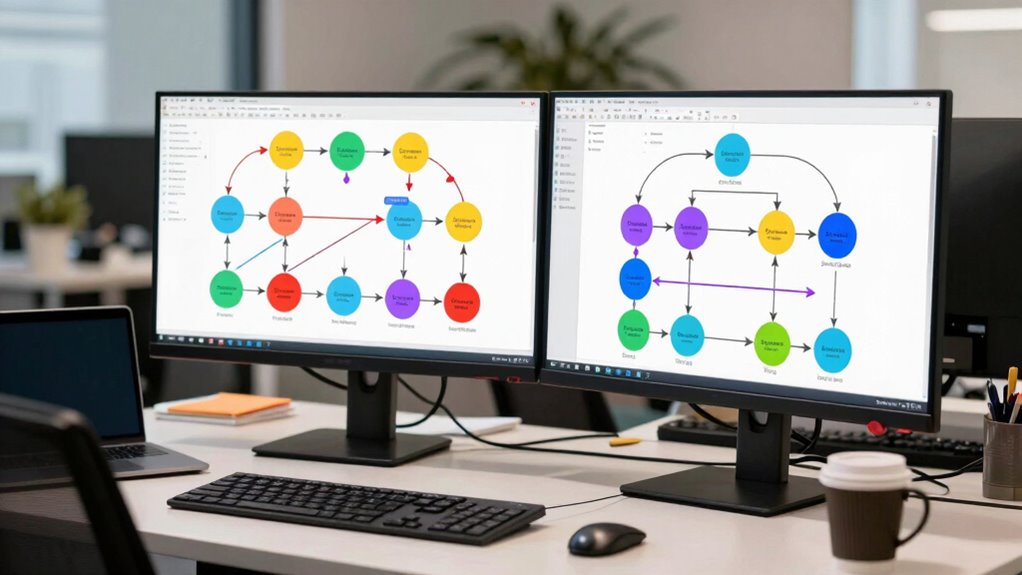
Have you ever wondered how complex, long-running transactions maintain consistency across multiple distributed systems? In traditional databases, transactions are straightforward—either everything succeeds, or everything rolls back—but things get tricky when you’re dealing with multiple services spread across different locations. That’s where Saga patterns come into play, offering a way to manage these long-running processes without sacrificing data integrity. Instead of relying on a single atomic transaction, Saga patterns break the process into a series of smaller, manageable steps, each with its own compensation mechanism ready to undo changes if needed. This approach guarantees that even if one step fails, the system can revert to a consistent state without halting the entire operation.
Saga patterns ensure data consistency across distributed systems through manageable steps and targeted compensation mechanisms.
In a Saga, message choreography plays a pivotal role. Think of it as a dance where each participant knows their moves and cues, coordinating actions through message exchanges without central control. You, as a developer, set up this choreography by designing a sequence of messages that trigger subsequent steps, ensuring that each service performs its task in order. If a step completes successfully, it sends a message to the next service, and the process continues smoothly. But if a failure occurs at any point, you activate compensation mechanisms—predefined actions that undo previous steps—restoring the system to its previous consistent state. This is different from a traditional transaction where a rollback would undo all changes; here, compensation mechanisms specifically target only those steps that need reversing, making the process more flexible and resilient. Designing effective compensation strategies is crucial for ensuring system reliability and consistency during failures. Additionally, understanding the distributed nature of these systems helps in designing effective compensation strategies aligned with your architecture.
By utilizing message choreography, you avoid the need for a central orchestrator, which can become a bottleneck or single point of failure. Instead, each service acts autonomously, listening for relevant messages and responding accordingly. This decentralization enhances scalability and fault tolerance, vital qualities for distributed systems. You also gain better control over long-running transactions, as you can implement compensation mechanisms tailored to each step. For example, if a payment is processed but subsequent inventory updates fail, you can trigger a refund or rollback of the payment, ensuring overall consistency. This way, Saga patterns enable your system to handle failures gracefully, maintaining data integrity across multiple services without locking resources for extended periods. Furthermore, adopting asynchronous messaging can help in managing long-running processes more effectively by decoupling steps and allowing retries when necessary.
In essence, Saga patterns with message choreography and well-designed compensation mechanisms empower you to build robust distributed applications. They allow long-running transactions to complete successfully, even amid partial failures, by breaking down complex operations into smaller, manageable, and reversible steps. This approach not only preserves consistency but also enhances system resilience and flexibility, making it an essential pattern for modern distributed architectures.
distributed transaction management software
As an affiliate, we earn on qualifying purchases.
As an affiliate, we earn on qualifying purchases.
Frequently Asked Questions
How Do Saga Patterns Handle Data Consistency Across Services?
You handle data consistency in saga patterns by using event sourcing to track all changes as events, making it easier to replay or audit. When discrepancies occur, you perform data reconciliation to guarantee all services reflect the correct state. This approach allows you to maintain eventual consistency by coordinating compensating transactions if needed, ensuring that each service stays aligned despite the distributed nature of the system.
What Are Common Challenges in Implementing Saga Patterns?
You face challenges like maintaining eventual consistency across services, which can lead to data discrepancies if not managed carefully. Coordinating messages during each transaction step is complex, especially when failures occur, requiring reliable messaging and compensation actions. Ensuring all services stay synchronized without blocking processes demands careful design. You must also handle error recovery smoothly to prevent data corruption, making message coordination and consistency critical in implementing saga patterns effectively.
How Does Compensation Work in Saga Transactions?
When it comes to saga transactions, compensation works like a safety net, catching you if things go awry. You implement compensation strategies and rollback mechanisms to undo completed steps if a later step fails. This way, you keep data consistent without a traditional transaction. Fundamentally, you design each step with a corresponding compensating action, ensuring that if problems arise, you can gracefully backtrack and maintain system integrity.
Can Saga Patterns Be Applied to Real-Time Systems?
Yes, you can apply saga patterns to real-time systems, but you need to focus on real-time responsiveness and latency management. Since sagas coordinate distributed transactions through a series of local steps, they can cause delays if not optimized. To guarantee timely responses, you should design lightweight, fast-executing compensations and prioritize quick communication. Properly managing these factors helps you maintain performance and consistency in real-time environments.
What Tools or Frameworks Support Saga Pattern Implementation?
You’ll find that tools like Axon Framework, Kafka, and MassTransit support saga pattern implementation effectively. These frameworks leverage event sourcing and message queues, enabling you to orchestrate complex transactions gracefully. They help you manage long-running processes, ensuring data consistency without sacrificing system responsiveness. By adopting these tools, you subtly master the art of balancing reliability and performance, allowing your distributed systems to operate smoothly even amidst inevitable uncertainties.
message choreography tools for microservices
As an affiliate, we earn on qualifying purchases.
As an affiliate, we earn on qualifying purchases.
Conclusion
By implementing saga patterns, you effectively manage long-running distributed transactions, ensuring data consistency without traditional locking. This approach not only simplifies complex workflows but also enhances system resilience. Did you know that over 70% of enterprises adopting microservices report improved transaction reliability? Embracing saga patterns means you’re on the cutting edge of scalable, fault-tolerant architecture—making your systems more robust and adaptable to future challenges.
compensation mechanism software for distributed systems
As an affiliate, we earn on qualifying purchases.
As an affiliate, we earn on qualifying purchases.
resilient transaction workflow tools
As an affiliate, we earn on qualifying purchases.
As an affiliate, we earn on qualifying purchases.