
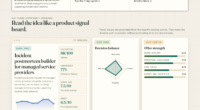
📊 Full opportunity report: The Orchestration Layer Arrives: What Anthropic’s Finance Agents Mean for Bloomberg, FactSet, and Wall Street on ThorstenMeyerAI.com — validation score, market gap, and execution plan.

Get business pricing on monitors, keyboards and dev gear
- Business-only prices and quantity discounts
- Tax-exempt purchasing
- Multiple users, one account, clear invoices
TL;DR
Anthropic has launched an orchestration layer that consolidates access to major financial data providers via Claude AI, potentially disrupting traditional financial industry UI models. This development enhances AI’s role in financial research and analysis, with significant implications for incumbents and analysts.
Anthropic has introduced a new orchestration layer that consolidates access to multiple financial data providers through its Claude AI platform, marking a significant shift in how financial analysts interact with data. This development positions Anthropic as a potential challenger to established incumbents like Bloomberg, with implications for the industry’s data and UI landscape.
On May 2026, Anthropic released ten ready-to-run AI agent templates tailored for financial services, including functions like earnings review, market research, and KYC screening. These agents are integrated with Claude AI and paired with new add-ins for Microsoft Office applications, along with eight new data connectors, including partnerships with FactSet, S&P Capital IQ, Moody’s, and others. Moody’s launched its first MCP app, providing credit ratings for over 600 million companies, further enhancing the data ecosystem.
The core technical claim is that Claude Opus 4.7 achieved a benchmark score of 64.37 percent on a comprehensive finance question set, outperforming competitors such as Sonnet and Meta’s Muse Spark. This benchmark, rebuilt early 2026 with input from Goldman Sachs, Silver Lake, and Citadel, indicates that approximately one-third of finance analyst questions answered by Claude are still incorrect, highlighting ongoing limitations.
Strategically, Anthropic is positioning Claude as an orchestration layer over existing data providers, rather than a direct competitor to Bloomberg Terminal. The platform pulls data from providers like FactSet, S&P, MSCI, and Moody’s, then orchestrates analysis within Microsoft Office environments. This approach could diminish Bloomberg’s UI moat, as Claude Cowork becomes a primary interface for analysts, integrating data, news, and analytics seamlessly.
Above the data.
Anthropic isn’t competing with Bloomberg Terminal. It’s positioning Claude as the orchestration layer over Bloomberg-class data providers.
10 ready-to-run agent templates · Claude across Excel, PowerPoint, Word, Outlook · 8 new connectors + Moody’s MCP app. Powered by Claude Opus 4.7 · state-of-the-art on Vals AI Finance Agent benchmark at 64.37%. Connector ecosystem (FactSet, S&P CapIQ, MSCI, PitchBook, Morningstar, LSEG, Daloopa + 8 new) is the moat. UI moves to Claude Cowork; data layer stays.
Ten templates. Ten cohorts.
The ten agent templates map cleanly to specific bank job functions. Reading them as displacement signals reveals which cohorts within financial services are most exposed — and which workflow categories deploy fastest.
Six providers. Three trajectories.
Bloomberg’s $32K/seat moat was the consolidated UI over data + news + analytics + chat. If Claude Cowork wins the analyst desktop, the UI moat erodes. The data layer stays where it is.
Three scenarios. One vertical.
30/50/20 probability allocation. Base case represents bifurcated deployment — back/middle office aggressive, front office cautious due to liability. The 64.37% accuracy threshold determines deployment pattern.
- 3-5× productivitySenior analysts on covered workflows.
- Gradual hiring contraction15-25% annually. Natural attrition.
- Bloomberg defense holds~30% mindshare maintained.
- 75-80% accuracy by 2027-28Vals benchmark trajectory.
- Outcome: Cooperative regulatory framework develops.
- Back/middle office aggressiveKYC, GL, audit deploy fast.
- Front office cautiousLiability concerns slow IB pitches, M&A.
- 100-150K displacementBy end of 2028.
- Coexistence with Bloomberg ASKBDifferent segments.
- Outcome: Liability framework refinement 2027-28.
- High-profile failureKYC miss · M&A error · client misrep.
- Industry deployment retreatAdvisory-only AI use.
- Stricter validationErodes productivity gains.
- 50-75K displacement onlySlower trajectory.
- Outcome: Vals accuracy stalls at 70-72%. Bear case for AI lab valuations gains support.
State-of-the-art at 64.37% means approximately one in three professional finance-analyst questions is answered wrong. Senior analysts as validation layer is the durable pattern. Junior analysts trusting AI output is the failure mode. The deployment architecture follows directly from the accuracy threshold.
Four assignments. By role.
Back/middle aggressive. Front cautious.
Deploy back/middle office templates aggressively (KYC screener, GL reconciler, month-end closer, statement auditor) — human validation pattern is straightforward. Deploy front-office templates (pitch builder, model builder, valuation reviewer) cautiously with senior validation. Plan cohort headcount with 15-25% annual contraction in affected junior roles. Compliance and legal in deployment governance from day one.
Bloomberg accelerates. Others position.
Bloomberg should accelerate ASKB rollout and emphasize data-depth differentiation — the race is timeline-pressured. FactSet, LSEG, Moody’s should aggressively position MCP/connector integration. Specialized vertical providers should pursue first-mover advantage in their domain. Hybrid (own UI + Claude integration) is most likely durable.
Reskill toward vertical AI.
Vertical AI specialists (combining finance domain expertise with AI fluency) is the most defensible path. Senior cloud / security / data engineering paths offer durable demand. Geographic flexibility helps — financial centers (NYC, London, Singapore, Frankfurt) face most concentrated displacement; secondary centers may face less. The Atlassian template (cut + AI-hire rebalance) is the durable employer model.
Update provider competitive models.
Bloomberg position is timeline-pressured. FactSet (FDS), LSEG (LSE), S&P Global (SPGI), Moody’s (MCO) all have public equity exposure — orchestration-layer dynamic is mostly bullish for non-Bloomberg providers. Anthropic IPO valuation case strengthens with finance vertical penetration. Watch Google I/O May 19-20 for Gemini finance vertical response.
Disruption of Bloomberg’s UI Dominance in Financial Analysis
This development could fundamentally alter the competitive landscape of financial data access. By acting as an orchestration layer that integrates multiple data sources through a conversational AI interface, Anthropic threatens Bloomberg’s longstanding UI moat. If Claude Cowork becomes the dominant analyst interface, the value of Bloomberg’s proprietary UI diminishes, potentially leading to a shift in industry standards for financial research tools.
The impact extends to various industry segments, including corporate banking, wealth management, compliance, and private equity. The deployment of Claude’s templates and connectors could accelerate research workflows, reduce analyst labor, and modify the competitive dynamics among data providers and financial institutions.
As an affiliate, we earn on qualifying purchases.
Strategic Shift Toward AI-Driven Data Orchestration in Finance
Earlier in 2026, Anthropic released Claude 4.7, setting a new benchmark in financial AI performance. Concurrently, the firm announced partnerships with major data providers such as FactSet, S&P, MSCI, and Moody’s, aiming to create a unified, AI-powered interface for financial analysis. The release coincides with broader industry moves, including Bloomberg’s beta launch of ASKB, which also leverages multiple large language models to serve as an AI assistant within the Bloomberg Terminal environment.
The timing of these announcements—SpaceX’s capacity expansion and Anthropic’s product release—suggests a strategic push to capture enterprise AI adoption in finance, targeting the high-value verticals of research, credit analysis, and compliance. The industry has been gradually shifting toward AI-enhanced workflows, but the recent developments mark a significant acceleration.
“This will be the new terminal. The primary way most interactions happen.”
— Shawn Edwards, Bloomberg CTO
AI-powered financial research tools
As an affiliate, we earn on qualifying purchases.
As an affiliate, we earn on qualifying purchases.
Uncertainties Around Deployment and Industry Adoption
It remains unclear how quickly and broadly the industry will adopt Anthropic’s orchestration layer, especially given the existing dominance of Bloomberg Terminal. The actual impact depends on deployment speed, analyst trust in AI outputs, and regulatory considerations around AI use in finance. Additionally, the error rate of approximately one in three answers still poses risks for professional use without senior oversight.
Further, the competitive response from Bloomberg and other incumbents, such as enhanced AI integrations or new UI offerings, is still developing. The long-term effects on market share and industry standards are uncertain and will depend on future performance and strategic moves.
Microsoft Office financial add-ins
As an affiliate, we earn on qualifying purchases.
As an affiliate, we earn on qualifying purchases.
Next Steps in Industry Adoption and Competitive Response
Industry observers will watch for broader deployment of Claude-based tools across financial institutions, alongside Bloomberg’s updates to ASKB and other AI initiatives. Key milestones include increased adoption rates, improvements in Claude’s accuracy, and regulatory clarity regarding AI in finance. The next 6 to 12 months will reveal whether Anthropic’s orchestration approach becomes a dominant interface or remains a complementary tool.
Further, industry partnerships and integrations will evolve, potentially leading to new standards for AI-driven financial analysis. Regulatory and risk management considerations will also shape how widely these tools are adopted in professional settings.
As an affiliate, we earn on qualifying purchases.
Key Questions
How does Anthropic’s orchestration layer differ from traditional financial data platforms?
It acts as a conversational AI interface that pulls data from multiple providers and orchestrates analysis within familiar tools like Excel and PowerPoint, rather than relying solely on a proprietary UI like Bloomberg Terminal.
What are the main risks of deploying Claude AI in financial analysis?
The primary risks include the current error rate—about one in three answers may be incorrect—and potential over-reliance on AI outputs without sufficient human oversight, which could lead to costly mistakes.
Will Bloomberg respond to this shift with new AI features?
Bloomberg has launched ASKB, which uses multiple large language models, indicating a strategic response. The extent and effectiveness of Bloomberg’s future AI developments remain to be seen.
How will this impact analyst jobs in finance?
In the short term, junior analysts may face displacement due to automation, while senior analysts could see productivity gains. The overall effect will depend on deployment speed and AI accuracy improvements.
Source: ThorstenMeyerAI.com
Fall Picks
fall essentials
As an affiliate, we earn on qualifying purchases.