
Choosing between VR, AR, and mixed reality depends on your project goals, target audience, and resources. VR offers fully immersive experiences ideal for gaming and training but requires expensive hardware. AR is more accessible, leveraging smartphones for real-world overlays, while MR blends physical and virtual worlds for complex interactions. Your choice impacts development complexity and device requirements. Explore further to understand which device class aligns best with your objectives and capabilities.

Get business pricing on monitors, keyboards and dev gear
- Business-only prices and quantity discounts
- Tax-exempt purchasing
- Multiple users, one account, clear invoices
Key Takeaways
- Choose VR for immersive experiences requiring high-fidelity environments and extensive user engagement.
- Opt for AR when targeting broad audiences with lightweight, accessible devices like smartphones.
- Select MR for complex interactions blending physical and digital elements with advanced hardware needs.
- Consider development complexity and hardware costs to determine feasible device class for your project.
- Align device choices with user device capabilities and project goals to maximize engagement and scalability.
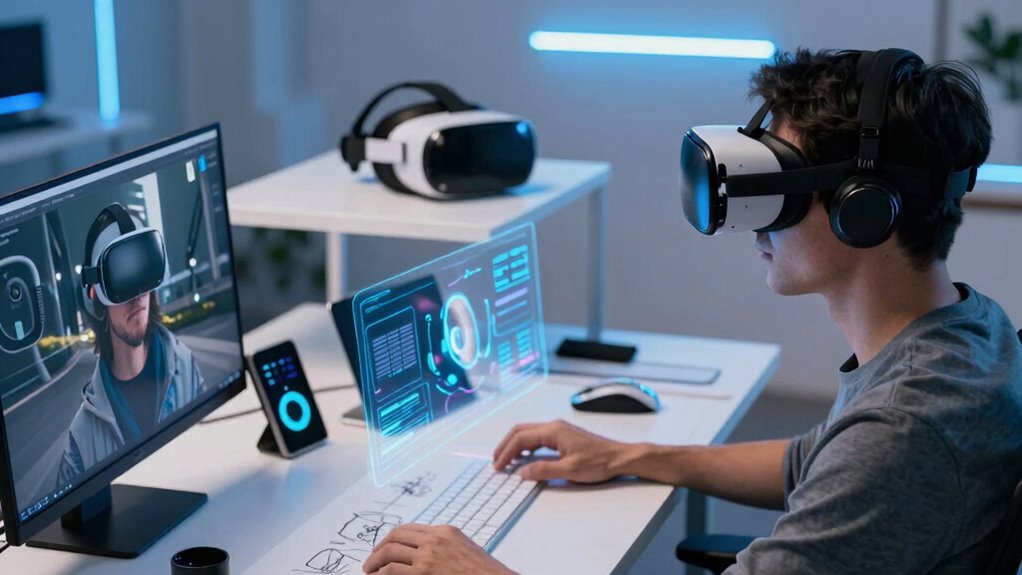
VR headset for gaming and training
As an affiliate, we earn on qualifying purchases.
As an affiliate, we earn on qualifying purchases.
Understanding the Differences Between VR, AR, and MR
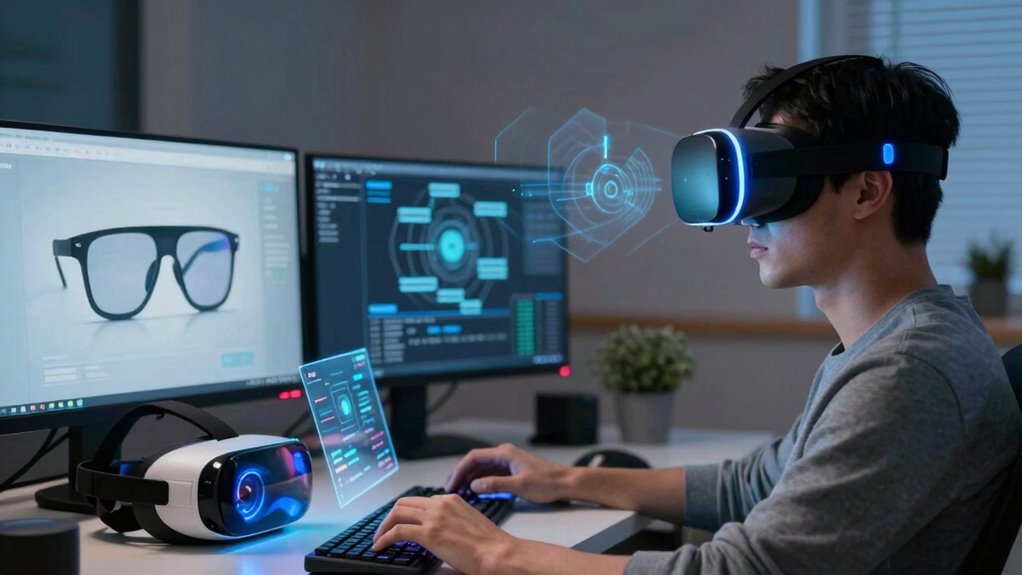
To understand the differences between VR, AR, and MR, it’s important to know that each technology creates immersive experiences but in distinct ways. In VR, you’re fully immersed in a digital environment, so interaction design focuses on controlling your virtual world through controllers or gestures, maximizing user engagement. AR overlays digital elements onto your real-world view, encouraging interaction with both the physical and digital spheres, which enhances user engagement through intuitive interfaces. MR combines elements of both, allowing digital objects to interact realistically with your environment. It requires sophisticated interaction design to enable seamless interaction between real and virtual objects. Additionally, the visual fidelity offered by each platform varies, affecting how convincing and engaging the immersive experience feels. By understanding these core differences, you can better grasp how each platform influences user engagement and shapes immersive experiences uniquely.
As an affiliate, we earn on qualifying purchases.
What Skills and Resources Do You Need to Develop for Each Platform?
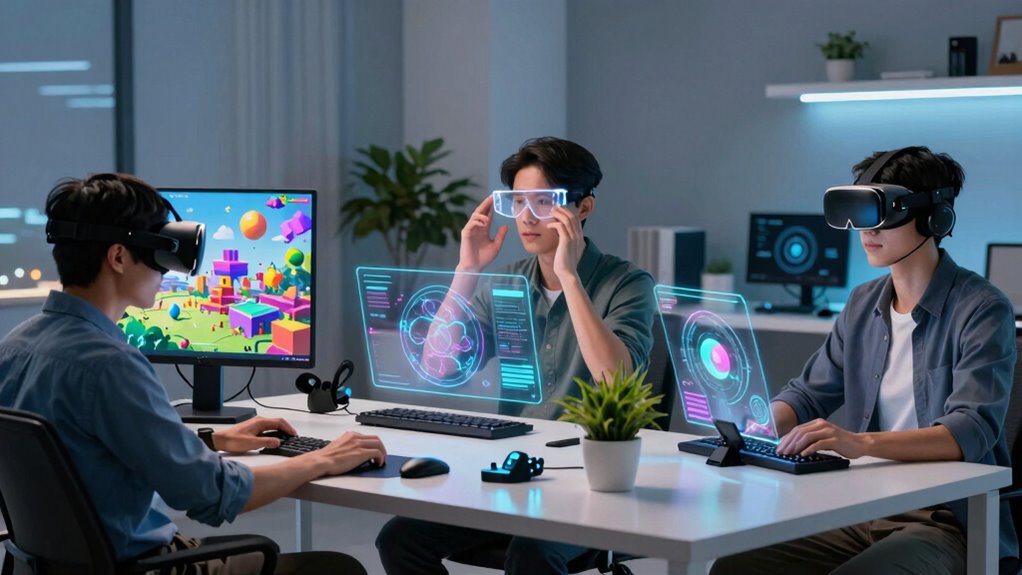
Developing skills and gathering resources for VR, AR, and MR requires understanding the unique technical and creative demands of each platform. You’ll need to focus on specific skill acquisition and resource management to succeed. Here are key areas to take into account:
- Programming Languages: Master Unity, Unreal Engine, or specialized SDKs for immersive development.
- 3D Modeling & Animation: Develop skills in tools like Blender or Maya for creating realistic assets.
- Hardware Knowledge: Understand device capabilities and limitations to optimize performance.
- User Experience Design: Prioritize intuitive interactions and spatial awareness for immersive environments.
- Understanding Content Formats: Recognize how different content formats influence the development process and user engagement.
As an affiliate, we earn on qualifying purchases.
Best Use Cases for VR, AR, and MR
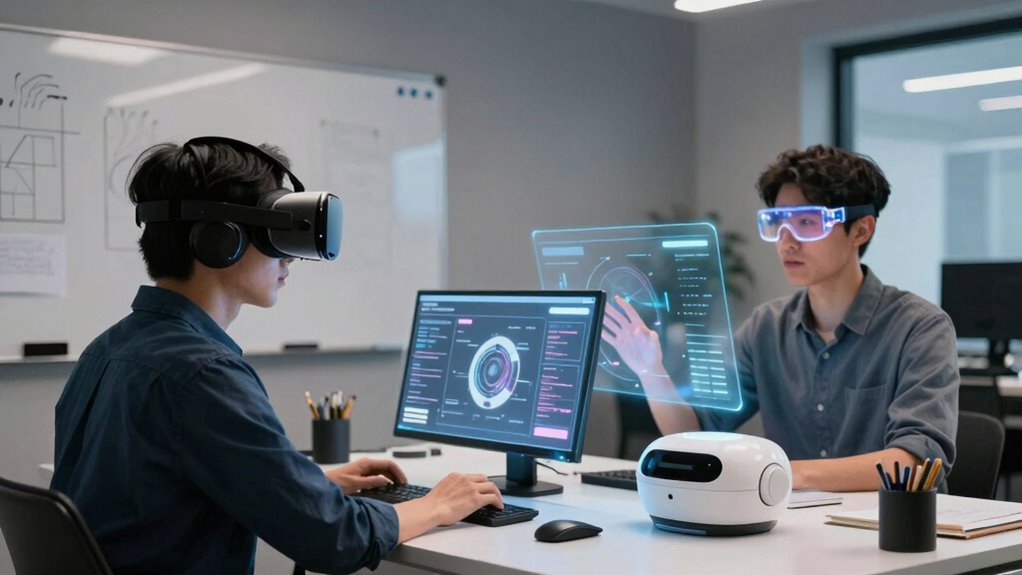
Understanding the best use cases for VR, AR, and MR helps you select the right platform for your goals. VR excels in immersive user experiences, making it ideal for gaming, training simulations, and virtual tours. AR enhances real-world interactions, perfect for retail, navigation, and maintenance apps that improve user experience without isolating users from their environment. MR combines elements of both, enabling interactive collaboration in fields like design, education, and healthcare. Market trends show increasing adoption across these sectors, driven by evolving hardware and user demands. By aligning your project’s objectives with these use cases, you guarantee a better fit for your development efforts. This strategic approach helps you create engaging, effective experiences tailored to the unique strengths of each technology.
As an affiliate, we earn on qualifying purchases.
How Do Cost, Hardware, and Accessibility Affect Your Choice?
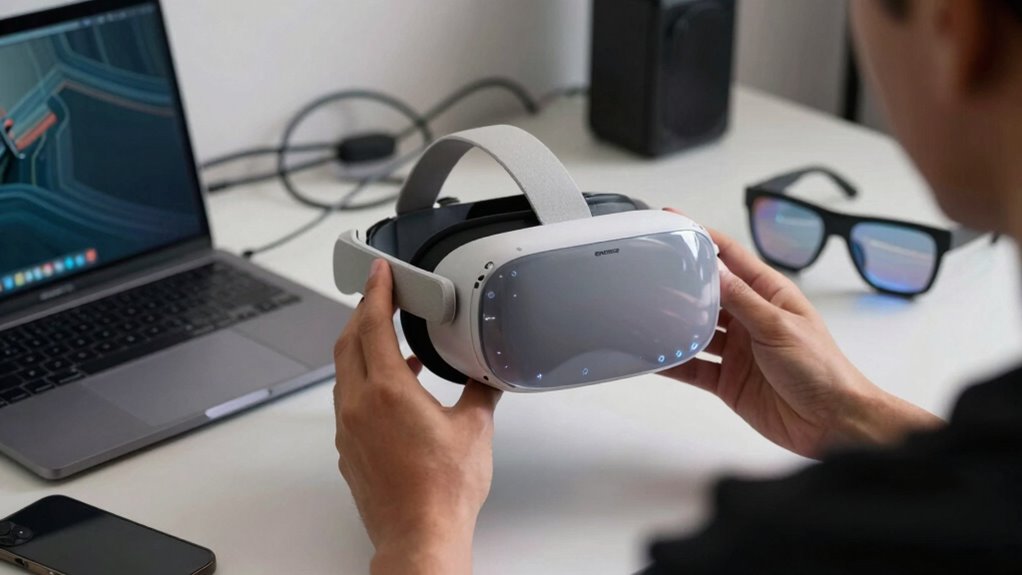
Choosing between VR, AR, and MR depends heavily on factors like cost, hardware requirements, and accessibility. Your decision hinges on understanding these key elements:
- Cost considerations: VR headsets often cost more upfront, especially high-end models, while AR devices like smartphones are more budget-friendly.
- Hardware limitations: VR requires powerful PCs or consoles, which can be limiting if your hardware isn’t up to par. AR and MR leverage existing smartphones or tablets, reducing barriers.
- Accessibility: AR experiences are widely accessible since they run on common devices, whereas VR and MR might need specialized gear.
- Portability: AR and MR devices tend to be more portable, making them easier to develop for on the go.
Your choice should balance these factors based on your project needs and budget.
Pros and Cons of Choosing VR, AR, or MR
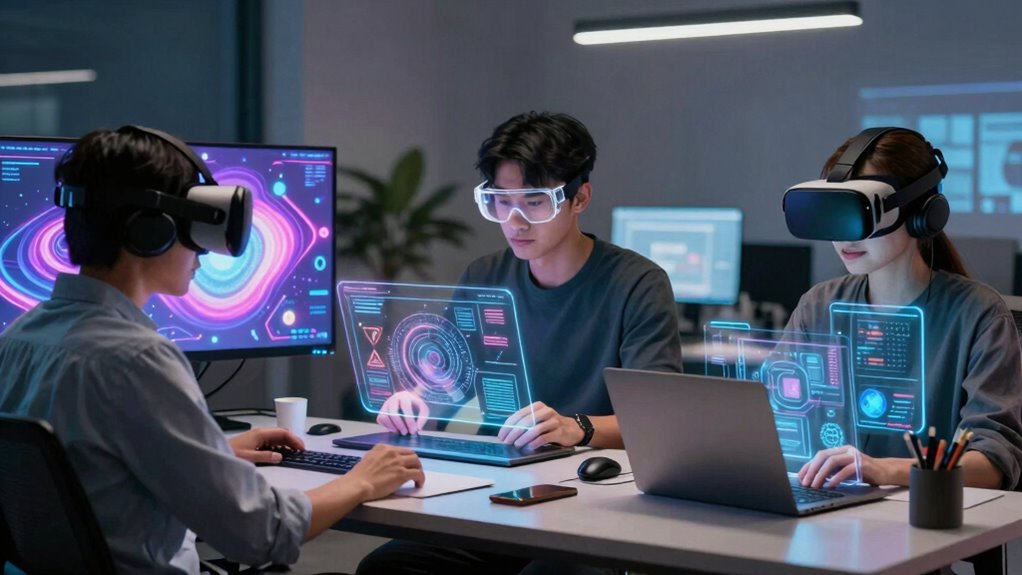
Choosing between VR, AR, and MR involves weighing their immersive experience depth, which can vary greatly. You’ll also face hardware accessibility challenges and the complexity of developing content for each platform. Understanding these pros and cons helps you decide which technology best fits your needs. Additionally, emerging AI-powered creative tools are beginning to streamline development processes across these platforms, potentially reducing some of the complexity involved. As these tools improve, they may also enhance content creation efficiency and open up new possibilities for developers working with each device class. Recognizing the importance of child development considerations can guide developers to create more engaging and beneficial experiences suited for varied audiences.
Immersive Experience Depth
Immersive experience depth varies considerably across VR, AR, and MR, influencing how fully you can lose yourself in digital environments. Your level of sensory immersion and narrative depth depends on each technology’s capabilities.
- VR offers the deepest sensory immersion, fully engaging your senses and creating a convincing digital world.
- AR provides moderate immersion by overlaying digital elements onto the real world, enhancing context without complete immersion.
- MR blends physical and digital environments, allowing interaction with virtual objects in real space, increasing narrative depth.
- The choice affects your ability to craft compelling stories, as deeper immersion enables richer, more engaging experiences, but may require more complex development.
Your decision hinges on how immersive you want your experience to be and the storytelling depth you aim to achieve.
Hardware Accessibility Challenges
While VR offers the most immersive experiences, it often comes with significant hardware accessibility challenges, such as expensive headsets and the need for powerful PCs or consoles. These cost barriers can limit entry for many developers, especially those with limited budgets. Additionally, hardware limitations—like bulky headsets, short battery life, and uncomfortable designs—can hinder prolonged development sessions. AR devices tend to be more accessible, with some options like smartphones and lightweight glasses, but high-end AR hardware still remains costly. Mixed Reality devices often require advanced sensors and powerful processing units, increasing both cost and hardware complexity. Overall, these hardware accessibility challenges can restrict your ability to experiment and iterate quickly, impacting your development process and project scalability. Natural beauty and landscaping can also influence the overall experience and integration of these devices within outdoor environments.
Content Development Complexity
Developing content for VR, AR, and MR presents distinct challenges that can influence your project’s complexity and timeline. Each platform requires different approaches to user interface design and developer toolkit integration. Here are key considerations:
- VR demands immersive environments that often need high-fidelity graphics and complex interactions.
- AR involves overlaying digital content on the real world, making user interface placement and realism vital.
- MR combines elements of both, requiring sophisticated tools for seamless interaction between physical and virtual objects.
- Developer toolkit availability varies, with some platforms offering more extensive resources, affecting development speed and flexibility.
Choosing the right device class impacts your content development effort, requiring careful planning to manage intricacy effectively.
How to Decide Which Device Class Fits Your Project Goals
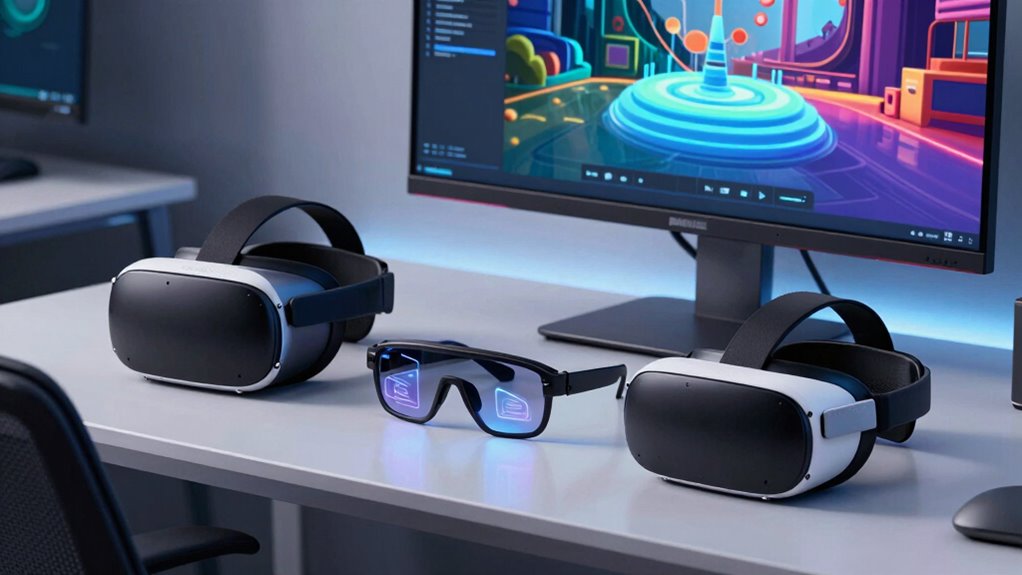
Choosing the right device class for your project starts with understanding your goals and the experience you want to deliver. If your focus is on immersive, depth-rich user experience, VR is ideal, but it may require more development scalability. For projects aiming to enhance real-world interaction with overlays, AR provides a seamless blend, often with simpler development processes. Mixed Reality offers a hybrid approach, combining elements of both, suited for complex interactions. Consider your target audience’s hardware capabilities and their expected engagement level. Ask yourself whether scalability is a priority—do you need broad device support or a more specialized experience? Align these factors with your project goals to determine whether VR, AR, or Mixed Reality best fits your vision. Additionally, understanding the core concept of digital lifestyle upgrades can help you tailor your experience to meet evolving user expectations.
Frequently Asked Questions
What ARe the Emerging Trends in VR, AR, and MR Technology?
You’ll notice emerging trends like gesture controls and spatial mapping shaping VR, AR, and MR. These advancements make interactions more intuitive and immersive, allowing you to manipulate virtual objects naturally and understand real-world environments better. Developers focus on improving device tracking and creating seamless experiences. As these trends evolve, expect more realistic simulations and smarter interfaces, pushing the boundaries of what’s possible in immersive technology.
How Does User Experience Differ Across VR, AR, and MR Platforms?
You notice that VR offers deep user immersion, fully transporting you into a digital world, while AR blends digital elements with your real environment for seamless interaction. MR combines both, allowing interaction design that feels natural across physical and virtual spaces. Your experience varies: VR emphasizes immersion, AR focuses on contextual awareness, and MR creates a hybrid, demanding adaptable interaction design to keep users engaged and comfortable across platforms.
Are There Any Industry-Specific Advantages for Each Device Class?
You’ll find industry-specific advantages for each device class based on adoption rates and cost considerations. For example, VR excels in gaming and training, where immersive experiences are essential. AR is popular in retail and manufacturing, offering real-world overlays for improved workflows. Mixed Reality balances both, thriving in design and healthcare. Your choice depends on industry adoption trends and budget constraints, ensuring you select the right technology to meet your project’s needs effectively.
What Are Common Challenges Developers Face When Working With These Technologies?
You might think these technologies are straightforward, but hardware compatibility and content optimization pose real challenges. You’ll often struggle ensuring your app works seamlessly across various devices and platforms, which demands extra testing and tweaking. Plus, creating immersive experiences that run smoothly without draining resources can be tough. To succeed, stay adaptable, prioritize efficient content design, and keep up-to-date with evolving hardware specs to avoid frustrating users.
How Do Updates and New Hardware Releases Impact Development Strategies?
Updates and new hardware releases profoundly impact your development strategies. You need to stay alert to changes in hardware compatibility, guaranteeing your apps work seamlessly across new devices. Frequent update cycles mean you must adapt quickly, testing your software against evolving platforms. Staying proactive helps avoid obsolescence and ensures your projects leverage the latest features, maximizing user experience and maintaining competitive advantage in this rapidly advancing tech landscape.
Conclusion
Choosing between VR, AR, and MR is like picking the right tool for a job—you need the one that fits best. Think about your project goals, budget, and skills, and you’ll find the perfect match. Remember, each technology is a different brushstroke in your creative canvas. Pick wisely, and you’ll paint a vivid experience that leaves your audience captivated—like a master artist finishing their masterpiece.
Fall Picks
fall essentials
As an affiliate, we earn on qualifying purchases.