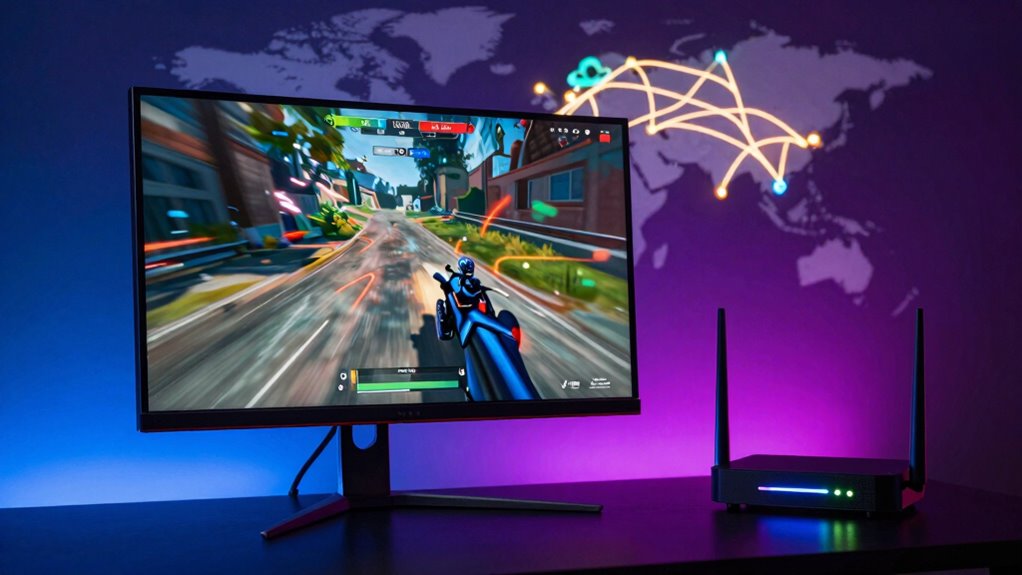

Cloud gaming platforms tackle latency and global delivery by bringing processing closer to you through edge computing, which reduces data travel time and boosts responsiveness. They optimize networks with smart traffic management and adaptive streaming, ensuring smooth gameplay even during peak times. Cloud servers dynamically adjust to your connection for high-quality visuals, while continuous advances in infrastructure further lower delays. If you keep exploring, you’ll discover how these innovations make cloud gaming more accessible and reliable worldwide.
Key Takeaways
- Deploy multiple edge servers worldwide to bring content closer to users, reducing data travel distance and latency.
- Utilize network optimization techniques like adaptive bitrate streaming and intelligent traffic management to ensure stable connectivity.
- Combine edge computing with real-time network monitoring for dynamic adjustments and minimal lag.
- Implement scalable cloud server infrastructure to support high-quality streaming and seamless global delivery.
- Continuously innovate with infrastructure improvements to enhance responsiveness, reduce jitter, and improve user experience globally.
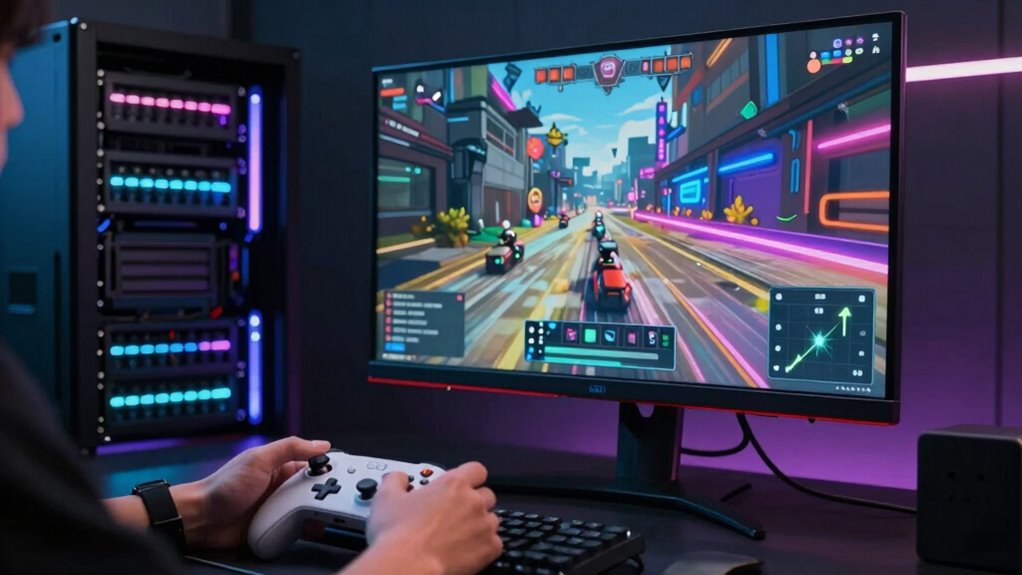
Cloud gaming platforms are transforming how you play video games by allowing you to stream titles directly to your device without the need for powerful hardware. This shift relies heavily on advanced technology to minimize latency and guarantee smooth gameplay, even over long distances. One key innovation is edge computing, which brings processing power closer to your location. Instead of sending data to distant data centers, edge servers handle much of the computation nearby, drastically reducing the delay between your actions and what you see on screen. This proximity is essential because it shortens the data travel time, making gameplay feel more responsive and natural.
Edge computing brings processing closer to you, reducing delay and making cloud gaming feel more responsive and natural.
Network optimization also plays an important role in tackling latency issues. Game developers and service providers prioritize efficient data routing, ensuring that your commands and game data take the quickest possible path through the network. Techniques like intelligent traffic management and adaptive bitrate streaming help adjust data flow based on real-time network conditions, preventing lag spikes. These optimizations mean your gaming experience remains stable, even during peak network usage or in areas with less reliable connectivity. Additionally, continuous advancements in network infrastructure are improving overall data transfer speeds, contributing to a more consistent experience. Moreover, these improvements are complemented by innovations in cloud server technology, which enhance the scalability and responsiveness of streaming services. Implementing effective data routing strategies is also crucial for maintaining low latency and high-quality streams.
Furthermore, cloud gaming platforms leverage a combination of edge computing and network optimization to deliver content globally. By deploying multiple edge nodes across different regions, they can serve your game stream from a location nearest to you, minimizing the distance data must travel. This setup reduces latency, enhancing your responsiveness and immersion during gameplay. Also, by continuously monitoring network conditions, platforms can dynamically switch between servers or adjust streaming quality, ensuring minimal interruption and consistent performance. In addition, adaptive streaming techniques are increasingly used to optimize visual quality based on real-time bandwidth, further improving the gaming experience.
The integration of these technologies isn’t just about speed; it’s about creating a seamless experience regardless of where you are. Whether you’re gaming in a bustling city or a remote area, edge computing and network optimization work together to deliver low-latency gameplay. They help mitigate the inherent challenges of cloud gaming—like jitter and lag—making it feel almost as if the game runs locally on your device. As these advancements continue, you’ll notice even more reliable and responsive gaming sessions, opening up new possibilities for multiplayer gaming, cloud-based esports, and streaming high-fidelity graphics without the need for expensive hardware.
In essence, cloud gaming platforms are overcoming latency and delivery hurdles through smart infrastructure choices. Edge computing reduces physical and network distance, while continuous network optimization ensures data flows swiftly and smoothly. Additionally, advancements in edge computing are enabling more localized processing, further reducing latency. Together, these innovations are making cloud gaming more accessible, dependable, and immersive for players like you around the world.
Large Extended Gaming Mouse Pad with Stitched Edges (31.5X15.7In) Mousepad
- Ultra Large Size: Fits desktop with ample space
- Enhanced Control: Made of high elasticity natural rubber
- Non-Slip Base: Firm grip on desktop surface
As an affiliate, we earn on qualifying purchases.
As an affiliate, we earn on qualifying purchases.
Frequently Asked Questions
How Do Cloud Gaming Platforms Ensure Security for User Data?
You can trust cloud gaming platforms to secure your data by using data encryption, which protects your information during transmission and storage. They also implement robust user authentication processes, ensuring only authorized users access your account. These measures work together to guard your personal details and gaming activity from unauthorized access, giving you peace of mind while enjoying your favorite games on the cloud.
What Are the Hardware Requirements for Optimal Cloud Gaming?
Think of your gaming setup as a finely tuned orchestra; the right hardware specifications guarantee harmony. To optimize performance, you need a powerful processor, ample RAM, and a high-quality GPU. A fast, stable internet connection is crucial, but don’t forget that your device’s hardware plays a essential role in smooth gameplay. When all components work together, you get an immersive experience that feels as seamless as a symphony.
How Is User Bandwidth Affected During Gameplay?
During gameplay, your bandwidth is actively used to stream high-quality video data from the cloud server to your device. Cloud gaming platforms implement bandwidth optimization techniques to guarantee smooth gameplay and reduce latency. As a result, your connection might fluctuate based on network stability. To maintain ideal performance, a stable and fast internet connection is essential, as it helps with latency reduction and makes certain your gaming experience remains seamless without interruptions.
Can Cloud Gaming Platforms Support Virtual Reality Gaming?
Imagine stepping into a virtual reality world through your cloud gaming platform; yes, it can support VR gaming. With advancements in cloud compatibility, platforms like NVIDIA GeForce NOW are experimenting with VR, enabling immersive experiences without high-end hardware. Although challenges remain, such as latency and bandwidth demands, cloud gaming’s evolving tech makes VR more accessible, offering a future where you can explore virtual worlds seamlessly from anywhere.
What Measures Are Taken to Prevent Service Outages?
You’re protected from service outages through measures like server redundancy and load balancing. Server redundancy guarantees there’s always a backup server ready to take over if one fails, maintaining seamless gameplay. Load balancing distributes user traffic evenly across servers, preventing overloads and delays. These strategies work together to keep your gaming experience smooth and reliable, even during high demand or unexpected technical issues.

HyperX Cloud III S – Wireless Gaming Headset for Multi-Platform, 2.4GHz, Bluetooth, Battery Life up to 120 Hours 2.4GHz / 200 Hours Bluetooth, 53mm Angled Drivers, Detachable Mic – Black
- Long Battery Life: Up to 120 hours on 2.4GHz, 200 hours Bluetooth
- Optimized 53mm Drivers: Angled drivers tuned for immersive sound
- Comfortable Fit: Memory foam headband and leatherette ear cushions
As an affiliate, we earn on qualifying purchases.
As an affiliate, we earn on qualifying purchases.
Conclusion
You see, cloud gaming platforms continuously innovate to reduce latency and improve global delivery, much like a skilled conductor fine-tunes an orchestra. As they optimize data routes and leverage advanced technologies, you experience smoother gameplay that feels almost seamless—like a whisper in your ear. By tackling these challenges head-on, they’re making gaming more accessible and immersive, regardless of where you’re playing from. The future of cloud gaming is bright, promising a world where distance no longer dims your gaming experience.

Low Latency, High Performance: Cloud Gaming
As an affiliate, we earn on qualifying purchases.
As an affiliate, we earn on qualifying purchases.

ASUS RT-AX1800S Dual Band WiFi 6 Extendable Router, Subscription-Free Network Security, Parental Control, Built-in VPN, AiMesh Compatible, Gaming & Streaming, Smart Home
- WiFi Standard: WiFi 6 (802.11ax) with MU-MIMO & OFDMA
- Antenna Type: External 4 antennas
- Processor: Dual-core VPE processor
As an affiliate, we earn on qualifying purchases.
As an affiliate, we earn on qualifying purchases.