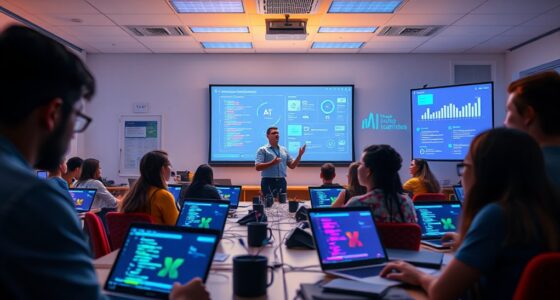

Google’s SRE practices show how automating testing and incident response boosts system reliability and uptime at scale. You’ll see how continuous automated tests verify code before deployment, while automated alerts help detect and resolve issues fast. Predefined runbooks and diagnostics streamline troubleshooting, reducing downtime. These integrated strategies create resilient, high-availability services. Keep exploring to discover the detailed approaches Google uses to achieve extraordinary reliability and efficiency in their operations.
Key Takeaways
- Google’s SRE integrates automation testing to validate system updates and prevent bugs before deployment.
- Incidents are managed with structured processes, real-time monitoring, and automated alerts for rapid response.
- Continuous feedback loops analyze incident data to improve testing, monitoring, and system resilience.
- Automation reduces manual effort, minimizes human error, and accelerates incident detection and resolution.
- These practices collectively enhance reliability, scalability, and high availability of Google’s services.

Google’s Site Reliability Engineering (SRE) practices have revolutionized how large-scale systems are built and maintained, setting industry standards for reliability and efficiency. Central to this approach is a relentless focus on automation testing, which ensures that software updates and system changes are validated quickly and accurately before deployment. By automating repetitive testing tasks, you reduce human error and accelerate release cycles, making it possible to push updates with confidence. Automation testing also allows you to identify issues early, preventing bugs from reaching production environments and minimizing downtime. This proactive approach is crucial in a world where users demand seamless, uninterrupted access to services.
Incident management is another core pillar of Google’s SRE methodology. When incidents occur, you don’t just react; you implement structured processes to diagnose, contain, and resolve issues swiftly. Google’s SRE teams leverage sophisticated monitoring tools and dashboards that provide real-time insights into system health. These tools enable you to detect anomalies immediately and prioritize incidents based on their impact. The goal isn’t just to fix problems but to understand their root causes, so you can prevent future occurrences. This systematic approach to incident management reduces downtime and enhances user trust, demonstrating how essential rapid response is in maintaining large-scale system reliability.
In practice, Google’s SRE teams integrate automation testing into their incident response workflows. For example, when a new code update is prepared, automated tests run continuously to verify stability. If an issue slips past testing and causes a service disruption, incident management protocols kick in. You’ll use automated alerting systems to notify the team instantly, triggering predefined runbooks that guide troubleshooting efforts. Automated incident logs and diagnostics help you pinpoint the problem faster, enabling quicker resolution. Over time, these practices lead to a more resilient infrastructure, where incidents are not just resolved faster but are also less likely to recur. Additionally, the use of password strength evaluation tools ensures that user credentials are securely managed during system updates, further enhancing overall reliability.
Together, automation testing and incident management form a feedback loop that continuously improves system reliability. Google’s SRE teams analyze incident data to refine tests and update monitoring parameters, creating a cycle of ongoing enhancement. This focus on automation reduces manual effort, minimizes human error, and ensures consistent quality. By adopting these practices, you can maintain a stable, high-availability environment that scales effortlessly as demand grows. Ultimately, Google’s SRE approach demonstrates that combining automation testing with robust incident management is key to delivering reliable, user-centric services at scale.

Android E-Ink ePaper Tablet, Paperwhite eBook Reader Digital Notebook for Note Taking, Drawing Paper White Graphics Notepad with Stylus and Case, Cloud Sync and Screen Casting - Model Mini 9.7" Silver
1. KloudNote Mini has a beautiful and stylish design, built-in A35 quad-core processor, 1.5GHz, 32G memory. The display...
As an affiliate, we earn on qualifying purchases.
Frequently Asked Questions
How Does Google Measure SRE Team Success?
You measure your SRE team’s success through performance metrics like uptime, latency, and error rates, which reflect system reliability. Additionally, effective team communication is vital; it ensures everyone stays aligned on goals and quickly addresses issues. When these metrics improve and communication remains strong, you know your team is succeeding in maintaining and enhancing system performance, ultimately delivering reliable services to users.
What Tools Do Google SRES Use Daily?
You rely on automation tools like Borg and Kubernetes to streamline operations, but also on incident dashboards for real-time insights. These tools help you detect issues swiftly, automate responses, and reduce downtime. While automation handles routine tasks, incident dashboards keep you informed during outages, enabling quick decision-making. This blend of automation and monitoring tools forms the backbone of your daily SRE activities, ensuring system reliability and performance.
How Are SRE Incidents Prioritized and Managed?
You prioritize SRE incidents based on their impact and urgency, conducting incident escalation when necessary. You perform a risk assessment to determine the severity, ensuring critical issues get immediate attention. You manage incidents by following predefined protocols, coordinating with teams to resolve problems swiftly. Continuous monitoring helps you identify potential risks early, allowing you to escalate incidents promptly and minimize downtime, maintaining system reliability and user trust efficiently.
What Training Programs Support Google’s SRE Teams?
You’re supported by extensive training programs that include SRE certifications and a focus on continuous learning. Google encourages your growth through formal certifications, which deepen your technical expertise, and ongoing workshops, conferences, and internal knowledge-sharing sessions. This combination guarantees you stay current with best practices, tools, and evolving technologies, empowering you to manage incidents effectively and maintain high reliability standards across systems.
How Does Google Handle Cross-Team SRE Collaborations?
You might think cross-team communication is complicated, but Google simplifies it through structured collaboration channels and shared goals. They foster organizational alignment by establishing clear responsibilities and regular syncs, ensuring all SRE teams work seamlessly together. This proactive approach minimizes silos, encourages knowledge sharing, and maintains reliability standards across projects. As a result, Google’s SRE teams coordinate efficiently, supporting rapid issue resolution and continuous system improvement.

XPPen 3 in 1 Color Digital Notebook 10.95'' Paper Note Taking Tablet with 16384 Pressure Levels Battey-Free X3 Pro Pencil 2 Magnetic Folio 6+128GB Magic Note Pad for Writing/Reading/Meeting/Study
Please Note: It is NOT an e-ink Tablet, it is a Normal Android Tablet. The XPPen digital notetaking...
As an affiliate, we earn on qualifying purchases.
Conclusion
Remember, a chain is only as strong as its weakest link. By adopting Google’s SRE practices, you can build a more reliable, resilient system that anticipates problems before they escalate. Staying proactive and embracing continuous improvement guarantees your services run smoothly under pressure. Don’t wait for failures to teach you lessons—be prepared. Like a well-tuned machine, your infrastructure can perform at its best when you prioritize reliability and operational excellence every step of the way.
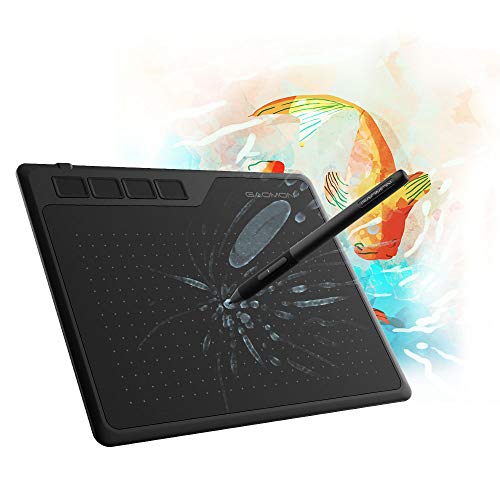
GAOMON S620 Drawing Tablet 6.5 x 4 Inch Graphics Tablet with 8192 Passive Pen 4 Customizable ExpressKeys for Digital Art, Painting, OSU Playing, Compatible with Windows PC, Mac
【FOR DIGITAL ART & CREATION】-- Perfect for beginner who starts digital drawing, sketching, graphics design, 3D art work,...
As an affiliate, we earn on qualifying purchases.

Wacom Intuos Small Bluetooth Graphics Drawing Tablet, 4 Customizable ExpressKeys, Portable for Teachers, Students and Creators, Compatible with Chromebook Mac OS Android and Windows - Black
Wacom Intuos Small Bluetooth Graphics Drawing Tablet: Enjoy industry leading tablet performance in superior control and precision with...
As an affiliate, we earn on qualifying purchases.