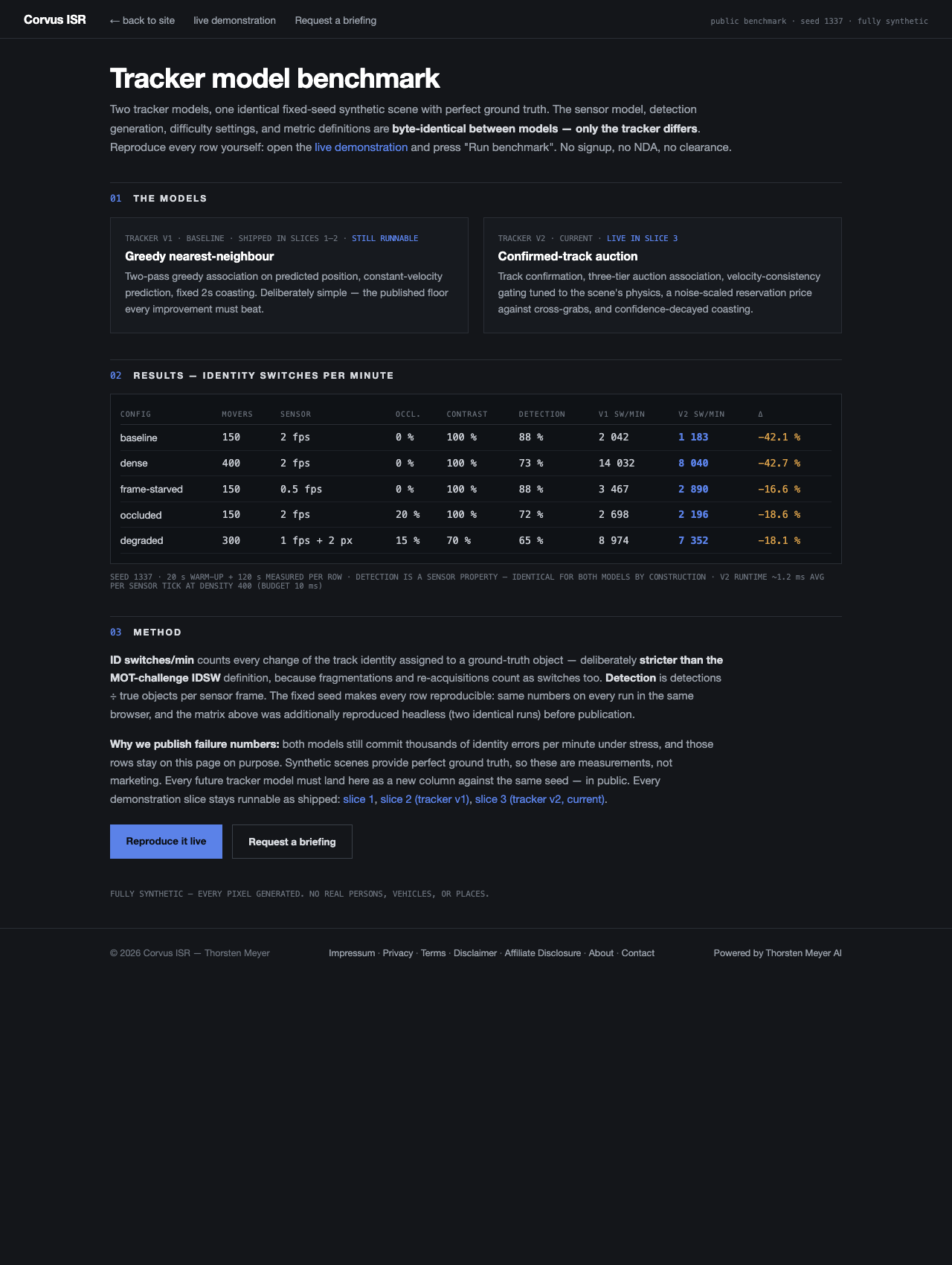
Corvus ISR, a leader in wide-area motion imagery (WAMI) exploitation, has unveiled a detailed public tracker benchmark showcasing a rigorous comparison between two tracker versions. This benchmark employs a fixed-seed synthetic scene with perfect ground truth (seed 1337), ensuring precise reproducibility and transparency in performance evaluation. The scene runs for 20 seconds of warm-up plus 120 seconds of measured data, with identical sensor properties, detection generation, and metric definitions, differing only in the tracking algorithms themselves.
The first model, v1, uses a simple greedy nearest-neighbour approach with two-pass association, constant velocity prediction, and fixed 2-second coasting — serving as the published baseline and a test of minimal complexity. In contrast, v2 features a more sophisticated confirmed-track auction method, incorporating three-tier auction association, velocity-consistency gating, noise-scaled reservation prices, and confidence-decayed coasting. These enhancements aim to improve tracking robustness under challenging conditions.
The benchmark results are telling: for a scenario with 150 movers at 2 frames per second, the v1 model recorded 2,042 ID switches per minute, which dropped by 42.1% to 1,183 with v2. Similarly, a dense scene with 400 movers showed a reduction from 14,032 to 8,040 ID switches — a 42.7% decrease. Under frame-starved conditions (0.5 fps), occlusions (20%), or degraded sensor input, ID switches decreased by approximately 18-19%, demonstrating the v2 model’s enhanced resilience.
Notably, the detection rate remains consistent across both models, as it is solely a sensor property. The published numbers reflect a strict interpretation of ID switches, counting every change in ground-truth object identity — including fragmentations and reacquisitions — making these metrics a rigorous honest test of tracker performance. Such transparency underscores the importance of measurement, not just marketing successes, especially since synthetic scenes provide perfect ground truth for objective evaluation.
From an engineering standpoint, v2 achieves an average of approximately 1.2 milliseconds per sensor tick at a density of 400 movers — well within real-time constraints (worst case ~5 ms against a 10 ms budget). This performance is demonstrated directly in the live demo where anyone can reproduce the benchmark results by pressing the ‘Run benchmark’ button — no signup or NDA required. The development process included building v2 with an AI executor, following a written acceptance contract, and undergoing an independent review before release.
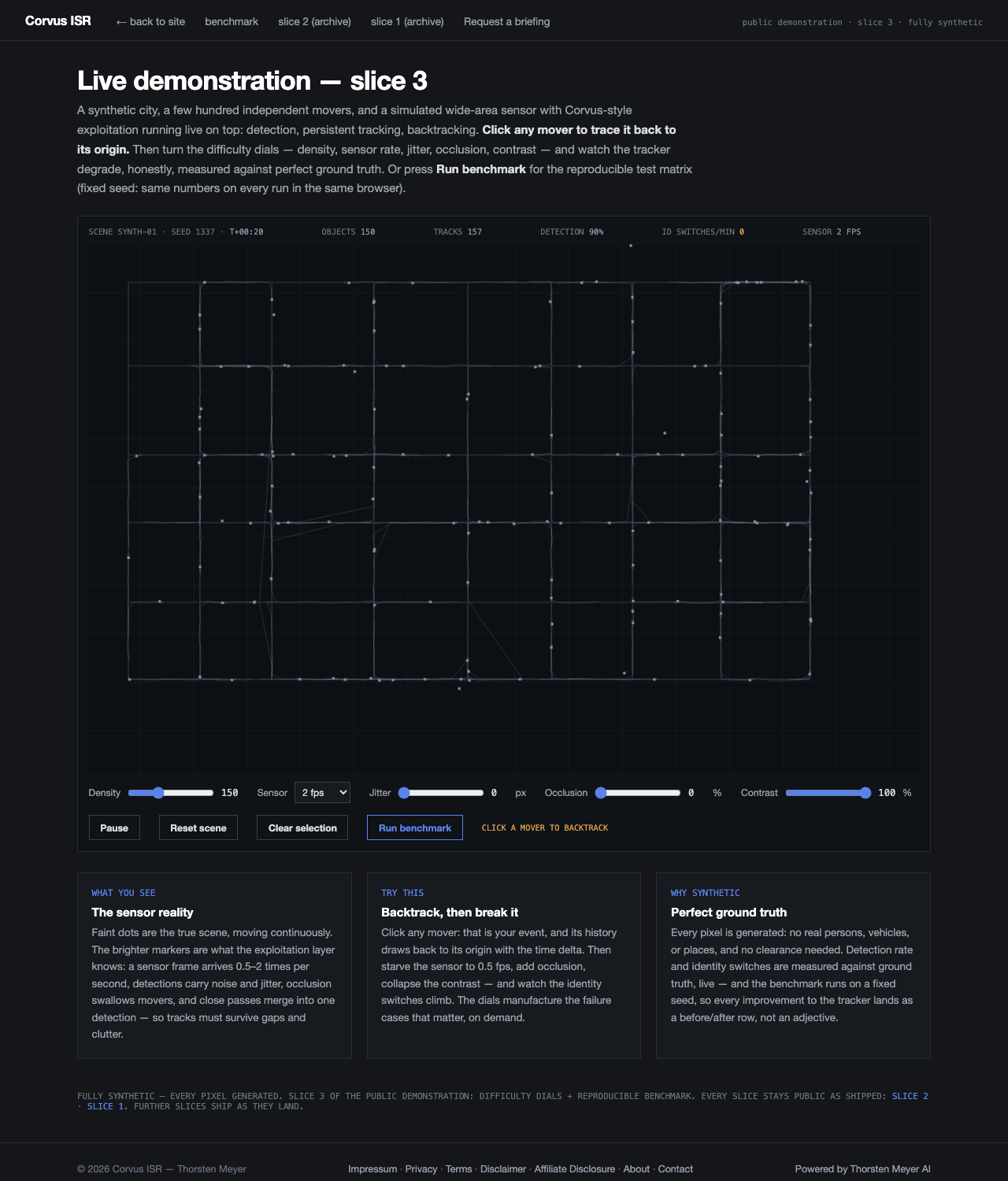
It’s important to emphasize that all data used in these tests are fully synthetic, with no real persons, vehicles, or locations involved; every pixel is artificially generated. The public benchmark serves as a transparent, reproducible, and honest measure of tracker performance, demonstrating a disciplined approach to software engineering and testing methodology. Every future tracker development is encouraged to land as a new public record against the same seed, fostering a culture of measurement over marketing.
We invite software, QA, and development professionals to explore the public benchmark themselves and see how their own algorithms perform. Feel free to reproduce the results live and verify the robustness of these models firsthand.
wide-area motion imagery (WAMI) tracking software
As an affiliate, we earn on qualifying purchases.
As an affiliate, we earn on qualifying purchases.
As an affiliate, we earn on qualifying purchases.

Fast 50hz Distance Sensors Module Real Time Tracking Dynamic Object Detection and Robotics Applications Distance Sensors Module
- Compact and Easy to Integrate: Clear pin layout and simple wiring
- Versatile Application: Used in obstacle avoidance and security
- Reliable Ranging Technology: Unaffected by lighting and noise
As an affiliate, we earn on qualifying purchases.
As an affiliate, we earn on qualifying purchases.

Computer Exposure Employee Time Tracking Software | Single PC, 100 Employees | Windows 7-11 | No Monthly Fees | Free Support
- Single PC Employee Tracking: Supports up to 100 employees on one PC
- No Monthly Fees: One-time purchase with no recurring costs
- Made in the USA: Product manufactured in the United States
As an affiliate, we earn on qualifying purchases.
As an affiliate, we earn on qualifying purchases.