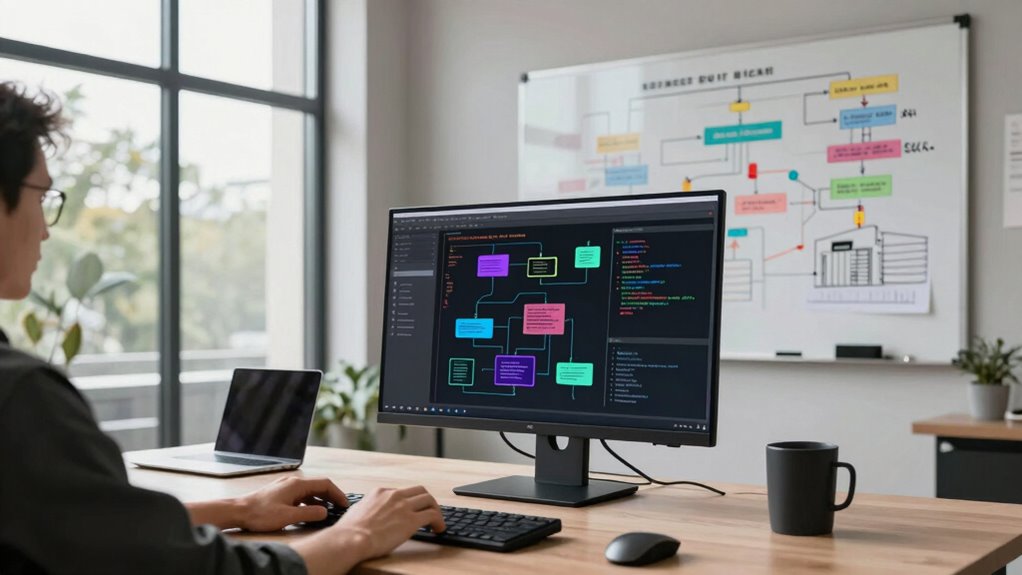

You’re seeing design systems expand into engineering platforms because organizations need more than just style guides—they require tools that support the entire product lifecycle. These platforms help bridge gaps between design and development, boosting collaboration, consistency, and efficiency. They automate updates, manage components, and streamline workflows, making scaling easier. By integrating design and engineering, you can reduce rework and technical debt. Stay with us to discover how this evolution can transform your team’s work processes.
Key Takeaways
- To support the entire product development lifecycle, integrating design and engineering workflows into unified platforms.
- To enhance scalability, consistency, and automation across growing design components and codebases.
- To improve cross-team collaboration, reducing miscommunication, rework, and technical debt.
- To accelerate innovation by enabling direct access to design assets and seamless design-to-code translation.
- To future-proof workflows by incorporating version control, testing, and deployment within a unified system.

Have you noticed how design systems are no longer just about UI components and style guides? Today, they’re evolving into all-encompassing engineering platforms that support the entire product development lifecycle. This shift is driven by the need for consistency, efficiency, and faster delivery across complex projects. As organizations scale, they face significant scalability challenges—ensuring that design standards remain uniform while accommodating growth. Relying solely on separate design and engineering teams often leads to misalignment, duplicated work, and inconsistencies that ripple through the product. By expanding design systems into engineering platforms, teams can bridge these gaps, creating a unified source of truth that both designers and developers trust.
Design systems now serve as comprehensive platforms uniting design and engineering for seamless, scalable product development.
This expansion also amplifies cross-team collaboration. When everyone works from the same engineering platform, communication becomes more streamlined. Designers can directly influence the codebase, and engineers can provide real-time feedback, reducing misunderstandings and rework. Instead of juggling multiple tools and documentation, teams operate within a shared environment that fosters transparency and accountability. This shared platform encourages a culture where collaboration isn’t just a phase but an ongoing, integrated process. As a result, product updates and new features roll out faster, with fewer hiccups related to misaligned expectations or outdated assets.
Moving design systems into engineering platforms also helps address the challenge of maintaining consistency at scale. As products grow, so do the number of components, styles, and interactions. Managing these manually becomes cumbersome and prone to errors. An integrated platform automates many of these processes, ensuring that updates are applied uniformly across all parts of the product. It enables version control, automated testing, and deployment pipelines that keep everything synchronized, reducing technical debt and improving reliability. This not only saves time but also builds confidence that every release adheres to the same design principles.
Furthermore, expanding into engineering platforms empowers teams to innovate more rapidly. Developers gain direct access to design assets and reusable components, speeding up development cycles. Designers, in turn, can see how their designs translate into actual code, enabling quicker iterations. This interconnectedness reduces handoffs and bottlenecks, making it easier to experiment and refine features. It also future-proofs the product by establishing scalable processes that evolve with the organization’s needs, rather than forcing teams into rigid workflows. In brief, integrating design systems into engineering platforms transforms how teams collaborate, scale, and deliver high-quality products efficiently.

Making Embedded Systems: Design Patterns for Great Software
As an affiliate, we earn on qualifying purchases.
As an affiliate, we earn on qualifying purchases.
Frequently Asked Questions
How Do Design Systems Impact Engineering Team Workflows?
Your engineering team benefits from design systems by achieving better collaboration efficiency and ensuring design consistency. When everyone uses the same components and guidelines, communication improves, and workflows become smoother. This reduces rework, speeds up development, and helps maintain a cohesive user experience. By streamlining processes, design systems empower your team to deliver high-quality products faster and more efficiently, fostering a more unified and productive work environment.
What Are the Main Technical Challenges in Integrating Design Systems?
Think of integrating design systems as building a bridge between design and development. Your main technical challenges include maintaining component consistency across platforms and tackling scalability challenges as your system grows. You must guarantee components work seamlessly everywhere, like a well-engineered bridge remains stable under varying loads. Overcoming these hurdles requires robust version control, automation, and flexible architecture to keep the system unified and adaptable as complexity increases.
How Do Design Systems Influence Software Development Timelines?
Design systems streamline software development timelines by promoting design consistency and fostering cross-functional collaboration. When you implement a well-structured design system, your team spends less time resolving inconsistencies, reducing rework and delays. It encourages seamless communication between designers and engineers, ensuring everyone stays aligned. As a result, development progresses faster, and products reach the market sooner, all while maintaining a cohesive user experience built on shared standards.
What Tools Facilitate the Transition From Design to Engineering Platforms?
Did you know that organizations with strong cross-functional collaboration report a 25% faster product development cycle? To facilitate the shift from design to engineering platforms, tools like Figma, Zeplin, and Storybook are essential. They promote design consistency and seamless communication between designers and developers. These tools enable real-time updates, version control, and shared workflows, ensuring everyone stays aligned and speeds up the implementation process, reducing errors and rework.
How Is User Feedback Incorporated Into Evolving Engineering Platforms?
You incorporate user feedback into evolving engineering platforms through continuous feedback loops that prioritize user centricity. By actively collecting insights from designers, developers, and end-users, you identify pain points and areas for improvement. You then iteratively update the platform, ensuring it better meets user needs. This dynamic process helps create more intuitive, efficient systems that adapt over time, fostering a user-focused approach to platform development.

Platform Engineering for Architects: Crafting modern platforms as a product
As an affiliate, we earn on qualifying purchases.
As an affiliate, we earn on qualifying purchases.
Conclusion
You might think design systems should stay separate from engineering, but blending them creates seamless workflows and faster development. This integration doesn’t mean sacrificing flexibility or control; it amplifies consistency and efficiency. If you’re worried about complexity, remember—well-structured platforms simplify collaboration, not complicate it. Embrace this shift, and you’ll gain access to innovative solutions, streamline your projects, and stay ahead in a rapidly evolving tech landscape. Don’t resist the change—capitalize on it.
![AutoCAD Electrical 2022 Software [1 User CPU] [Single User] [Permanent] ..](https://m.media-amazon.com/images/I/41MlCjNEUpL._SL500_.jpg)
AutoCAD Electrical 2022 Software [1 User CPU] [Single User] [Permanent] ..
Perpetual Full Version. No subscription, no additional fees. Online account not included, so no Tech support . For…
As an affiliate, we earn on qualifying purchases.
As an affiliate, we earn on qualifying purchases.

FNIRSI LCR-P1 Transistor Tester, Mosfet Transistor Capacitor Tester, SMD Electronic Component Tester, Diode Triode Zener Diode Resistance Inductance Battery Test LCR Meter MOS PNP NPN ESR Meter
Transistor Capacitor Tester: FNIRSI LCR-P1 transistor tester can be used for the measurement and analysis of patch component,…
As an affiliate, we earn on qualifying purchases.
As an affiliate, we earn on qualifying purchases.