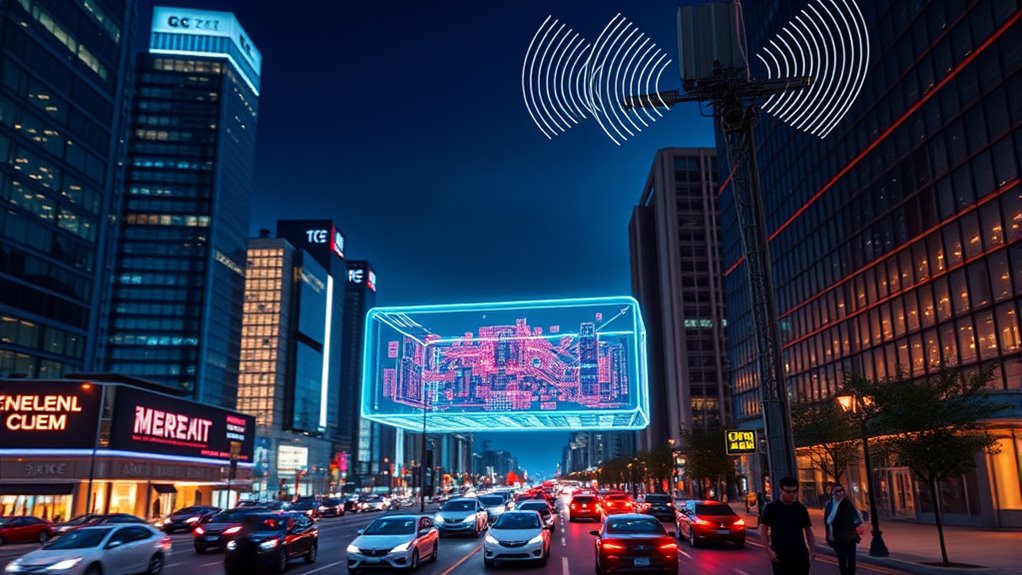

By 2025, edge computing will be embedded in your everyday devices, thanks to the widespread rollout of 5G and IoT. These technologies enable data to be processed locally, improving real-time responses and reducing reliance on distant data centers. You’ll benefit from enhanced privacy, data sovereignty, and more resilient network architectures. As these systems evolve, you’ll see smarter devices and new data-driven applications emerge—stay tuned to discover how these changes unfold.

Get business pricing on monitors, keyboards and dev gear
- Business-only prices and quantity discounts
- Tax-exempt purchasing
- Multiple users, one account, clear invoices
Key Takeaways
- Integration of edge computing in daily devices by 2025 enhances real-time data processing and reduces dependence on centralized data centers.
- 5G and IoT expand device connectivity, enabling localized data processing and significantly lowering latency.
- Distributed AI at edge nodes allows immediate data analysis, supporting smarter, autonomous device functions.
- Edge architectures improve data sovereignty and privacy, ensuring regional compliance and reducing breach risks.
- Enhanced infrastructure resilience and scalability foster robust, secure networks supporting new business models.

By 2025, edge computing will have become an integral part of everyday technology, transforming how data is processed and delivered. As more devices connect through 5G and IoT, you’ll notice that data no longer needs to travel vast distances to centralized data centers. Instead, processing occurs closer to where the data is generated, which markedly reduces latency and improves real-time responsiveness. One of the key innovations fueling this shift is distributed AI, where intelligence isn’t confined to a single location but spread across multiple edge nodes. This approach allows devices and local servers to analyze and act on data immediately, without waiting for instructions from a distant cloud. Distributed AI also bolsters data sovereignty, meaning you have greater control over your data, guaranteeing it stays within specific borders or complies with regional regulations. This is especially important as data privacy laws tighten worldwide, and organizations seek to prevent sensitive information from leaving certain jurisdictions.
You’ll find that with distributed AI, edge devices become smarter and more autonomous. Instead of relying on centralized servers, they can make decisions locally, which is essential for applications like autonomous vehicles, smart factories, or healthcare devices. In these scenarios, milliseconds count, and waiting for cloud-based processing could be dangerous or inefficient. The local processing power enabled by edge computing ensures that critical decisions happen instantly, securing safety and efficiency. Furthermore, this decentralization of AI helps maintain data sovereignty because data processing happens within regional boundaries, reducing the risk of data breaches or misuse during transmission across long distances. You’ll also see that organizations can better adhere to data sovereignty laws, giving users more confidence that their information is protected and managed according to local standards. Additionally, advancements in edge infrastructure will further support scalable and efficient deployment of these technologies.
In practical terms, this means your smart home devices, wearable tech, and industrial sensors all benefit from faster, more secure data handling. As edge infrastructure grows, you’ll notice a more resilient network architecture, less vulnerable to outages or cyberattacks because data isn’t concentrated in a single point. Instead, it’s distributed across multiple edge locations, making the entire system more robust. This decentralization, coupled with advancements in distributed AI, enables new business models and services that rely on instant insights and local data control. Overall, by 2025, edge computing will empower you with faster, safer, and more compliant technology, transforming how data is harnessed across industries and everyday life.
As an affiliate, we earn on qualifying purchases.
Frequently Asked Questions
How Will Edge Security Evolve With Increased Iot Deployment?
As IoT deployment grows, your edge security will become more advanced with stronger device authentication and real-time threat detection. You’ll implement multi-factor authentication to verify devices and utilize AI-powered threat detection systems that identify anomalies instantly. This evolution guarantees your network stays secure, even as more devices connect, by proactively blocking attacks and maintaining data integrity at the edge. Staying ahead requires continuous updates and vigilant monitoring.
What Industries Will Benefit Most From Edge Computing Advancements?
Imagine a world where your industries thrive on rapid data processing. You’ll see industrial automation leap forward, with factories becoming smarter and more efficient. Healthcare innovations will also benefit, enabling real-time patient monitoring and quicker diagnoses. As edge computing advances, these industries will gain faster insights and improved safety, transforming how you work and care for others. The synergy of 5G and IoT drives this exciting evolution, making your industry more responsive and innovative.
How Will Data Privacy Be Maintained at the Edge?
You’ll see data privacy maintained at the edge through robust edge encryption, which secures data during transmission and storage locally. Privacy frameworks, like GDPR and CCPA, guide compliance by defining data handling standards. These measures ensure sensitive information stays protected, even as data is processed closer to its source. Implementing strong encryption protocols and adhering to established privacy frameworks helps you safeguard user data effectively at the edge.
What Are the Energy Implications of Widespread Edge Deployment?
Widespread edge deployment increases energy consumption due to the many devices and servers involved. You can mitigate this by integrating renewable energy sources, which reduce reliance on fossil fuels and lower overall carbon footprint. Efficient hardware design and optimized data processing also help minimize energy use. By prioritizing renewable integration and energy-efficient practices, you guarantee that edge computing remains sustainable and environmentally friendly, even as deployment scales up.
How Will Edge Computing Influence Global Network Infrastructure?
Imagine a sprawling web of tiny data hubs, each processing near where data is generated. Your network becomes more resilient and scalable, thanks to distributed architecture that reduces latency and congestion. Edge computing transforms global infrastructure by enabling seamless connectivity, supporting the explosive growth of 5G and IoT devices. You’ll experience faster, more reliable services as networks adapt to handle increased demand through smarter, decentralized processing.
As an affiliate, we earn on qualifying purchases.
Conclusion
By 2025, edge computing evolves with exciting energy, empowering enterprises through enhanced efficiency and endless innovation. With 5G’s fast flow and IoT’s interconnected intelligence, new architectures emerge, enabling exceptional experiences. You’ll see smarter systems, stronger security, and seamless scalability shaping your success. Stay savvy, stay strategic, and embrace this bold, boundary-breaking boundary of the future. Edge computing’s evolution energizes your enterprise, ensuring you’re always a step ahead in this fast-paced digital frontier.
As an affiliate, we earn on qualifying purchases.
As an affiliate, we earn on qualifying purchases.
Fall Picks
fall essentials
As an affiliate, we earn on qualifying purchases.