

You’re adopting local AI inference because it speeds up response times, reduces latency, and gives you more control over your applications. It also boosts security, keeping sensitive data within your secure environment and ensuring compliance with privacy laws. Plus, it helps you monitor and improve model behavior easily. Although it requires some technical setup, the benefits often outweigh the challenges. Keep exploring to understand how this approach can transform your development process further.
Key Takeaways
- Enables faster response times and reduces latency, improving user experience and development efficiency.
- Enhances data privacy and compliance by keeping sensitive information within secure local environments.
- Reduces dependency on unreliable network connections, ensuring consistent performance and smoother workflows.
- Facilitates quicker testing, iteration, and deployment cycles, accelerating development timelines.
- Supports responsible AI practices by allowing better model monitoring, bias detection, and ethical adjustments.
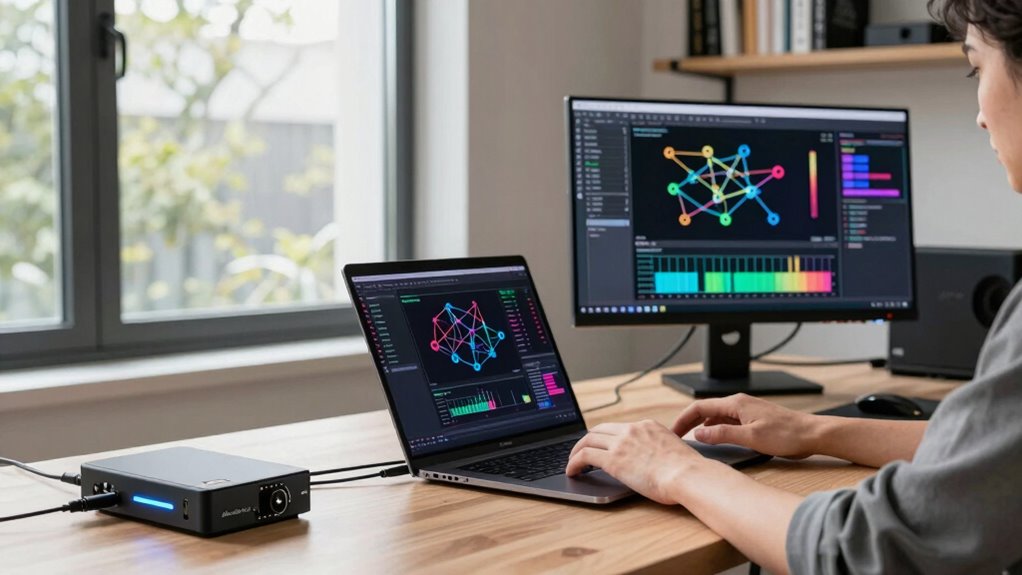
As AI models grow more powerful and complex, integrating local inference into your developer workflows becomes increasingly vital. You’re likely aware of the advantages: faster response times, reduced reliance on cloud services, and greater control over your applications. But beyond performance, local inference plays a fundamental role in addressing key concerns like AI ethics and data privacy. When you run models locally, you mitigate the risk of exposing sensitive information to third parties, which is especially important in sectors handling confidential data, such as healthcare, finance, or legal services. This shift allows you to guarantee that data stays within your secure environment, giving you peace of mind and satisfying compliance requirements.
Implementing local inference also aligns with responsible AI development. AI ethics emphasizes transparency, fairness, and accountability—principles that are easier to uphold when you control the entire inference process. You can monitor how models behave on your data, identify biases, and make adjustments without worrying about data leakage or unintended disclosures. This control supports ethical decision-making, enabling you to build trustworthy AI systems that respect user privacy and adhere to regulations. As data privacy laws become stricter worldwide, local inference becomes a strategic choice, safeguarding user information while maintaining compliance with frameworks like GDPR or HIPAA. Additionally, local inference allows for more consistent performance, especially in environments with fluctuating network conditions or limited connectivity.
Control inference processes to ensure transparency, fairness, and compliance with data privacy regulations like GDPR and HIPAA.
Moreover, integrating local inference into your workflows streamlines your development cycle. You no longer need to rely on unstable network connections or endure latency issues caused by remote server calls. Instead, your models run directly on your hardware, which speeds up testing, iteration, and deployment. This autonomy empowers you to experiment more freely, knowing that your privacy remains intact and that your models are less vulnerable to external disruptions. As a result, you gain more control over your project timelines and improve overall efficiency. Additionally, understanding the role of contrast ratio in image quality can help you optimize the visual aspects of your projects, ensuring clarity and sharpness in your outputs. Leveraging local inference also allows for easier integration with existing security measures, making your AI infrastructure more resilient against external threats.
However, adopting local inference isn’t without challenges. You need sufficient hardware resources and expertise to deploy and maintain models locally. Still, the benefits—enhanced data privacy, stronger adherence to AI ethics, and improved performance—often outweigh these hurdles. As you become more familiar with local inference tools and frameworks, you’ll find it easier to embed AI into your workflows securely and ethically. This shift ultimately helps you develop more responsible AI solutions, giving users confidence that their data is protected and that your systems adhere to ethical standards. In today’s AI landscape, making local inference a core part of your developer toolkit is not just a technical upgrade; it’s a commitment to privacy, ethics, and quality.

Qwen 3.5 AI Agents on GPU and CUDA: The Engineer's Guide to Mastering Hardware Sizing, Local LLM Inference, Optimize VRAM, Building and Scaling Native Multimodal AI in Production
As an affiliate, we earn on qualifying purchases.
As an affiliate, we earn on qualifying purchases.
Frequently Asked Questions
How Does Local AI Inference Impact Data Privacy?
Local AI inference greatly enhances your data privacy by keeping sensitive information on your device, reducing exposure risks. You maintain better data security, as data doesn’t need to be transmitted over networks, minimizing breaches. This approach also helps you meet privacy compliance standards, since you have more control over data handling and storage. Overall, local inference empowers you to protect user privacy while efficiently deploying AI models.
What Hardware Is Needed for Efficient Local AI Inference?
Think of your hardware as the engine powering your AI car. For efficient local AI inference, you need a robust GPU with edge optimization and hardware acceleration features. A modern NVIDIA RTX or AMD Radeon GPU can handle intensive tasks, while dedicated AI chips like Google’s Coral Edge TPU boost performance. These components guarantee your AI runs smoothly on-device, making inference faster and more reliable without relying on cloud resources.
Can Local Inference Models Be Easily Updated?
Yes, local inference models can be easily updated through streamlined processes like model versioning and update deployment. You can manage different model versions, test updates locally, and deploy new models smoothly without disrupting your workflow. This flexibility allows you to keep your AI models current, improve accuracy, and adapt quickly to changing needs, making local inference a practical choice for ongoing development and deployment.
How Does Local Inference Compare in Cost to Cloud Solutions?
Local AI inference often costs less than cloud solutions over time, especially when considering the total cost comparison. You avoid ongoing cloud service fees and can leverage existing infrastructure, reducing infrastructure requirements. While initial setup might involve hardware investments, maintaining local inference allows you to scale efficiently without recurring expenses, making it a cost-effective choice for many developers. This approach provides better budget control and predictable costs.
Are There Limitations on Model Size for Local Inference?
Yes, there are limitations on model size for local inference. Larger models require more memory and processing power, which can increase inference latency. To address this, you can use model compression techniques, reducing size without sacrificing much accuracy. This helps guarantee your local hardware can handle the model efficiently, maintaining faster inference times. Keep in mind, balancing model size and performance is key for effective local inference.

MCP Architecture & Development: A Comprehensive Handbook for Building Tools, Servers, and LLM Workflows Using the Model Context Protocol
As an affiliate, we earn on qualifying purchases.
As an affiliate, we earn on qualifying purchases.
Conclusion
As you embrace local AI inference, you’re stepping into a new era of development—one where speed, privacy, and control are in your hands. But the real game-changer is just beginning. Imagine what’s possible when the boundary between data and insights disappears, revealing innovations you’ve only dreamed of. Are you ready to harness this power and redefine your workflow? The future of AI development is waiting—are you prepared to take the leap?

msi GeForce RTX 5070 Ti Shadow 3X OC Graphics Card, 16GB GDDR7, 28 Gbps, 256-bit, 1406 AI Tops, DLSS 4, AI Content Creation, Local LLM Inference, DP 2.1b x3, HDMI 2.1b, with GPU Holder
[1406 AI TOPS, 5th Gen Tensor Cores, AI Content Creation] Accelerate AI powered photo and video workflows like…
As an affiliate, we earn on qualifying purchases.
As an affiliate, we earn on qualifying purchases.

Edge AI Performance on NVIDIA Jetson: Mastering Orin Nano and TensorRT for Real-Time Computer Vision and Robotics Projects
As an affiliate, we earn on qualifying purchases.
As an affiliate, we earn on qualifying purchases.