
📊 Full opportunity report: A Better Way To Choose Your First SMB Automation Project on IdeaNavigator AI — validation score, market gap, and execution plan.

Get business pricing on monitors, keyboards and dev gear
- Business-only prices and quantity discounts
- Tax-exempt purchasing
- Multiple users, one account, clear invoices
TL;DR
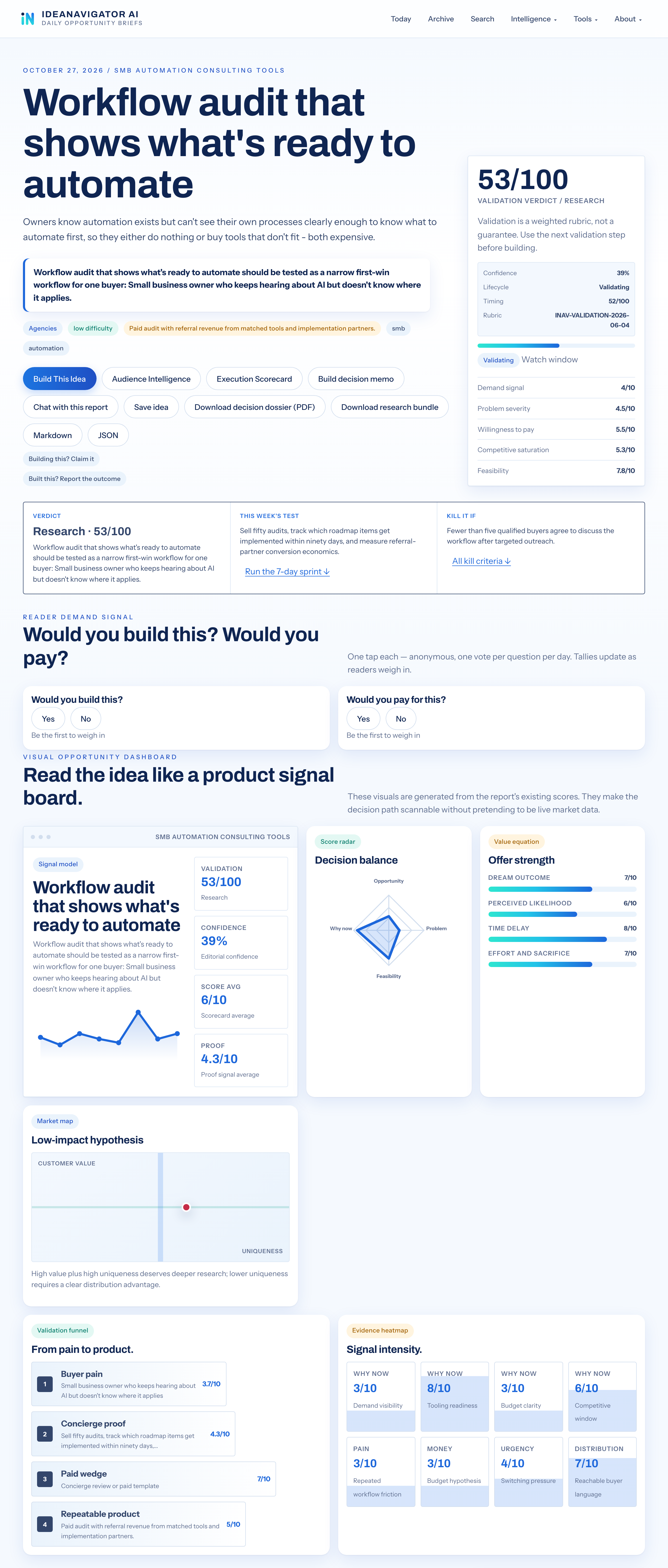
IdeaNavigator AI proposes a paid workflow audit to help small-business owners decide which processes may be suitable for automation. The concept would map operations, score possible projects and suggest a sequenced 90-day roadmap; its commercial viability has not yet been demonstrated in the material provided.
IdeaNavigator AI has proposed a workflow audit to help small-business owners identify which of their processes may be ready for automation and what to tackle first. The concept would turn an interview about a company’s operations into a ranked process map and 90-day roadmap, addressing a decision problem that can lead owners either to postpone automation or buy tools that do not fit.
The proposed minimum viable product would guide an owner through questions about how the business operates, then map the processes discussed. Each potential automation project would be assessed on automation readiness, expected return on investment and difficulty. The output would sequence recommended work over 90 days and suggest tools for individual steps.
The intended customer is a small-business owner unsure where AI or automation applies. The product is framed as a way to make existing work visible before choosing software, rather than starting with a particular tool and looking for a use for it. The proposal does not provide a working product, customer results or evidence that its scoring method has been tested.
The proposed revenue model combines a paid audit with referral income from tools and implementation partners recommended in the roadmap. IdeaNavigator AI says the concept should be tested by selling 50 audits, then tracking which recommendations are implemented within 90 days and whether referrals convert economically. No sales, implementation or referral outcomes are reported.
SMB AUTOMATION · CONCEPT REVIEW
A Better Way To Choose Your First SMB Automation Project
IdeaNavigator AI proposes a paid workflow audit to help small-business owners decide what may be suitable for automation. The idea maps operations, scores project candidates and sequences a 90-day roadmap. Its commercial viability has not yet been demonstrated.
01 / THE DECISION GAP
Why start with a workflow map?
Owners may know automation is available without knowing which internal processes are ready for it. That uncertainty can mean postponing a useful improvement or buying software that does not fit how the work actually happens.
Unclear processes
A tool may miss the mark when a workflow is poorly understood, rarely repeated or driven by decisions that resist standardization.
Make work visible
A guided interview and process map could help owners compare opportunities before spending on subscriptions or implementation.
Scoring must earn trust
Readiness, cost and potential return need credible estimates. The proposal provides no tested scoring results.
02 / HOW THE AUDIT COULD WORK
From interview to a sequenced plan
The proposed minimum viable product guides an owner through questions about operations, maps the processes discussed and connects promising candidates to suggested tools.
Interview
Capture how the business operates and where work repeats.
Map
Make the processes discussed visible as a workflow map.
Assess
Compare readiness, expected ROI and implementation difficulty.
Sequence
Suggest tools and order potential work across 90 days.
03 / PROPOSED SCORING MODEL
Three lenses for choosing a first project
These are the dimensions the proposal says it would use. No formula, calibration method or evidence of tested rankings is provided.
Automation readiness
Could this process be automated given its repeatability, inputs and decision points?
Expected return
What time, cost or other benefit might justify investment in a change?
Implementation difficulty
How much effort, integration work or change might delivery require?
04 / WHAT IS KNOWN SO FAR
A concept with open validation questions
The available description outlines a product idea and a test plan. It reports no working product, paying customers, implementation results or referral outcomes.
Described in the proposal
- Guided interview and process map for a small-business owner
- Candidate scoring across readiness, expected ROI and difficulty
- A sequenced 90-day roadmap with suggested tools
- Revenue from paid audits and referrals to tools or partners
Still unreported
- Whether a product has been built or customers have paid
- How ROI is calculated and what counts as implementation
- How sensitive data and complex human judgment are handled
- Referral fees, disclosures and safeguards for independent recommendations
05 / THE PROPOSED VALIDATION
Test willingness to pay—and follow-through
The proposed pilot would sell 50 audits, then track which recommendations are implemented within 90 days and whether referrals convert economically.
SOURCE: IDEANAVIGATOR AI · CONCEPT AND VALIDATION PLAN
A Better First Automation Decision
For a small business, choosing what to automate can be as consequential as choosing which software to buy. A tool may not solve the underlying problem if the process is poorly understood, rarely repeated or dependent on decisions that cannot be standardized. A structured review could give owners a way to compare opportunities before spending on subscriptions or outside implementation.
The proposal also places process selection ahead of tool selection. That matters in a crowded market where owners may hear broad claims about AI without a clear link to the day-to-day work in their own company. A ranked assessment could help narrow the options, but its value would depend on whether the questions capture real workflows and whether readiness, cost and potential returns are estimated credibly.
The commercial incentives need scrutiny as well. Referral revenue could connect owners with relevant vendors or partners, but it can also influence which tools are recommended. The proposal does not describe how recommendations would be kept independent, how referral relationships would be disclosed, or whether customers would see alternatives that do not pay for referrals.
Products Worth Considering

Apple iPad Air (4th Generation, 10.9-inch, Wi-Fi, 256GB) – Space Gray

Bose QuietComfort Wireless Noise-Cancelling Over-Ear Headphones, Black

Samsung 27-inch Odyssey OLED G6 QD-OLED QHD Gaming Monitor
As an affiliate, we earn on qualifying purchases.
Why Owners Need a Workflow Map
The proposal describes a familiar gap: owners may know automation is available but lack a clear view of which internal processes are suitable for it. That can produce two different costs: delaying a potentially useful improvement, or purchasing software that does not match the work employees actually do.
IdeaNavigator AI argues that the growth of AI tools has increased the difficulty of choosing among them, while guided interviews and process mapping may now be easier to structure with large language models. This is the proposal’s rationale, not evidence that an AI-led audit will produce accurate recommendations. The concept’s suggested response is to begin with an operational interview, make the process map explicit and connect recommendations to a defined testing period.
The proposed 90-day roadmap is meant to turn an audit into a sequence of decisions rather than a general list of possible uses. The description does not specify which industries or business sizes the first version would serve, or how it would handle workflows involving sensitive information, regulatory obligations or complex human judgment.
What the Pilot Must Establish
The concept remains a proposal in the information available. It is not clear whether an audit product has been built, whether any customers have paid for one, or whether owners can complete the interview without substantial assistance. There are also no reported findings on the accuracy or consistency of the readiness, ROI and difficulty scores.
The proposed test leaves several practical questions open. The description does not define what counts as an implemented roadmap item, how ROI would be calculated, or how the audit would distinguish a promising automation candidate from a process that needs redesign first. It also does not state how the product would handle inaccurate answers, changing business conditions or sensitive operational data.
The referral model’s economics and safeguards remain unreported. There is no information on partner fees, customer disclosures, tool-selection criteria or whether recommendations would change based on commercial relationships. Until these points are tested and explained, the audit’s usefulness and independence cannot be judged.
The Proposed 90-Day Test
The next step set out in the proposal is to sell 50 audits and follow each customer’s roadmap for 90 days. That would provide an initial measure of whether owners will pay for this kind of assessment and whether they act on the recommendations, rather than judging the idea only by interest in automation.
The test is also intended to examine referral-partner conversion economics. To interpret the results, the project would need to report what was recommended, what customers implemented, how long implementation took and what costs or outcomes were observed. The supplied description does not say when the test will begin, who will run it or what threshold would count as success. Until those details or results are available, the audit is best understood as a proposed product and validation plan, not a proven route to automation savings.
Source: IdeaNavigator AI
Key Questions
What is the proposed SMB workflow audit?
It is a proposed guided interview that would map a small business’s operations, score possible automation projects and produce a sequenced 90-day roadmap with suggested tools.
How would the audit rank automation opportunities?
The proposed assessment would consider automation readiness, expected ROI and difficulty. No scoring formula or evidence of tested rankings has been provided.
How would the product make money?
The proposed model combines a paid audit with referral revenue from recommended software tools and implementation partners. Details about fees and recommendation safeguards are not available.
Has the audit been tested with customers?
No customer results are reported in the available description. The proposed validation plan is to sell 50 audits and track roadmap implementation over 90 days, alongside referral conversions.
What remains unknown about the proposal?
It is unclear whether a product has been built, when a pilot might start, how ROI would be measured and how tool recommendations would be kept independent of referral income.
Source: IdeaNavigator AI