📊 Full opportunity report: A Parent-Friendly Intro To IEP Negotiation Rehearsal Simulators on IdeaNavigator AI — validation score, market gap, and execution plan.

Get business pricing on monitors, keyboards and dev gear
- Business-only prices and quantity discounts
- Tax-exempt purchasing
- Multiple users, one account, clear invoices
TL;DR
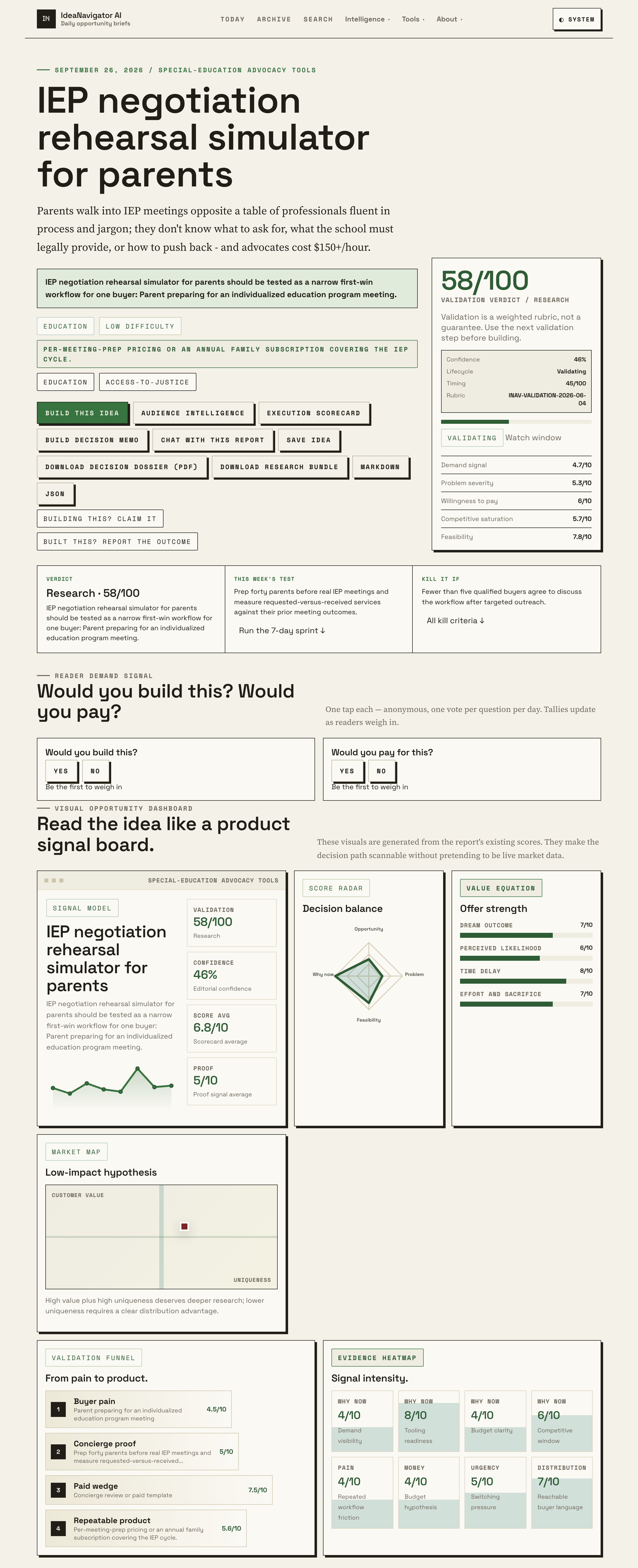
A proposal outlines a simulator that would help parents prepare for individualized education program meetings by explaining documents, forming requests and rehearsing conversations. The concept has not been shown to improve services or meeting outcomes; its proposed validation is a 40-parent trial.
IdeaNavigator AI has proposed a rehearsal simulator to help parents prepare for individualized education program meetings, where they discuss a student’s special education needs and services with school staff. The concept would use a family’s current IEP and evaluation reports to explain them in plain language, help prepare requests and practice responses to realistic pushback; no product launch or evidence of improved outcomes is reported.
The proposed tool is aimed at a specific moment: a parent preparing for an IEP meeting. Its planned workflow would let a parent upload the student’s current IEP and evaluation reports. The simulator would then explain the documents and relevant entitlements in plain language, generate a list of possible requests with legal grounding, and run a role-play of the meeting.
In the role-play, the system would simulate school representatives and their likely objections so a parent could practice holding a position and responding. The proposal describes this as preparation, rather than representation at the meeting. It does not specify how the tool would check legal explanations, handle different state rules, protect uploaded student records or respond when a family’s circumstances fall outside the system’s knowledge.
Possible payment models include a fee for each meeting-preparation session or an annual family subscription covering the IEP cycle. To test demand and effectiveness, the proposal suggests preparing 40 parents before actual meetings and comparing services requested with services received, against each parent’s prior meeting outcomes. No trial results, pricing, recruitment plan or comparison method are provided.
Testing Preparation Against Outcomes
The proposal addresses an imbalance in familiarity with the meeting process: parents may be discussing a child’s needs with professionals who routinely work with education plans and related terminology. A rehearsal tool could give families time to review documents and organize questions before the meeting, particularly if hiring an advocate is beyond their budget. The proposal cites advocacy rates of $150 or more per hour, but does not identify a survey, location or date for that figure.
Whether practice changes what services students receive is a separate question. A parent might make more requests after preparation, but the number of requests alone would not show whether those services were appropriate, agreed to or delivered. Comparing requested and received services with prior meetings could offer an initial signal, though differences between students, schools and cases would make results difficult to interpret without a clear method.
Because the suggested product would interpret education and evaluation records and offer legally grounded requests, accuracy could affect parents’ expectations and decisions. The proposal does not establish that an AI simulator can provide reliable legal guidance or replace an advocate. Those limits matter to families deciding how much to rely on its explanations during a consequential planning process.
A Defined IEP Preparation Task
An IEP, or individualized education program, sets out a student’s special education plan. Meetings bring families and school personnel together to review needs and discuss services. The proposed simulator focuses on helping parents prepare for that conversation, rather than automating the meeting or making decisions for a school.
IdeaNavigator AI presents the concept as a narrow first product for one intended buyer: a parent preparing for an IEP meeting. Its rationale is that language models can now support role-play, while special education identification is rising and district resources are tightening. Those are the proposal’s stated reasons for timing; it gives no figures or citations to establish the scale or pace of either trend.
The suggested sequence is to assemble the document-upload, plain-language explanation, request-generation and role-play features, then test the workflow with parents before real meetings. The proposal does not say that a simulator has been built, that families have tested it or that schools are involved.
Accuracy, Safety and Results
No evidence of effectiveness is reported, and the suggested 40-parent exercise has not been described as underway. It is unclear how participants would be selected, what counts as a service received, how prior outcomes would be recorded or whether another comparison group would be used. The proposal also does not say how long outcomes would be tracked.
The legal grounding of generated requests is another open issue. The proposal does not name the laws, jurisdictions or review process the system would use, and it gives no account of how the tool would flag uncertain answers. It is also unclear how sensitive student records would be stored, accessed or deleted after upload.
Finally, the stated advocacy price and claims about identification rates and district resources lack supporting data in the proposal. There is no confirmed product, price, launch schedule, developer or partner. These details would be needed to judge affordability, reliability and whether the concept can work across different family and school situations.
A Forty-Parent Pilot Proposed
The next step described is a pilot involving 40 parents preparing for real IEP meetings. The proposed measure is the relationship between services parents request and services they receive, compared with their earlier meeting outcomes. No start date or findings have been announced.
For that test to show more than whether parents made different requests, organizers would need to define how they assess the requests, agreements and services delivered, and account for changes in each student’s needs and circumstances. The proposal does not provide those details. Until a trial is conducted and its method and results are available, the simulator remains an unvalidated product concept.
Key Questions
Has the IEP rehearsal simulator launched?
No launch is reported. The concept describes a proposed product and workflow; it does not identify an available service or release date.
What would the simulator do?
It would take a parent’s current IEP and evaluation reports, explain them in plain language, help prepare requests with legal grounding and let the parent rehearse a meeting with simulated pushback.
Has the tool been shown to improve IEP outcomes?
No results are reported. IdeaNavigator AI proposes testing the concept with 40 parents and comparing requested and received services with prior meeting outcomes.
Would it replace a special education advocate?
The proposal describes meeting preparation, not professional representation, and does not establish that the tool can replace an advocate or provide reliable legal advice.
Source: IdeaNavigator AI
Fall Picks
fall essentials
As an affiliate, we earn on qualifying purchases.