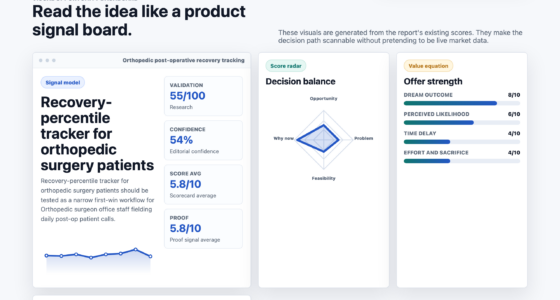
📊 Full opportunity report: A Screen Use Counseling Directory For Behavioral Health Navigation on IdeaNavigator AI — validation score, market gap, and execution plan.

Get business pricing on monitors, keyboards and dev gear
- Business-only prices and quantity discounts
- Tax-exempt purchasing
- Multiple users, one account, clear invoices
TL;DR

IdeaNavigator AI has proposed testing a therapist directory focused on compulsive screen use, including gaming, pornography and social media. The concept would verify providers’ relevant training and experience, then test demand with 50 specialists across three metropolitan areas; no launch or results are reported.
IdeaNavigator AI has proposed a focused therapist directory for people seeking help with compulsive screen use, including gaming, pornography and social-media use. The concept would verify listed providers’ screen-specific training, treatment approach and case experience, and test whether patients book consultations through a pilot in three metropolitan areas.
The proposed service is aimed at a person or parent looking for a therapist who treats a particular pattern of screen use, rather than a general behavioral-health listing. Patients would be able to filter providers by presentation—gaming, pornography or social media—along with age group and whether telehealth is available.
IdeaNavigator AI describes the problem as a mismatch between broad directory labels and providers’ actual expertise. A therapist may select a “technology addiction” category without, the proposal says, having a specific treatment protocol or relevant experience. That can leave prospective patients paying intake fees before discovering whether a clinician is suited to their needs.
The proposed minimum viable product would require providers to document their screen-related training, treatment approach and case experience, with the platform verifying those details. The business model under consideration combines therapist listing subscriptions with fees tied to bookings. The proposal does not report that a platform has launched, that any providers have been recruited, or that patient bookings have been measured.
Finding Screen-Use Specialists
A specialized directory could give people searching for care a way to identify clinicians who report relevant experience. If provider information is checked and presented clearly, patients and families could review it before booking an appointment.
The proposal’s potential value would depend on the number of verified specialists available in each location and treatment category, as well as a clear explanation of the verification process. A listing alone cannot establish that therapy will be effective or that a clinician is the right fit for an individual patient.
For behavioral-health providers, the concept would test whether a narrower route to new clients can support subscription and booking charges. For patients, it would test whether the directory reduces the time and expense of finding care. These are proposed benefits; the proposal reports no outcomes.
therapist directory for screen addiction
As an affiliate, we earn on qualifying purchases.
As an affiliate, we earn on qualifying purchases.
How the Proposed Pilot Works
IdeaNavigator AI frames the directory as a behavioral-health navigation product rather than a treatment program. Its initial audience is deliberately narrow: people, including parents seeking support for a child, who want a clinician with experience related to compulsive screen use.
The proposed validation plan is to recruit 50 verified specialists in three metropolitan areas, publish patient-acquisition content and track booked consultations per listing per month. That metric would offer an early indication of whether the listings attract inquiries that turn into appointments. The proposal does not name the cities, set a recruitment deadline or provide a comparison benchmark for judging performance.
The rationale offered is that screen-related concerns are reaching behavioral-health practices while specialized training remains difficult to identify. This is presented as the opportunity behind the idea, not as a quantified finding: the proposal supplies no prevalence estimates, workforce data or research citations. Its immediate development question is whether providers can be verified and patients can be reached at a cost that supports the service.
telehealth therapy for gaming addiction
As an affiliate, we earn on qualifying purchases.
As an affiliate, we earn on qualifying purchases.
Verification and Demand Still Untested
The proposal does not specify what evidence therapists would need to provide, who would review it, how often credentials would be checked or what would qualify as sufficient case experience. Without those details, “verified” remains a proposed standard rather than a defined guarantee of clinical competence or treatment quality.
It is also unclear whether the directory is being built, when a pilot might begin, which metropolitan areas would be included and how patients would be recruited. No consultation results, provider commitments, operating costs or evidence of demand are provided. The proposal does not establish how it would handle privacy, complaints, inaccurate listings or differences in clinical practice.
The listed categories and filters describe a product plan; they do not establish that compulsive screen use has one agreed clinical definition or that the same approach applies across gaming, pornography and social-media concerns. The proposal offers no clinical guidance and does not claim that using the directory replaces an assessment by a qualified health professional.
professional counseling for social media overuse
As an affiliate, we earn on qualifying purchases.
As an affiliate, we earn on qualifying purchases.
Pilot Recruitment and Booking Results
The next stated step is to recruit 50 specialists across three metropolitan areas, then use patient-acquisition content to bring prospective clients to the listings. If the test proceeds, the proposed measure is booked consultations per listing per month. The proposal gives no timetable or named launch milestones.
Evaluating the concept would require further details on how provider credentials are checked, how booking fees and subscriptions work, and how the team will interpret results. Reporting on the number of providers who qualify, patient inquiries and completed bookings could show whether the directory attracts interest. Until such information is available, the idea remains a proposed pilot rather than an operating service with demonstrated results.
Source: IdeaNavigator AI
verified behavioral health specialists for pornography addiction
As an affiliate, we earn on qualifying purchases.
As an affiliate, we earn on qualifying purchases.
Key Questions
Has the screen-use therapist directory launched?
No launch is reported. IdeaNavigator AI describes a proposed directory and pilot, without a launch date or confirmation that development is underway.
What kinds of concerns would the directory cover?
The proposed filters include gaming, pornography and social-media use, as well as age group and telehealth availability.
How would therapists be verified?
The concept calls for providers to document screen-specific training, treatment approach and case experience, which the platform would verify. The proposal does not explain the review process or set qualification standards.
How would the pilot measure demand?
The proposed test would recruit 50 specialists in three metropolitan areas and measure booked consultations per listing per month after patient-acquisition efforts. No pilot results are available in the proposal.
Source: IdeaNavigator AI
Halloween Picks
halloween
As an affiliate, we earn on qualifying purchases.