📊 Full opportunity report: An Empty Trust Tracker For Managing Probate Work on IdeaNavigator AI — validation score, market gap, and execution plan.

Get business pricing on monitors, keyboards and dev gear
- Business-only prices and quantity discounts
- Tax-exempt purchasing
- Multiple users, one account, clear invoices
TL;DR
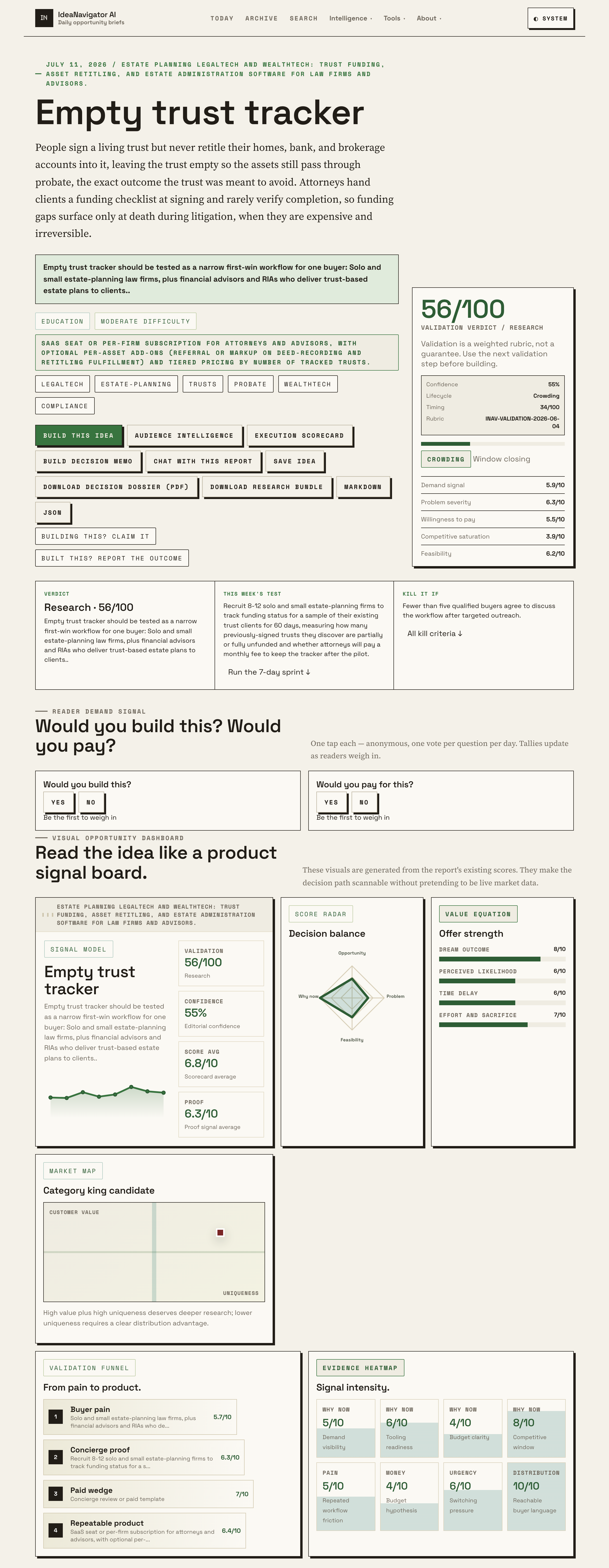
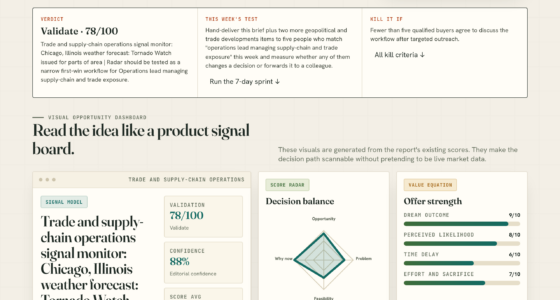
IdeaNavigator AI has published a proposal for a trust funding tracker aimed at solo and small estate-planning law firms and financial advisors. The tool would flag ’empty’ living trusts — trusts whose assets were never retitled into them — so clients’ assets avoid probate as intended.
A new product proposal from IdeaNavigator AI recommends building a dedicated trust funding tracker — a tool that flags so-called “empty trusts” — as a narrow, first-win software product for solo and small estate-planning law firms and for financial advisors and RIAs who deliver trust-based estate plans. The proposal targets a long-standing gap in estate planning: clients sign living trusts but never retitle their assets into them, so the assets still pass through probate, the exact outcome the trust was designed to avoid.
According to the proposal, the core problem is procedural rather than legal. Attorneys typically hand clients a funding checklist at signing and rarely verify whether the client actually completed the retitling of homes, bank accounts, and brokerage accounts. As a result, funding gaps surface only at death, often during litigation, when they are expensive and irreversible to fix.
The proposed MVP is a client-by-client tracker. Attorneys or advisors would create a funding checklist per trust covering real estate, bank, brokerage, retirement accounts, business interests, and beneficiary designations. Each asset would carry a status — pending, in-progress, or confirmed funded — with proof attached, such as a recorded deed or a retitled account statement. Automated client reminders would nudge completion, and a firm-level dashboard would show the firm’s book of trusts by percent funded, letting partners flag dangerously empty trusts before a client dies.
The proposed revenue model is a SaaS seat or per-firm subscription for attorneys and advisors, with optional per-asset add-ons such as referral fees or markups on deed-recording and retitling fulfillment, and tiered pricing based on the number of tracked trusts. The proposal situates the product in the estate planning legaltech and wealthtech market, specifically trust funding, asset retitling, and estate administration software.
Why Unfunded Trusts Cost Clients
The proposal’s significance rests on the scale of the underlying problem. It cites an estimate that only about 11% of Americans hold a trust, while estate planning adoption and digital tooling are surging in 2026 — meaning the population of signed-but-unfunded trusts is likely to grow. Existing document-drafting software, the proposal argues, does not close the funding step, which remains manual and fragmented across county recorder offices, banks, and brokerages.
For firms, the tracker would convert an invisible liability into a managed workflow: partners could see, at a glance, which client trusts are dangerously underfunded. For advisors and RIAs, it aligns with a broader race to bundle funded estate plans into client offerings, a differentiator as wealthtech platforms compete on end-to-end service. The proposal also notes that per-deed funding services priced from $250 have already created a paid market that a tracking and verification layer can sit on top of, giving the product a plausible attach point rather than requiring firms to build fulfillment from scratch.
Top picks for "empty trust tracker"
As an affiliate, we earn on qualifying purchases.
The Current Estate Planning Tooling Gap
Estate planning software has historically concentrated on document generation — drafting trusts, wills, and powers of attorney. What happens after signing has received far less attention: retitling a home requires recording a new deed with a county, and retitling bank and brokerage accounts requires separate processes at each institution. Because these steps fall on the client, completion rates are largely untracked by the professionals who drafted the plan.
The proposal positions the empty trust tracker as a deliberately narrow first-win workflow — a small, focused product that solves one verification problem rather than attempting a full estate administration platform. This framing reflects a common software strategy of validating a single high-pain workflow with a small user base before expanding scope. The 2026 timing, the proposal argues, is driven by surging estate planning adoption, advisor interest in bundled plans, and the emergence of a paid per-deed fulfillment market.
Unvalidated Numbers and Unbuilt Product
No product exists yet. The empty trust tracker is a concept proposal, not a launched company or shipped software, and no pricing, vendor, or release timeline has been announced. The claim that only about 11% of Americans hold a trust is presented in the proposal without a named underlying study, and the assertion that existing document-drafting software does not close the funding gap reflects the proposal’s own market analysis rather than an independent assessment.
The most consequential open question is the prevalence of unfunded trusts among existing clients. The proposal itself does not claim to know this number; its validation plan is designed to discover it. Whether attorneys will pay an ongoing monthly fee after a free pilot, whether clients will respond to automated reminders, and whether proof-attachment workflows (recorded deeds, retitled statements) can be kept current across thousands of institutions all remain untested. Potential professional-responsibility questions — such as whether tracking funding status creates new duties for attorneys once a gap is documented — are not addressed in the proposal.
A 60-Day Firm Pilot Design
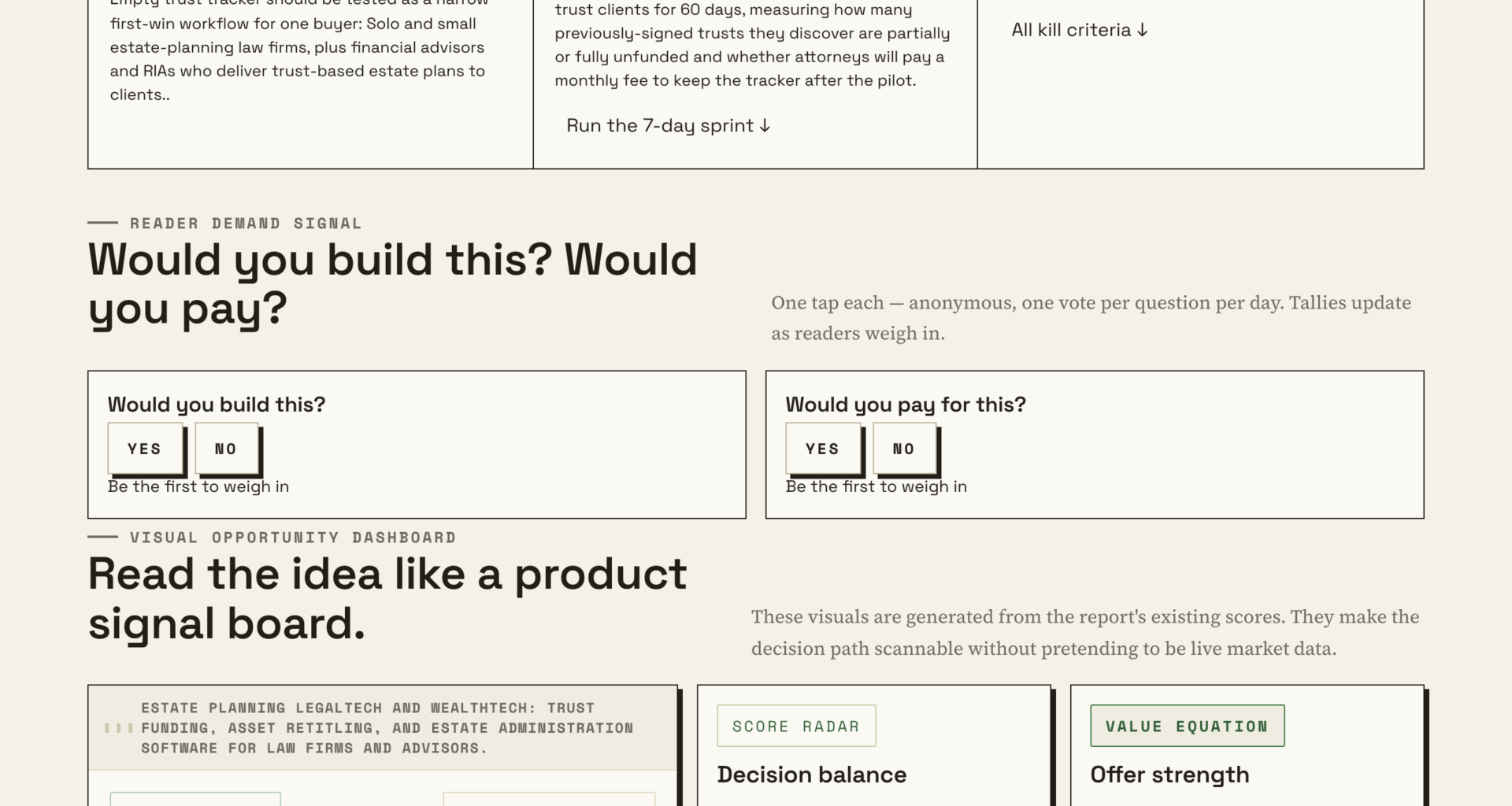
The proposal lays out a concrete validation step: recruit 8–12 solo and small estate-planning firms to track funding status for a sample of their existing trust clients over 60 days. Two metrics would determine viability: how many previously signed trusts the firms discover are partially or fully unfunded, and whether the attorneys are willing to pay a monthly fee to keep the tracker after the pilot ends.
If the pilot surfaces a high rate of unfunded trusts and firms convert to paid subscriptions, the proposal envisions expansion into per-asset fulfillment add-ons — deed recording and account retitling — and tiered pricing by tracked-trust volume. Until such a pilot is run, the empty trust tracker remains an untested hypothesis about how much latent unfunded-trust risk sits inside small firms’ existing client books.
Source: IdeaNavigator AI
Key Questions
What is an “empty trust”?
It is a living trust that was legally signed but whose assets — a home, bank accounts, brokerage accounts — were never retitled into the trust’s name. Because the trust holds nothing, those assets still pass through probate, the court process the trust was created to avoid.
Does the empty trust tracker exist as a product today?
No. It is a product proposal published by IdeaNavigator AI describing an MVP that could be built. No vendor, pricing, or launch date has been announced.
Who would use the tracker?
The proposal targets solo and small estate-planning law firms and financial advisors and RIAs who deliver trust-based estate plans to clients and want to verify those plans are actually funded.
How would the tracker be validated?
By recruiting 8–12 firms to track funding status for existing trust clients over 60 days, measuring how many signed trusts turn out to be partially or fully unfunded and whether attorneys will pay a monthly subscription afterward.
How would the product make money?
Through a SaaS seat or per-firm subscription, plus optional per-asset add-ons such as referral fees or markups on deed-recording and retitling services, with tiered pricing based on the number of trusts tracked.
Source: IdeaNavigator AI
Fall Picks
fall essentials
As an affiliate, we earn on qualifying purchases.