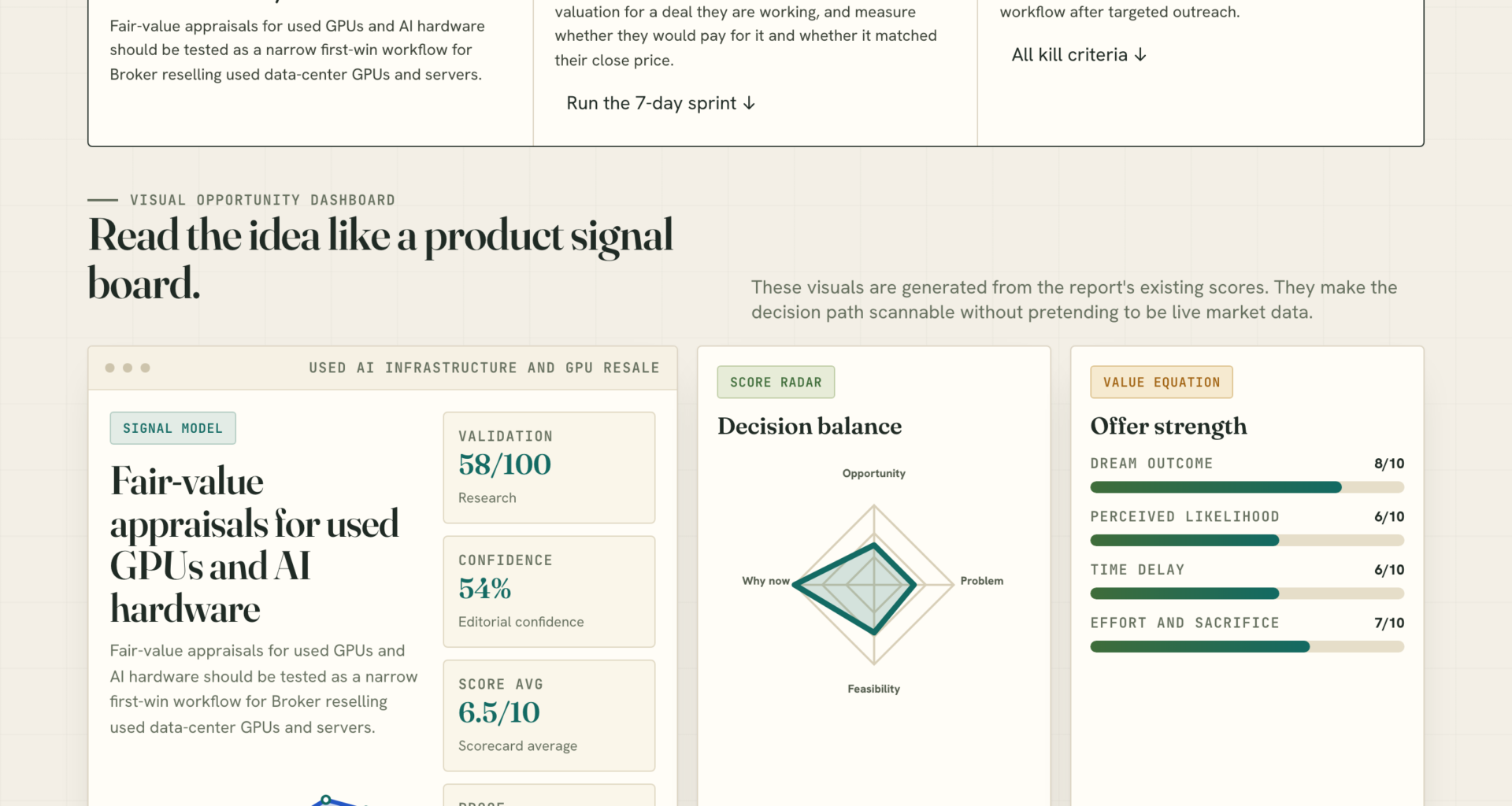

📊 Full opportunity report: Fair-value appraisals for used GPUs and AI hardware on IdeaNavigator AI — validation score, market gap, and execution plan.

Get business pricing on monitors, keyboards and dev gear
- Business-only prices and quantity discounts
- Tax-exempt purchasing
- Multiple users, one account, clear invoices
TL;DR

A proposed fair-value appraisal system for used GPUs and AI hardware aims to provide brokers with transparent pricing benchmarks. This development could streamline the resale market and reduce deal disputes. Validation is ongoing through pilot testing with active brokers.
A new manual valuation approach for used GPUs and AI hardware is being tested to establish fair market value benchmarks, addressing a significant gap in the secondary AI hardware market. This initiative aims to reduce pricing disputes and improve deal transparency for brokers dealing with used data-center equipment.
The opportunity arises as hyperscalers and research labs are rapidly refreshing their GPU fleets, flooding the secondary market with recent-generation hardware such as NVIDIA H100s and DGX racks. Currently, buyers and sellers lack reliable reference points for fair market value, leading to frequent disputes and mispricing that can amount to thousands of dollars per unit.
The proposed solution involves a manual valuation sheet where brokers input details such as GPU model, condition, and quantity. The system then provides a curated fair-value range based on three recent comparable sales pulled from public listings. This process aims to offer a practical, scalable first step towards establishing transparent, standardized pricing benchmarks in this fast-moving market.
IdeaNavigator AI suggests testing this approach with a pilot involving ten active used-GPU brokers. The goal is to see whether brokers find the valuation useful enough to pay for it and whether it aligns with the prices they ultimately close deals at. The model is intended to generate revenue through per-appraisal fees or subscription plans for unlimited valuations.
Potential Impact on Used AI Hardware Resale Market
If successful, this fair-value appraisal system could significantly reduce pricing disputes and improve market transparency, making used AI hardware trading more efficient. It offers brokers a practical tool to determine realistic prices, potentially boosting liquidity and confidence in the secondary market. This development could also influence how hyperscalers and labs manage their hardware refresh cycles, as clearer valuation standards become available.
As an affiliate, we earn on qualifying purchases.
Market Dynamics Driving Need for Fair-Value Appraisals
The secondary market for AI hardware has grown rapidly as large organizations refresh their GPU fleets, often selling off recent-generation equipment. However, the lack of standardized pricing references has led to frequent disagreements and mispricing, which hampers deal flow. Currently, brokers rely on manual research and subjective judgment, creating inefficiencies and potential financial losses. The idea of a simple, manual valuation tool emerges amid these challenges as a practical first step toward more transparent and reliable pricing benchmarks.
“This manual valuation approach could become a practical first step toward standardizing pricing in a fragmented secondary market.”
— an anonymous researcher
AI hardware resale valuation tools
As an affiliate, we earn on qualifying purchases.
As an affiliate, we earn on qualifying purchases.
Uncertainties in Validation and Adoption
It is not yet clear how accurately the manual valuation sheet will reflect real market prices across different regions and hardware conditions. The pilot testing with ten brokers will provide initial insights, but broader adoption and long-term effectiveness remain uncertain. Additionally, the impact of automated or AI-driven valuation methods on this manual approach is still to be explored.
As an affiliate, we earn on qualifying purchases.
Next Steps for Pilot Testing and Market Adoption
The immediate next step involves conducting pilot tests with ten active used-GPU brokers to evaluate the system’s accuracy and usability. Success in this phase could lead to wider deployment, potential integration with existing broker platforms, and the development of a scalable pricing model. Ongoing feedback will shape further refinements and determine whether the approach can become a standard in the industry.
As an affiliate, we earn on qualifying purchases.
Key Questions
How will the manual valuation system determine fair market value?
The system will use input parameters such as GPU model, condition, and quantity, then pull recent comparable sales from public listings to generate a fair-value range.
Who will pay for these appraisals, and how much will it cost?
Brokers or resellers will pay per appraisal or subscribe for unlimited valuations. Exact pricing will depend on pilot results and market acceptance.
Will this system replace automated valuation tools?
It is intended as a practical first step; automation and machine learning may be integrated later as the market matures and data availability improves.
How soon could this tool become widely available?
If pilot testing shows positive results, broader deployment could occur within the next six to twelve months, depending on development and adoption rates.
What are the biggest challenges to implementing this valuation approach?
Ensuring the accuracy of comparable sales data, gaining industry trust, and integrating the tool into existing broker workflows are key challenges.
Source: IdeaNavigator AI
Fall Picks
fall essentials
As an affiliate, we earn on qualifying purchases.