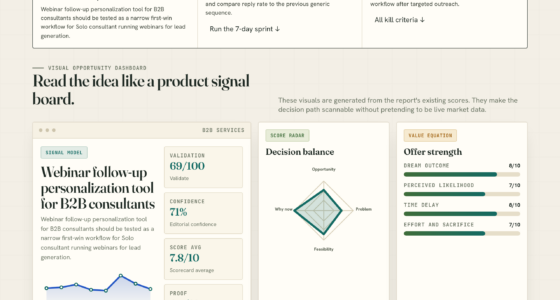

📊 Full opportunity report: Is The $400 Million Public AI Initiative A Strategic Sovereignty Move Or Political Theater? on ThorstenMeyerAI.com — validation score, market gap, and execution plan.
TL;DR
The $400 million public AI initiative has made limited tangible progress after 17 months, raising questions about its true purpose. Experts debate whether it aims to establish technological sovereignty or serve political interests.
The $400 million public AI initiative, launched 17 months ago with the goal of creating a public-interest AI infrastructure, has yet to produce significant tangible outputs, prompting questions about its true purpose. While some see it as a strategic move to build technological sovereignty, others view it as a political gesture or a largely symbolic effort.
Initially announced at the Paris AI Action Summit, the initiative was seeded with over $100 million from the French government and supported by a coalition including the Ford and MacArthur foundations, Google DeepMind, Salesforce, and others. The stated goal was to mobilize $2.5 billion over five years.
In the 17 months since launch, the organization has disbursed only $3.2 million across four projects, representing less than 1% of its commitments. Notable outputs include Suno Sutra, an offline AI device supporting 22 Indian languages, and Alpha Chat, an open-source chatbot. However, the organization emphasizes that initial phases focused on governance and strategy, not large-scale deployment.
Critics argue that the slow disbursement rate indicates a failure to translate commitments into tangible results, raising concerns about whether the initiative is merely symbolic or genuinely aimed at building public-interest AI infrastructure. Supporters contend that establishing governance and foundational artifacts is a necessary first step, and that the real impact will emerge as projects mature.
A public option for AI:
infrastructure or theater?
Current AI: ~$100M French seed, $400M+ committed, ten Paris Charter countries, a $2.5B five-year target — and, seventeen months in, $3.2M actually granted. Both steelmen at full strength; verdict deferred to a dated test.
Three verbs, three very different numbers
Bars to scale against the $2.5B target. The disbursement curve is the test of a funding vehicle — and every verb above is doing different work. (Fair note: the org’s own first six months were an explicit governance start-up phase; commitments were never claimed as disbursements.)
What has actually shipped
Funder list worth naming: the public alternative to Big Tech is part-funded by Google DeepMind and Salesforce — a governance question answerable only in artifacts, not charters.
Two European routes, same clock
Public route · Current AI
- ~$100M state seed → $400M+ committed → $3.2M granted in 17 months
- Output: governance framework, two open artifacts, ten charter signatures
- Ownership: everyone. Suno Sutra belongs to the commons.
Private route · Prior Labs
- €9M pre-seed → Nature paper + SOTA model in 18 months → €1B+ committed by SAP, closed in ten weeks
- Output: a frontier lab, shipping
- Ownership: SAP’s shareholders. Velocity’s price.
The velocity comparison isn’t as one-sided as it looks: for a public option, “who owns the result” is the metric — and only one route answers “everyone.”
- Disbursement: cumulative grants ≥ ~25% of the $400M, and a real second government tranche toward the $2.5B.
- Adoption: one load-bearing artifact — a dataset in production model cards, devices at population scale, a tool with a living developer community.
- Independence: at least one funded thing its corporate funders would prefer it hadn’t. The only observable proof a public option is public.
Pass two of three: the strongest answer yet to how Europe funds AI it controls. Fail two of three: €100M tuition for the lesson Prior Labs taught for €9M.
Implications for AI Sovereignty and Public Policy
This initiative’s progress, or lack thereof, has implications for AI sovereignty in Europe and other regions, especially given the involvement of major tech companies and governments. If successful, it could serve as a model for public-interest AI development, reducing dependence on private tech giants. Conversely, if it remains symbolic, it risks being a political gesture with limited practical impact.
The debate touches on broader issues of public control over AI infrastructure, data sovereignty, and the role of government funding in shaping technological futures. The outcome will influence policy directions and international AI governance standards.

The FPGA Programming Handbook: An essential guide to FPGA design for transforming ideas into hardware using SystemVerilog and VHDL
As an affiliate, we earn on qualifying purchases.
As an affiliate, we earn on qualifying purchases.
Background of the Public AI Funding Effort
The initiative traces back to the Paris AI Action Summit, where France announced a pioneering effort to fund public-interest AI projects, aiming to counterbalance private tech dominance. The coalition grew to include multiple foundations, governments, and industry players, with a goal of mobilizing $2.5 billion over five years.
Initial funding focused on strategic planning, governance, and early prototypes, with the expectation that broader deployment would follow. Over time, the initiative has faced scrutiny due to slow disbursements and questions about its actual influence on AI development and governance.
Meanwhile, private sector efforts, such as SAP’s rapid development of AI models through Prior Labs, have demonstrated faster progress driven by profit motives, contrasting with the slower pace of public projects.
“Our goal is to create a public option for AI, open and free, modeled on the early web — progress takes time but foundational work is essential.”
— Ayah Bdeir, CEO of Current AI
AI research laptops for data science
As an affiliate, we earn on qualifying purchases.
As an affiliate, we earn on qualifying purchases.
Unclear Impact and Future Trajectory
It is not yet clear whether the initiative will accelerate significantly in the coming months or remain largely symbolic. The slow disbursement rate and limited outputs raise questions about its ability to realize its ambitious goals of building sovereignty infrastructure.
Additionally, the influence of major corporate funders like Google DeepMind and Salesforce on governance and project priorities remains a concern for critics questioning its independence.
offline AI devices supporting multiple languages
As an affiliate, we earn on qualifying purchases.
As an affiliate, we earn on qualifying purchases.
Next Milestones and Evaluation Criteria
The organization is expected to announce further project grants and progress reports over the next year. Key indicators of success include increased disbursement, tangible AI tools for public use, and clearer governance structures. The upcoming months will be critical in determining whether the initiative can fulfill its promise or remains a symbolic gesture.
As an affiliate, we earn on qualifying purchases.
Key Questions
What is the main goal of the $400 million public AI initiative?
The initiative aims to develop open, public-interest AI infrastructure to promote sovereignty, data privacy, and equitable access, countering private tech dominance.
Why has progress been so slow after 17 months?
The organization has focused on establishing governance, legal, and operational frameworks, with disbursements and outputs still in early stages, which critics see as a sign of limited impact so far.
Who funds the initiative, and does that influence its independence?
The initiative is funded by a coalition including governments, foundations, and major tech companies like Google DeepMind and Salesforce, raising questions about potential conflicts of interest and independence.
How does this initiative compare to private sector AI development?
Private efforts like SAP’s Prior Labs have demonstrated faster progress driven by profit incentives, whereas the public initiative emphasizes foundational work and governance, which typically takes longer.
What are the prospects for the initiative to achieve its goals?
Its future success depends on increased disbursements, project outputs, and governance transparency. The next 12 months will be critical for assessing whether it can move beyond symbolism.
Source: ThorstenMeyerAI.com