
📊 Full opportunity report: Listing Vacant Storefronts To Connect Small-Town Properties And Businesses on IdeaNavigator AI — validation score, market gap, and execution plan.

Get monitors, keyboards and dev gear delivered free — and shop member deals
- Fast, free delivery on millions of items
- Access to Prime Big Deal Days deals on October 6–7
- Prime Video, Amazon Music and more included
TL;DR
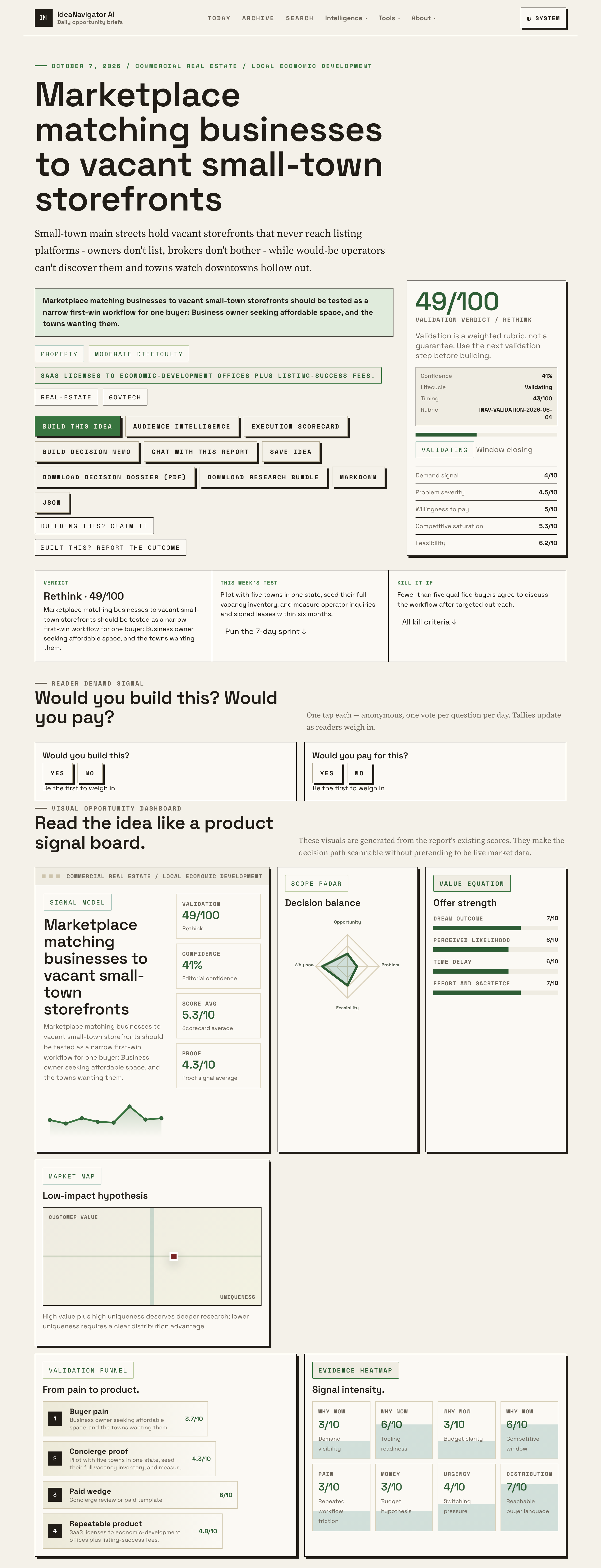
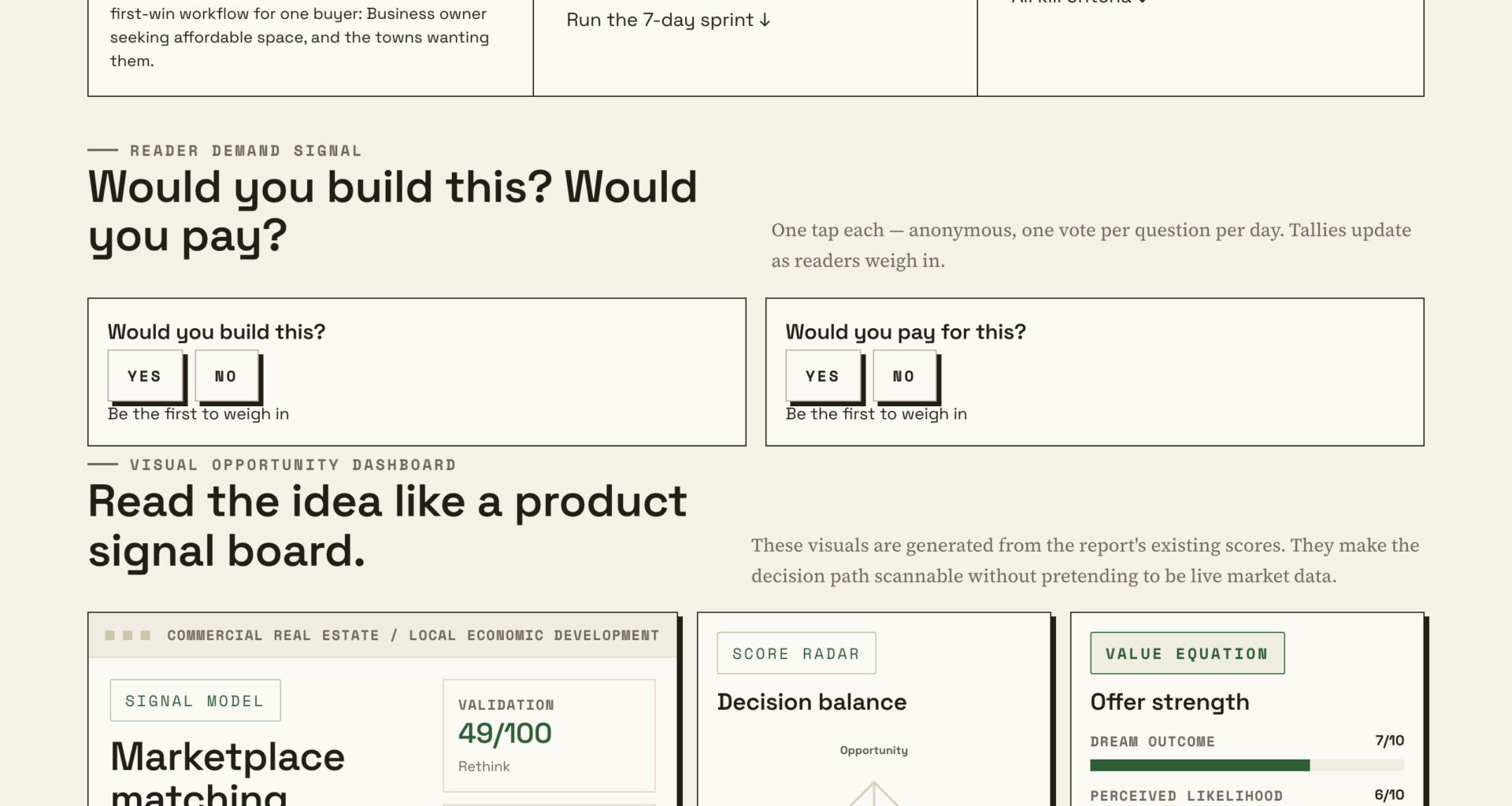
IdeaNavigator AI has proposed testing a marketplace that lists vacant small-town storefronts and connects interested business operators with property owners and local economic-development offices. The concept has not been described as an operating service or funded pilot; its suggested test would cover five towns in one state and track inquiries and signed leases over six months.
IdeaNavigator AI has proposed a marketplace that would list vacant storefronts in small towns and connect them with business operators seeking space. The concept would also route prospective matches to local economic-development offices, which could share available grants or other incentives; it is a proposal, not a confirmed operating platform or launched pilot.
The suggested service would let property owners and towns post storefront listings with details such as photographs, floor area, rent and incentive programs. Operators could browse locations using town profiles and foot-traffic data, then send inquiries through the marketplace. The proposal does not specify how that data would be collected, updated or verified.
Under the proposed workflow, a potential match would be sent to the local economic-development office, with relevant grant opportunities attached where available. The concept identifies economic-development offices as likely customers through SaaS licenses, while also suggesting fees tied to successful listings. No pricing, fee structure or customer commitments are provided.
To test the idea, IdeaNavigator AI recommends a pilot in five towns in one state. The proposed test would first compile a full inventory of vacant storefronts, then measure operator inquiries and signed leases over six months. The proposal gives no state, participating towns, launch schedule or target number of leases.
A Route From Empty Shops to Operators
The concept addresses an information gap: storefronts may be vacant without appearing on property-listing platforms, while prospective operators may not know which properties are available or whom to contact. If listings and inquiry routes are incomplete, a potential business can miss an affordable location and a town can have difficulty attracting tenants. The proposal is designed to bring those details into one place and connect searches with local contacts.
For small towns, the practical test would be whether the service produces more than a directory. Inquiries and signed leases are the proposed measures, but results would depend on accurate inventory, workable rents, interested operators and the availability of suitable properties. A listing service could make opportunities easier to find; it cannot by itself establish that a location is viable or that a business will open.
The proposed model also ties a commercial property search to local assistance. Linking listings to grant programs and development offices could help operators identify support alongside available space. Whether that connection leads to funding or completed leases is not established, and no outcomes have been reported.
vacant storefront listing platform
As an affiliate, we earn on qualifying purchases.
As an affiliate, we earn on qualifying purchases.
The Proposed Small-Town Pilot
IdeaNavigator AI frames the marketplace as a narrow initial workflow for two groups: business owners seeking affordable space and towns looking to attract businesses. Its stated problem is that some vacant storefronts are not listed publicly, leaving operators unable to discover them and local officials with persistent empty properties. The proposal does not provide a count of affected storefronts or evidence measuring the scale of the problem.
The idea’s timing rationale is that remote-work migration has renewed interest in small-town commercial areas and that economic-development offices have grant money intended for matching businesses with property. Those points are presented as the proposal’s case for testing the service; no migration figures, grant totals or named programs are supplied.
The suggested pilot is deliberately limited to five towns in one state, with a six-month measurement period. That design would allow organizers to assess whether owners provide listings and whether operators respond. The proposal does not state whether all vacancies would be included, how towns would be selected or how success would be judged beyond tracking inquiries and leases.
small town commercial property listings
As an affiliate, we earn on qualifying purchases.
As an affiliate, we earn on qualifying purchases.
Pilot Details Remain Unannounced
No operating marketplace, launch date or participating towns are identified in the proposal. It is not clear whether any economic-development offices or property owners have agreed to take part, whether grant funding has been secured, or who would build and maintain the service.
Several practical questions are also unanswered: how listing information and foot-traffic data would be checked, how often rents and availability would be updated, and how the platform would handle privacy and inquiries. The proposal does not define what counts as a successful match or lease, provide a budget, or explain how listing-success fees would work. Its claims about renewed small-town commercial interest and available grants are not accompanied by figures or named programs.
business startup grants for small towns
As an affiliate, we earn on qualifying purchases.
As an affiliate, we earn on qualifying purchases.
A Five-Town Test Is Proposed
The next step described is a five-town pilot in one state, beginning with a complete inventory of vacant storefronts. If organized, the test would track inquiries and signed leases for six months. No timetable has been announced, so it is not clear when or whether the pilot will begin.
For the proposal to move forward, towns and property owners would need to supply listings, and local development offices would need to confirm which grants or incentives can be attached. A later assessment could report how many listings were added, how many operators made inquiries and how many leases were signed. Until those details or results are available, the marketplace remains a proposed approach rather than a demonstrated solution.
Source: IdeaNavigator AI
As an affiliate, we earn on qualifying purchases.
Key Questions
Is the storefront marketplace already available?
No launch is reported. The marketplace is described as a proposal, and no operating service or launch date is identified.
Who would use the proposed service?
The concept is aimed at business operators looking for space, property owners with vacant storefronts and towns seeking to attract tenants. Economic-development offices would help route inquiries and share relevant incentives.
What information would storefront listings include?
The proposed listings would include photos, size, rent and incentive programs. Operators would also be able to browse using town profiles and foot-traffic data, though the proposal does not explain how that data would be verified.
How would the idea be tested?
IdeaNavigator AI suggests a six-month pilot across five towns in one state, starting with a full vacancy inventory and tracking operator inquiries and signed leases. No towns or start date have been announced.
Source: IdeaNavigator AI
Halloween Picks
halloween
As an affiliate, we earn on qualifying purchases.