TL;DR

Get business pricing on monitors, keyboards and dev gear
- Business-only prices and quantity discounts
- Tax-exempt purchasing
- Multiple users, one account, clear invoices
OpenAI launched a beta Business Hub on November 10, letting companies manage profiles, product feeds and aggregated visibility metrics in ChatGPT. Founder Francis Davidson said OpenAI acquired his travel startup Odessia, while media reports put OpenAI’s third-quarter revenue at about $10 billion and operating losses at $10.9 billion. The developments point to a push to make ChatGPT a place where users discover businesses, but the financial figures and the new tools’ reach have limits that remain unclear.
OpenAI launched a beta Business Hub in ChatGPT on November 10, giving companies tools to manage profiles, submit product information and track aggregated engagement, as founder Francis Davidson said OpenAI acquired his travel startup Odessia. The moves come as media reports put OpenAI’s third-quarter revenue at about $10 billion, a figure that has not been confirmed in published financial statements.
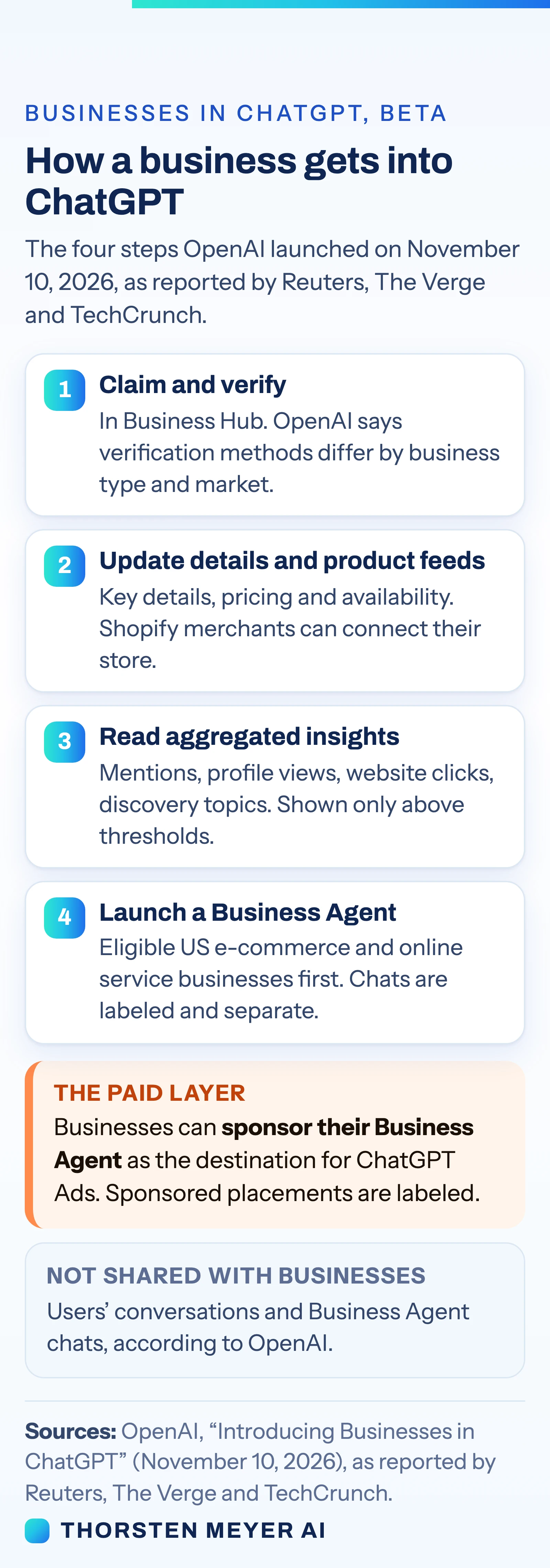
The Business Hub lets a company claim and verify its profile, update business details and provide product feeds containing prices and availability. According to OpenAI, as reported by Reuters and other outlets, the hub also provides aggregated measures including mentions in ChatGPT responses, profile views, website clicks and topics that lead users to the business. OpenAI has not publicly detailed its verification process.
A second feature, Business Agents, is available at launch to eligible e-commerce and online service businesses in the United States. Users who encounter a participating business in a ChatGPT response can open a separate conversation with its agent to ask about its offerings. Businesses supply the agent’s instructions and information. OpenAI says these conversations are labeled and separated from the main ChatGPT conversation.
OpenAI says it does not share users’ conversations or Business Agent chats with businesses. Business insights are aggregated and appear only after activity passes thresholds, though the company has not specified those thresholds. Businesses can sponsor their agents as destinations for ChatGPT ads, with sponsored placements labeled. Existing enterprise customers and advertisers can claim businesses through an OpenAI representative; Shopify merchants can connect through Business Hub or Shopify’s administration tools.
ChatGPT Becomes a Business Discovery Channel
The launch gives companies a direct way to supply information that may shape how ChatGPT describes their products and services. For users asking for recommendations or comparisons, accurate prices, availability and business details could make answers more useful. The reporting tools also give businesses a way to measure activity from ChatGPT, although mentions, views and clicks do not by themselves show whether users made purchases.
The features connect discovery with potential advertising. A business may provide information for ChatGPT to use and may also pay to sponsor its agent as an ad destination. That creates questions about how organic recommendations, business-provided details and sponsored placements will appear together. OpenAI says sponsored placements are labeled, but it has not described every aspect of how business information affects answers.
The reported revenue figure suggests substantial commercial scale, while the reported operating loss shows that revenue does not equal profit. Together, the product and financial developments offer a snapshot of OpenAI’s effort to expand its business model around ChatGPT, but they do not establish how much revenue these specific features will generate.
Products Worth Considering

Samsung Galaxy Tab S7 11-inch Android Tablet 128GB Wi‑Fi with S Pen Mystic Black

Sony WH-1000XM5 Premium Noise Cancelling Wireless Headphones – Midnight Blue

Samsung Galaxy Tab A11+ 8GB RAM, 256GB Storage, Gray
As an affiliate, we earn on qualifying purchases.
From ChatGPT Shopping to Business Profiles
OpenAI previously pursued direct checkout and commissions as part of an effort to make ChatGPT a shopping destination. TechCrunch reported that the effort did not gain traction and was retired in March. The Business Hub approach centers instead on business information, product feeds, referrals and conversations with company agents.
ChatGPT advertising also predates this launch. OpenAI said in August that its advertising business had reached a $1 billion annualized revenue run rate. That is a rate calculated from a period of activity, not a report of a full year’s advertising revenue. The company now says businesses can sponsor eligible agents as destinations for ChatGPT Ads.
Odessia’s founder, Francis Davidson, announced the acquisition and said he would join OpenAI. An OpenAI spokesperson confirmed his hiring to TechCrunch. The acquisition price and other terms were not disclosed. The Information first reported the roughly $10 billion third-quarter revenue figure; Bloomberg reported quarter-over-quarter growth of nearly 50%, citing a person familiar with the matter. Reuters reported, citing the Wall Street Journal, that operating losses widened to $10.9 billion over the same quarter.
Verification, Revenue and User Impact
OpenAI has not explained exactly how businesses will be verified, what activity thresholds apply to analytics, or how much influence product feeds have on ChatGPT recommendations. The company says user conversations are not shared with businesses, but has not provided further detail here about how business-submitted information is reviewed or how errors and disputes will be handled.
The financial figures are media reports, not published financial statements from OpenAI. The revenue estimate and reported operating loss describe different measures, and the sources cited do not provide a full accounting breakdown. The terms of the Odessia acquisition are also unknown. It is not yet clear how the startup’s technology or team will be integrated into OpenAI products.
The beta’s initial agent availability is limited to eligible U.S. e-commerce and online service businesses. OpenAI has not announced when the features will expand to other businesses or countries, nor has it said how many companies have joined.
Business Hub Beta Expansion
OpenAI’s next steps will be visible in how it expands Business Hub access and explains its verification, analytics and agent rules. Businesses will be able to claim profiles and connect supported product feeds during the beta, while eligible U.S. companies can offer agents in separate, labeled chats. OpenAI has not set out a broader availability timetable.
For readers and businesses, the practical test will be whether the profiles keep information current and whether the resulting recommendations and referrals produce useful outcomes. Future company disclosures or reporting may clarify OpenAI’s financial performance and the Odessia deal, but no acquisition terms or detailed third-quarter accounts have been released in the source material.
Key Questions
What did OpenAI launch for businesses in ChatGPT?
OpenAI launched a beta Business Hub where companies can claim profiles, update details, add product feeds and view aggregated measures such as mentions, profile views and website clicks.
What are ChatGPT Business Agents?
They are business-provided AI agents that eligible U.S. e-commerce and online service companies can offer in separate, labeled ChatGPT conversations. Users can ask about the company’s offerings.
Did OpenAI confirm $10 billion in third-quarter revenue?
No published financial statements confirm that figure. The Information reported revenue of about $10 billion, and Bloomberg reported nearly 50% growth from the prior quarter, citing a person familiar with the matter.
What is known about OpenAI’s Odessia acquisition?
Odessia founder Francis Davidson announced that OpenAI acquired the AI travel startup and said he would join the company. An OpenAI spokesperson confirmed his hiring to TechCrunch. The deal’s terms were not disclosed.
Source: Thorsten Meyer AI