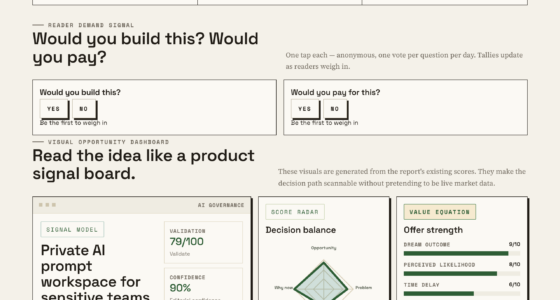
📊 Full opportunity report: Anthropic’s Bold Move: Watermarking To Differentiate Human And AI Text on ThorstenMeyerAI.com — validation score, market gap, and execution plan.

Get business pricing on monitors, keyboards and dev gear
- Business-only prices and quantity discounts
- Tax-exempt purchasing
- Multiple users, one account, clear invoices
TL;DR
Anthropic has confirmed that its Claude models will embed imperceptible watermarks and attach signed provenance data to support files. This move aims to improve AI content attribution, influenced by EU transparency rules, but detection limitations remain.
Anthropic has confirmed that its supported Claude models will embed imperceptible watermarks into generated text and attach signed provenance metadata to certain files, including images and vectors. This development aims to help identify AI-produced content globally, with compliance driven by recent European Union transparency regulations. For more details, see the original analysis.
According to Anthropic, when a supported Claude model generates text, it weaves a machine-readable watermark directly into the output, which does not alter readability or meaning. The watermark can remain detectable after copying or minor edits, though its durability is limited. Additionally, the company plans to attach digitally signed provenance metadata to files using the C2PA Content Credentials standard, recording origin and processing history. This metadata travels with the file but can be removed if the file is converted or stripped of its original format.
The marking system will be implemented across all supported Claude products, including Claude API, Claude Code, Claude Cowork, and Claude Tag, starting with models released in the European Union on or after August 2, 2026. This initiative is closely linked to EU regulations requiring AI providers to make synthetic content identifiable in machine-readable form, with compliance deadlines set for December 2, 2026. Learn more about Microsoft’s AI strategy. The company is working to extend support to earlier models and plans to apply the marking globally, not only within Europe. For context on AI watermarking practices, see the original analysis. The initiative is closely linked to EU regulations requiring AI providers to make synthetic content identifiable in machine-readable form, with compliance deadlines set for December 2, 2026.
Implications for AI Content Attribution and Regulation
This move by Anthropic could significantly impact how AI-generated content is identified and verified across industries, including publishing, education, and enterprise workflows. The watermark provides a technical method to distinguish AI-produced text from human writing, supplementing existing style-based classifiers. However, it does not offer definitive proof of authorship or how the content was used. The global rollout aligns with EU transparency laws, potentially setting a new standard for AI accountability worldwide, but technical limitations—such as resilience to editing and detection accuracy—remain to be tested.
AI content watermark detection tools
As an affiliate, we earn on qualifying purchases.
As an affiliate, we earn on qualifying purchases.
EU Regulations Drive Global AI Marking Standards
The European Union’s AI Act, effective from August 2, 2026, mandates that providers of certain AI systems include technical markings to identify synthetic content. This regulation aims to promote transparency and accountability in AI-generated material. Although initially targeted at EU markets, many companies, including Anthropic, are applying these standards globally to preempt regulatory divergence. The industry has previously relied on AI text classifiers, which analyze writing style but cannot conclusively prove authorship. The new watermarking approach offers a more direct, technical method of attribution, though its reliability and adoption are still under evaluation.
“Embedding imperceptible watermarks into AI output represents a significant step toward transparent content attribution, but technical challenges remain.”
— Thorsten Meyer, AI researcher
digital provenance metadata software
As an affiliate, we earn on qualifying purchases.
As an affiliate, we earn on qualifying purchases.
Technical Limitations and Detection Reliability Unclear
Anthropic has not publicly disclosed detailed technical specifications of the watermarking system, including its accuracy, false-positive rate, or resilience to editing. It remains uncertain how well the watermark survives common editing practices or whether detection tools will be publicly available. The effectiveness of the watermark in different content types, such as code or highly rewritten text, is also still under question.
AI-generated text verification tools
As an affiliate, we earn on qualifying purchases.
As an affiliate, we earn on qualifying purchases.
Upcoming Implementation and Industry Testing Phases
In the coming months, the industry will observe how Anthropic rolls out support for watermarking across all Claude models, especially older versions. Independent testing and verification tools are expected to emerge, evaluating the robustness and reliability of detection. Organizations using Claude through APIs or cloud services will need to assess how watermarking impacts their workflows and compliance practices. The December 2026 deadline for compliance with EU rules will likely prompt further technical developments and policy clarifications.
content attribution software for AI
As an affiliate, we earn on qualifying purchases.
As an affiliate, we earn on qualifying purchases.
Key Questions
Will the watermark be visible to users?
No. The watermark is designed to be imperceptible to readers and embedded within the text’s word choices, detectable only through specialized tools.
No. The presence of a watermark indicates that a supported Claude model generated the text, but it does not prove authorship of the entire document or how it was used.
Will detection tools be publicly available?
It is not yet clear whether Anthropic or third parties will release official detection tools or how accessible they will be to organizations.
Does the watermark affect the quality or readability of the generated text?
No. The watermark is designed to be imperceptible and not to alter the meaning or readability of the output.
Will this affect AI deployment outside the EU?
Yes. Anthropic plans to apply watermarking globally, regardless of regional regulations, making it a widespread standard for AI content attribution.
Source: ThorstenMeyerAI.com
Fall Picks
fall essentials
As an affiliate, we earn on qualifying purchases.