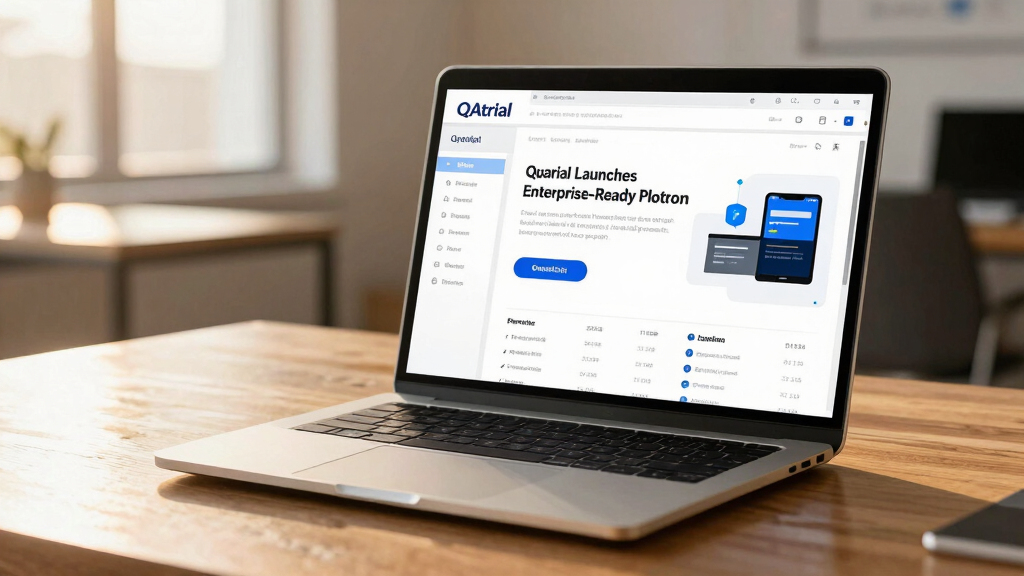

QAtrial Introduces Enterprise-Grade Open-Source Quality Management System
The latest release offers comprehensive features including Docker deployment, single sign-on, validation documentation, and seamless integrations for regulated industries.

Producing Open Source Software: How to Run a Successful Free Software Project
Used Book in Good Condition
As an affiliate, we earn on qualifying purchases.
As an affiliate, we earn on qualifying purchases.
Introduction of QAtrial v3.0.0: An Open-Source Solution for Quality Management
In April 2026, QAtrial announced the availability of its latest version, 3.0.0, marking a significant milestone in delivering a fully functional, enterprise-ready open-source platform tailored for quality management in regulated sectors. This release completes a strategic five-phase development process, evolving QAtrial from a prototype focused on requirements management into a robust, production-grade workspace equipped with a backend, containerized deployment, authentication, validation tools, and integration capabilities with popular engineering and quality tools.
Built on a stack comprising Hono, PostgreSQL, and Prisma, version 3.0.0 offers over 60 REST API endpoints, 15 database models, and JWT-based role management supporting five distinct access levels. With a single command, users can deploy the entire environment, which includes the application server, PostgreSQL 16 database, and static file hosting, all configured with health checks and persistent storage volumes by default.
Docker deployment tools for QA systems
As an affiliate, we earn on qualifying purchases.
As an affiliate, we earn on qualifying purchases.
Core Features and Functionalities
Unified Single Sign-On (SSO) Support
QAtrial now seamlessly integrates with identity providers such as Okta, Azure AD/Entra ID, Auth0, Keycloak, and Google Workspace. When users log in for the first time, they are automatically provisioned with roles based on configurable defaults, removing the need for manual account setup, especially for organizations with existing identity management systems.
Built-In Validation Documentation
The new release includes five comprehensive validation documents: an Installation Qualification with nine test steps, an Operational Qualification with eighteen steps, a Performance Qualification template, a Compliance Statement aligning QAtrial with 21 CFR Part 11 (covering fifteen sections), EU Annex 11 (covering seventeen sections), and GAMP 5 Category 4. Additionally, a Traceability Matrix links 75 regulatory requirements directly to specific features and associated test identifiers.
Pre-Configured Compliance Packs
Four ready-to-use compliance packs are included: FDA Software Validation aligned with GAMP 5, EU MDR Medical Device Quality Management System, FDA Good Manufacturing Practice (GMP) Pharmaceutical Quality, and ISO 27001 with GDPR. These packs automatically populate the setup wizard with relevant country, industry, modules, and project type details, simplifying initial configuration.
Webhook Events and Integration Options
Fourteen webhook triggers are supported, covering events such as requirement modifications, test failures, CAPA process transitions, approval requests, electronic signatures, and evidence uploads. Payloads are secured with HMAC-SHA256 signatures. The platform also offers bidirectional synchronization with Jira Cloud, along with GitHub pull request linking and test result import from continuous integration pipelines, accessible through the settings interface.
Audit Mode for External Review
Administrators can generate time-limited, read-only links (valid for 24 hours, 72 hours, or seven days) that grant auditors access to a comprehensive seven-tab view of the project. This includes overviews, requirements, testing, traceability, evidence, audit trail, and signatures, all without requiring user login credentials.
single sign-on (SSO) authentication solutions
As an affiliate, we earn on qualifying purchases.
As an affiliate, we earn on qualifying purchases.
Open-Source Commitment for Quality Management
“For too long, quality management software has been locked behind expensive licenses,” commented the QAtrial team. “Regulated organizations—particularly small and medium-sized manufacturers, biotech firms, and software developers—deserve tools that are transparent, auditable, and affordable. By releasing QAtrial under the AGPL-3.0 license, any organization can deploy a validated quality workspace on their own infrastructure at no license cost, and auditors can review the source code that maintains their compliance records.”

Extending Gemini CLI: A Developer's Guide to the Model Context Protocol (MCP), Building Custom Tools, and Integrating Private Enterprise APIs
As an affiliate, we earn on qualifying purchases.
As an affiliate, we earn on qualifying purchases.
Market Landscape and Industry Relevance
The worldwide market for quality management software is forecasted to surpass $12.5 billion by 2028. Rising regulatory demands, such as the FDA’s Quality Management System Regulation (QMSR) effective from February 2026, which mandates adherence to ISO 13485, continue to influence industry practices. The FDA reports a 115% increase in medical device recalls over the past decade, emphasizing the need for robust yet accessible compliance systems.
QAtrial addresses these needs by offering a platform supporting ten industry sectors—including pharmaceuticals, biotech, medical devices, clinical research organizations, laboratories, logistics, software, cosmetics, aerospace, and environmental sectors—and covering 37 countries. Its modular architecture comprises fifteen quality modules, such as audit trail, electronic signatures, CAPA, risk management, and supplier qualification, tailored to diverse regulatory environments.
Immediate Availability and Deployment Instructions
QAtrial version 3.0.0 is now accessible on GitHub at https://github.com/MeyerThorsten/QAtrial, licensed under AGPL-3.0. To deploy the platform, clone the repository, set up the environment, and run the containerized environment with a single command:
git clone https://github.com/MeyerThorsten/QAtrial.git
cd QAtrial
cp .env.example .env
docker-compose up
The system can be reached at http://localhost:3001 within minutes of deployment.
Official Website and Documentation Resources
The QAtrial team maintains a dedicated portal at https://qatrial.com/. This site provides extensive documentation, deployment instructions, feature overviews, and community support resources. It offers detailed explanations of compliance starter packs, validation materials, and integration options, enabling organizations to evaluate QAtrial’s capabilities before initiating deployment.
About QAtrial
QAtrial is an open-source platform designed to facilitate quality management processes in heavily regulated industries. Its features include requirements tracing, test management, risk evaluation, CAPA tracking, electronic signatures, and comprehensive audit trails, all accessible through a multilingual interface supporting twelve languages. The platform covers ten industry verticals across 37 countries and offers four predefined compliance packs. An AI assistant supports test case creation, risk assessment, gap analysis, CAPA recommendations, and requirement validation, leveraging multiple large language models such as Anthropic, OpenAI, and local Ollama deployments. The project comprises over 130 source files and exceeds 25,000 lines of TypeScript code.
Website: https://qatrial.com/
GitHub: https://github.com/MeyerThorsten/QAtrial
License: AGPL-3.0
Key Facts
- QAtrial version 3.0.0 introduces Docker deployment, SSO, validation documentation, webhooks, and Jira/GitHub integrations.
- The platform is licensed under the AGPL-3.0 license, enabling free self-hosting and source code inspection.
- Supports multiple identity providers including Okta, Azure AD, Auth0, Keycloak, and Google Workspace.
- Includes five validation documents and four compliance starter packs to streamline setup for regulated industries.
- Provides extensive webhook support and integration options for requirement changes, test failures, and evidence uploads.
“”Historically, quality management software has been tied to costly licensing models,” said the QAtrial team. “Organizations working within regulated environments—especially smaller manufacturers, biotech companies, and software developers—deserve tools that are open, transparent, and affordable. By releasing QAtrial under the AGPL-3.0 license, organizations can deploy a validated quality management system on their own infrastructure at no licensing expense, with full visibility into the source code used for compliance.””
— QAtrial development team
Availability
QAtrial v3.0.0 is accessible immediately via GitHub at https://github.com/MeyerThorsten/QAtrial. To start using the platform, clone the repository, configure environment variables, and launch the containerized environment with a single command:
git clone https://github.com/MeyerThorsten/QAtrial.git
cd QAtrial
cp .env.example .env
docker-compose up
The system will be operational at http://localhost:3001 shortly after deployment.
About
QAtrial is an open-source, AI-augmented quality management system tailored for regulated sectors. It integrates requirements management, testing, risk analysis, CAPA, electronic signatures, and audit trail functionalities within a unified platform. Supporting twelve languages and ten industry verticals, QAtrial covers 37 countries and offers four compliance starter packs. Its AI co-pilot assists in test case development, risk classification, gap analysis, CAPA recommendations, and requirement validation, utilizing multiple large language models including Anthropic, OpenAI, and local Ollama instances. The project includes more than 130 source files and over 25,000 lines of TypeScript code.
Website: https://qatrial.com/
GitHub: https://github.com/MeyerThorsten/QAtrial
License: AGPL-3.0
Frequently Asked Questions
How can I deploy QAtrial v3.0.0?
You can clone the GitHub repository at https://github.com/MeyerThorsten/QAtrial, copy the environment template, and run docker-compose up. The platform will be accessible at http://localhost:3001 within minutes.
What are the main features included in this release?
Key features include Docker deployment, single sign-on support with major identity providers, validation documentation, webhook event handling, Jira and GitHub integrations, and pre-configured compliance packs for various industry standards.
Is QAtrial suitable for regulated industries?
Yes, QAtrial is designed specifically for regulated sectors such as pharmaceuticals, medical devices, biotech, and software, supporting compliance with standards like 21 CFR Part 11, EU Annex 11, GAMP 5, ISO 13485, and GDPR.
Under what license is QAtrial released?
The platform is distributed under the AGPL-3.0 license, allowing organizations to deploy, modify, and review the source code freely.
Where can I find more information and documentation?
Visit the official website at https://qatrial.com/ for detailed guides, feature overviews, and community resources.