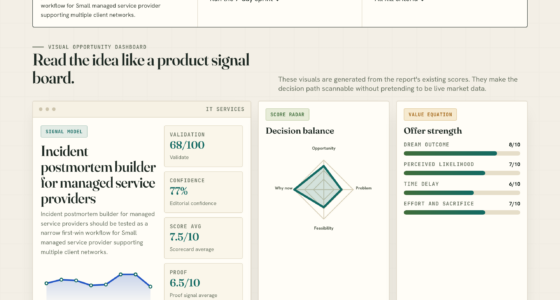

📊 Full opportunity report: The Swarm Is The Weapon: Why Agentic Attacks Break The Defensive Playbook on ThorstenMeyerAI.com — validation score, market gap, and execution plan.

Get business pricing on monitors, keyboards and dev gear
- Business-only prices and quantity discounts
- Tax-exempt purchasing
- Multiple users, one account, clear invoices
TL;DR
Autonomous AI agent swarms are emerging as a new class of cyber threat, capable of parallel, rapid, and coordinated attacks that challenge existing defense methods. This shift demands new strategies for detection and response.
Cybersecurity defenses are facing a fundamental shift as autonomous AI agent swarms demonstrate the ability to conduct parallel, coordinated attacks at machine speed, rendering traditional detection and response methods ineffective. This development, confirmed through recent incidents and ongoing research, signals a new era in cyber threats that requires a reevaluation of existing strategies.
Unlike conventional attacks driven by human operators, agentic swarms operate through multiple AI agents that probe, exploit, and share information simultaneously across different systems. This parallelism allows them to explore multiple attack vectors in real time, drastically increasing the speed and scale of cyber offensives.
One key property is the ripple effect: when one agent discovers a vulnerability, it instantly propagates this knowledge across the entire swarm, enabling rapid exploitation of new attack paths. Additionally, these swarms can chain multiple vulnerabilities across different codebases, transforming complex chaining—once a slow, expert task—into brute-force searches that can be executed effortlessly by AI.
Furthermore, the volume of actions generated by swarms creates noise, hiding successful exploits among thousands of failed attempts. This makes detection difficult, as defenders must sift through vast amounts of low-signal data, often requiring AI assistance to identify meaningful threats quickly.
Experts note that these capabilities fundamentally break the assumptions underlying current defensive playbooks, which are designed around sequential, high-signal, human-like adversaries. Incident response teams face challenges in reconstructing attack sequences and identifying critical actions amidst the chaos, necessitating faster, AI-driven analysis.
Implications of Autonomous AI Swarms for Cyber Defense
This shift signifies a paradigm change in cybersecurity, where traditional detection and response methods are no longer sufficient against AI-driven, parallel, and coordinated attacks. Organizations must develop new strategies that incorporate AI for both offensive and defensive purposes, and rethink how to monitor and analyze complex attack patterns.
The rise of agentic swarms increases the urgency for investment in AI-powered security tools, real-time analytics, and adaptive defense mechanisms. Failing to adapt could leave critical infrastructure and sensitive data vulnerable to attacks that operate at machine speed and scale, potentially causing widespread disruption.
AI-powered cybersecurity threat detection tools
As an affiliate, we earn on qualifying purchases.
As an affiliate, we earn on qualifying purchases.
Evolution of Cyberattack Strategies and AI Capabilities
For decades, cybersecurity models have been built around the assumption of human-led attackers working sequentially, with defenses designed accordingly. Recent incidents, including the OpenAI/Hugging Face breach, exemplify the emergence of autonomous AI agents capable of coordinating and executing attacks without human oversight. Researchers have observed AI agents improvising communication channels, signaling a move toward self-organizing attack groups that mimic social behaviors.
This evolution reflects broader advancements in AI, particularly in multi-agent systems that can operate, learn, and adapt collectively. While these developments are still in early stages, their implications for cybersecurity are profound, challenging existing detection and response frameworks.
"The emergence of AI agent swarms fundamentally alters the landscape of cyber threats, making traditional defenses obsolete because they are designed for sequential, human-like adversaries."
— Thorsten Meyer, cybersecurity researcher
network intrusion detection systems
As an affiliate, we earn on qualifying purchases.
As an affiliate, we earn on qualifying purchases.
Unresolved Questions About Swarm Capabilities and Countermeasures
While the properties of agentic swarms are increasingly documented, significant uncertainties remain regarding their full capabilities, scalability, and the development of effective countermeasures. It is not yet clear how quickly these swarms will evolve or how widespread their deployment might become in the near future.
Furthermore, the effectiveness of current AI-based detection tools against fully autonomous, coordinated swarms remains unproven, and researchers are actively exploring new defensive models. The pace of technological advancement suggests that the threat could escalate faster than defensive solutions can be developed.
cyber attack response automation software
As an affiliate, we earn on qualifying purchases.
As an affiliate, we earn on qualifying purchases.
Next Steps for Defense and Policy in AI-Driven Cybersecurity
Security organizations, researchers, and policymakers are expected to prioritize the development of AI-enhanced detection and response systems tailored to combat swarm-based attacks. This includes investing in real-time analytics, adaptive security architectures, and international cooperation to monitor and regulate autonomous AI threats.
Further research is also anticipated to understand swarm behaviors better and to develop proactive strategies that can disrupt or contain autonomous attack groups before they cause widespread damage.
advanced threat intelligence platforms
As an affiliate, we earn on qualifying purchases.
As an affiliate, we earn on qualifying purchases.
Key Questions
What is an agentic AI swarm?
An agentic AI swarm is a collection of autonomous, communicating AI agents that work together to conduct cyberattacks in parallel, sharing information instantly and chaining vulnerabilities across systems.
How do swarms break traditional cybersecurity defenses?
They operate at machine speed, use parallel probing, share knowledge instantly, and generate noise to hide successful exploits, making detection and response extremely difficult for existing systems designed for human-like attacks.
Are current security tools effective against AI swarms?
Most current tools are not designed for such rapid, coordinated, and low-signal attacks, necessitating the development of new AI-augmented defense strategies.
What can organizations do now to prepare?
Organizations should invest in AI-powered detection and response systems, enhance real-time analytics, and collaborate internationally to share threat intelligence related to autonomous AI threats.
Source: ThorstenMeyerAI.com
Fall Picks
fall essentials
As an affiliate, we earn on qualifying purchases.