
This checklist is for developers and QA teams building a practical toolkit for testing APIs and the hardware connections around them. Start with the interfaces your work actually touches, then choose tools that make those connections easier to inspect and troubleshoot. Match tools to your setup before adding them to your kit.

Get business pricing on monitors, keyboards and dev gear
- Business-only prices and quantity discounts
- Tax-exempt purchasing
- Multiple users, one account, clear invoices
The sections are organized by tool type, from USB testing to Ethernet and serial connections. Each section explains why the slot matters, common selection pitfalls, and what to check for compatibility. Some slots include a named pick; others offer selection guidance without a specific product. Use the product names as starting points, and confirm the relevant device and connector details.
Read each section alongside your test environment: identify the port, protocol, and device you need to work with, then check the tool’s connector and intended role. If a detail is not clear from the product name, verify it with the manufacturer or seller before relying on it. Build around your actual test cases and add tools as those needs become clear.
USB Protocol Analyzer
A USB protocol analyzer can help make USB behavior easier to examine during testing. The right choice depends on the devices and connections in your test setup, so begin by identifying the USB connector and the kind of traffic you need to inspect. A tool selected only because it is labeled for USB may not fit the specific job. Check the interface and intended use before choosing.
The listed pick is the ChargerLAB Power-Z KM003C USB-C Charging Tester. Its name identifies it as a USB-C charging tester, which is a narrower description than a general-purpose protocol analyzer. Consider whether a charging tester suits the test case you have in mind, and confirm its capabilities from product documentation. Do not assume that a tester for charging covers every USB protocol analysis need. Confirm the function you need and the connector arrangement before adding it to your workflow.
What to look for:
- Confirm the USB connector type on the device under test.
- Check that the tool’s documented function matches the test case.
- Verify how the tester connects in your current setup.
- Review product documentation for supported devices and use cases.
ChargerLAB Power-Z KM003C USB-C Charging Tester
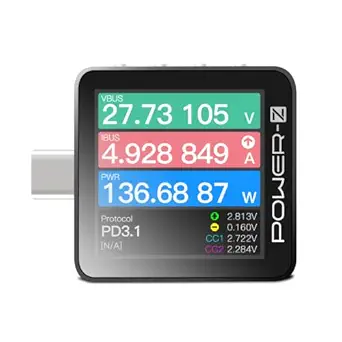
A USB-C tester for measuring voltage, current, capacity, and energy, and for checking E-markers, PDOs, and charging protocols. It supports up to 50 V and 6 A, features a 1.54-inch rotating LCD, and connects to a PC for data analysis.
Pros:
- Supports multiple electrical, capacity, and protocol tests
- Handles up to 50 V and 6 A
- Large rotating display and PC software support
Cons:
- Designed for USB-C testing, limiting compatibility with other connector types
- PC software and manual must be obtained from the official website
Best for: Teams checking USB-C charging behavior
Not ideal for: Test cases requiring unverified protocol analysis features
Bottom line: Consider this pick when its documented charging-test functions match your USB-C test case.
Programmable USB Hub
A programmable USB hub can be useful when testing depends on controlling how connected USB devices are presented or managed. Start by listing the devices you need to connect and the behavior your tests must exercise. Hub labels can sound similar while describing different capabilities, so look for documentation that explicitly covers the controls your test workflow needs. Define the control requirements first.
No specific product is named for this slot, so select by compatibility and documented behavior rather than appearance alone. Check the host connection, downstream port types, and whether the hub supports the control features you intend to use. Confirm that its power arrangement is suitable for the devices in your setup, and consider whether its physical layout works with your bench or enclosure. Match ports, power, and controls to the test environment before standardizing on a hub.
What to look for:
- A host connector compatible with your test system.
- Downstream port types that match the devices under test.
- Documented programmable controls that fit your test cases.
- A power arrangement suitable for the connected devices.
- A physical layout that works with your bench setup.
USB-C Power Meter
A USB-C power meter provides a way to check power-related behavior in a USB-C setup. Before selecting one, identify the connection path and the measurements your test work requires. A meter that fits physically may still be a poor match if its documented functions do not cover the checks you need. Start with the measurements your workflow calls for.
No product is named for this slot, so compare devices using their documentation and connector details. Check the USB-C connections on both sides, how the meter fits between the source and device, and whether its stated measurement capabilities suit your test case. Consider clearance and cable routing if the meter will sit in a crowded bench setup. Avoid assuming that every USB-C meter supports the same functions or works with every combination of equipment. Verify the measurement scope and fit before using one as a standard test tool.
What to look for:
- USB-C connections that match the source and device.
- Documented measurements relevant to the intended test.
- A connection path that fits the equipment under test.
- Physical clearance for the meter and attached cables.
- Clear compatibility information for the planned setup.
Ethernet Loopback Adapter
An Ethernet loopback adapter can support connection checks when its interface matches the device and test path. The listed pick is Ethernet Adapter for Fire TV Stick – Micro USB to RJ45. Its name describes an adapter with a Micro USB connection and an RJ45 connection, so first confirm that those interfaces match the equipment involved. Check both ends of the connection before treating it as a fit.
The name identifies an Ethernet adapter, but it does not establish that the product performs a loopback function. Review the product documentation for the exact role it supports and whether it suits the test you plan to run. Check the device’s available port, the cable path, and any required compatibility details rather than assuming that an Ethernet connection alone provides loopback testing. Verify the intended function alongside connector fit before adding it to a test kit.
What to look for:
- A Micro USB port on the device where the adapter will connect.
- An RJ45 connection compatible with the planned network path.
- Documentation confirming the adapter’s intended function.
- Compatibility details for the device under test.
- A cable route that works with the test setup.
Ethernet Adapter for Fire TV Stick – Micro USB to RJ45

The Uelkr micro‑USB to RJ45 Ethernet adapter provides a plug‑and‑play wired connection for compatible streaming sticks, delivering reliable 10/100 Mbps speeds. Its aluminum alloy body dissipates heat during long sessions and includes two adhesive pads for secure mounting.
Pros:
- Plug‑and‑play – no drivers required
- Aluminum alloy design prevents overheating
- Includes adhesive tapes for stable mounting
- Provides a reliable wired connection to eliminate Wi‑Fi dropouts
Cons:
- Not compatible with USB‑C devices such as Chromecast with Google TV
Best for: Setups needing Micro USB to RJ45 connectivity
Not ideal for: Loopback tests without documented loopback support
Bottom line: Confirm both the connector fit and the documented function before using this adapter for loopback testing.
Serial to USB Adapter
A serial-to-USB adapter can bridge equipment with a serial connection to a USB-equipped computer or test system. The listed pick is SerialGuardX USB-C to RS232 DB9 Serial Adapter with 9-LED Indicators a. Its name specifies USB-C and RS232 DB9, so check that those are the exact host and device interfaces your setup requires. Match the serial standard and connector before selecting it.
Do not rely on a connector match alone: confirm the documented compatibility and intended use for the computer, operating system, and serial equipment involved. Check whether the adapter’s cable or connector arrangement will reach comfortably, and consider how the indicator lights fit into your troubleshooting workflow. The product name ends with an “a”; verify the exact listing and model details so you know which item you are evaluating. Confirm the exact model and setup requirements before putting it into regular use.
What to look for:
- A USB-C host connection compatible with your system.
- An RS232 DB9 connection matching the serial device.
- Documented compatibility with the computer and equipment.
- A cable and connector arrangement that suits the bench.
- An exact product listing and model identifier.
SerialGuardX USB-C to RS232 DB9 Serial Adapter with 9-LED Indicators and FTDI Ch

This USB-C to RS232 serial adapter features 9 status LEDs for real-time signal monitoring and comprehensive ESD, surge, and optical isolation protection. Designed for industrial automation, data acquisition, and legacy device connectivity, it ensures reliable, interference-free serial communication in demanding environments.
Pros:
- Provides real-time signal monitoring with 9 LEDs
- Offers comprehensive ESD, surge, and optical isolation protection
- Compatible with PC, Mac, and Linux systems
- Reliable for industrial automation and legacy device connections
Cons:
- Requires USB-C port; not compatible with older USB types
- Limited to a single port connection
- No included power plug
Best for: Setups connecting USB-C systems to RS232 DB9 equipment
Not ideal for: Devices requiring a different serial interface
Bottom line: Confirm the exact listing, compatibility, and USB-C to RS232 DB9 fit before choosing this adapter.
Network Tap Device
A network tap device is a distinct toolkit slot from a cable-making tool, so identify the function your test plan requires before choosing a product. The listed pick is Ethernet Crimping Tool Kit 10-in-1 Pass Through RJ45/RJ11 Network Tool. Its name describes a crimping tool kit for RJ45 and RJ11 connectors; it does not identify a network tap. Match the product to the slot before counting it as a tap device.
If you need a network tap, select a product whose documentation explicitly describes that function and confirms compatibility with the link and setup you intend to inspect. If you also need to prepare or terminate cables, the named crimping kit may be relevant for that separate task; check its connector support and contents in the product listing. Avoid assuming a cable tool provides network visibility or traffic access. Verify the intended role and keep the tap requirement distinct from cable preparation.
What to look for:
- Documentation explicitly identifying a network tap function.
- Compatibility with the network link under test.
- A connection layout that fits the test environment.
- For cable preparation, support for the connectors you use.
- A clear distinction between monitoring and crimping tasks.
Ethernet Crimping Tool Kit 10-in-1 Pass Through RJ45/RJ11 Network Tool Kit with

The AMPCOM 10‑in‑1 Ethernet crimping kit provides all essential tools for RJ45 and RJ11 termination, testing, and maintenance. It includes a high‑carbon steel crimper, network cable tester, punch‑down tool, wire strippers, extra blades, and a waterproof carrying bag for on‑site work.
Pros:
- Comprehensive 10‑piece set covers crimping, testing, stripping, and punch‑down tasks.
- Durable high‑carbon steel tools with gold‑plated connectors ensure reliable performance.
- Portable waterproof bag makes it easy to transport and use on site.
- Includes extra blades for long‑term use.
Cons:
- May be bulkier than single‑purpose tools, making storage less convenient.
Best for: Teams needing visibility into a network link
Not ideal for: Buyers treating a crimping kit as a tap
Bottom line: The named crimping kit is for cable work by its title; choose a documented network tap for this slot.
Build the kit in budget-first order by prioritizing the tools tied to your current test cases and existing ports. Confirm the required function and compatibility before committing to a specialized tool, then add the remaining categories as a real testing need arises. Spend first on verified fit for the equipment already in your workflow.
A useful toolkit is one that matches the connections you actually test and the functions your process requires. Keep product documentation close, double-check model details, and revisit the checklist when your devices or test cases change. Start with the essentials and let your testing needs guide the next addition.