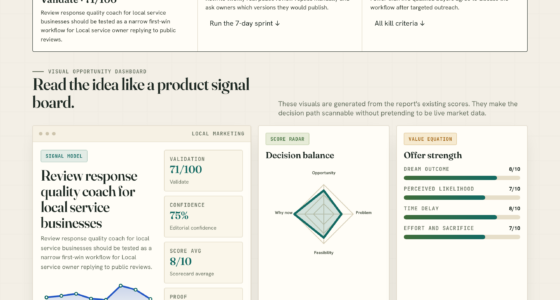

📊 Full opportunity report: Understanding Anthropic’s $965B Series H: The Compute Revolution on ThorstenMeyerAI.com — validation score, market gap, and execution plan.
TL;DR
Anthropic raised $65 billion in Series H funding, primarily to invest in hardware infrastructure like chips and data centers, not just company valuation. This move aims to support the massive compute demands of future AI models.
Anthropic announced a $65 billion Series H funding round, valuing the company at $965 billion. Unlike typical funding rounds, this capital is primarily allocated toward securing massive compute infrastructure—chips, memory, and power—to support the scaling of AI models like Claude.
The funding is driven by commitments from major chipmakers and hyperscalers, including over 10 gigawatts of compute capacity from companies like Amazon, Micron, Samsung, and SK hynix. This indicates a strategic focus on building physical infrastructure to overcome hardware bottlenecks in AI development.
Anthropic’s revenue surged from about $1 billion in late 2024 to a $47 billion annual run rate by early 2026, reflecting explosive demand for their AI models. Despite the valuation tripling from $380 billion to nearly a trillion dollars in a few months, the valuation multiple decreased from 27× to approximately 20.5×, signaling market confidence in real revenue growth rather than speculative valuation.
Major investors like Amazon have committed around $15 billion specifically for cloud infrastructure, chips, and data centers, underscoring the importance of physical hardware in future AI capabilities. The focus on hardware supply chains—especially high-speed memory and chips—highlights the shift toward infrastructure as a key determinant of AI scaling potential.
$965B and climbing — it’s really a compute bet
The viral headline is the valuation. The interesting story is in the press release’s middle paragraphs — and in three chipmakers Anthropic just named as strategic partners. This is a capacity round dressed as a funding round.
The numbers nobody can quite parse in sequence
Read together they describe a trajectory with no precedent in enterprise software. Read individually, each looks like a typo.

AI Chip Design: From Transistors to Neural Networks
As an affiliate, we earn on qualifying purchases.
As an affiliate, we earn on qualifying purchases.
From $61.5B to $965B in fourteen months
Salesforce took roughly two decades to reach revenue numbers Anthropic just blew past. The sequence below is the part most coverage skips — it’s not the size, it’s the shape.
Anthropic’s valuation ladder · Mar 2025 → May 2026
Five rounds, fourteen months. Bar height is the valuation; the climb itself is the story. Tap any milestone for context.

Tecmojo 1U Rack Mount 19 Outlet PDU Power Distribution Unit Circuit Breaker fits 19-inch AV/Network/Server Cabinet/Closet/Enclosure
Versatile and Space-Saving: This 1U Rack mount PDU features a compact design that allows for efficient use of…
As an affiliate, we earn on qualifying purchases.
As an affiliate, we earn on qualifying purchases.
The multiple actually got cheaper
Bubbles look like multiples expanding while revenue lags. Anthropic’s pattern is the inverse — the valuation tripled, but revenue grew faster, and the multiple compressed.
Revenue-to-valuation multiple · Series G → Series H
Same company, three months apart. The denominator (revenue) is outrunning the numerator (valuation) — exactly the opposite of what a bubble narrative predicts.

EPOCH HMA82GR7DJR8N-XN 16GB DDR4 3200 RDIMM ECC REG 2Rx8 CL22 PC4-25600 1.2V 288-PIN Server Module
DDR4 3200 RDIMM (FOR SERVERS)
As an affiliate, we earn on qualifying purchases.
As an affiliate, we earn on qualifying purchases.
10+ gigawatts and three chipmakers
When you name Micron, Samsung & SK hynix alongside your equity backers, you’re saying the binding constraint isn’t demand or model quality — it’s the physical supply of memory chips. The Series H is a capacity round.
Compute commitments backing Anthropic’s capacity bet
$200B+ in announced compute spend across multi-year contracts. The $65B Series H raise has to be read against that bill, not against operating losses.

The AI Data Center Race: No-Constraints Thinking for the Age of Compute
As an affiliate, we earn on qualifying purchases.
As an affiliate, we earn on qualifying purchases.
A genuinely durable bet — or a structural exposure?
Both readings can be true at once. The answer arrives over the next 18–24 months as the gigawatts come online and either fill with paying demand or don’t.
Revenue growth has no precedent in B2B software ($1B → $47B in 17 months). The multiple is compressing, not expanding. Claude is the only frontier model on all 3 major clouds. Enterprise AI spend share went from ~10% to >65% in a year. Compute commitments are tied to specific contracts with capacity dates.
20× revenue is not cheap by any historical software-investing standard. Revenue is reported gross of cloud-reseller pass-throughs, which inflates the top line. Profitability is 2 years out. Amodei’s own warning: a 12-month delay in AI progress “would make him bankrupt” — the compute commitments are a structural exposure to demand persistence.
The valuation race — and the IPO context
Anthropic shipped Opus 4.8 the same morning as Series H — not a coincidence. One week after OpenAI filed confidentially for IPO. The late-2026 frame is set: two frontier AI companies racing to public markets, each pitching durability.
Why Infrastructure Investment Defines AI’s Future
This funding round underscores a paradigm shift: AI companies are now heavily investing in physical infrastructure—chips, memory, and power—beyond software development. This approach aims to eliminate hardware bottlenecks that could limit the growth of large AI models, enabling a new era of AI performance and scalability.
By prioritizing infrastructure, Anthropic and its partners are positioning themselves to support models that require immense compute resources, which could accelerate AI capabilities but also introduce risks related to supply chain disruptions and hardware obsolescence. The strategic investments signal a long-term commitment to building the physical backbone necessary for AI’s next leap forward.
The Hardware Bottleneck in AI Growth
Traditionally, AI development focused on algorithms and datasets. Recently, the focus has shifted toward the physical infrastructure needed to run large models at scale. Anthropic’s rapid revenue growth and high valuation reflect increased demand for AI services, but this growth is constrained by hardware limitations such as chip supply, memory bandwidth, and power capacity.
Major chipmakers like Micron, Samsung, and SK hynix are now central to this effort, with commitments to supply the high-speed memory and chips required for AI training and inference. Previous industry developments, including Nvidia’s dominance in GPU hardware, highlight how hardware supply chains are critical to AI progress.
“Investing heavily in chips and data centers now is about building the physical foundation for AI’s future. Without this, scaling models at the desired level isn’t feasible.”
— An anonymous industry executive
Uncertain Aspects of Infrastructure Deployment and Risks
It remains unclear how quickly the hardware supply commitments will translate into operational data centers capable of supporting the scale of AI models Anthropic envisions. The potential for supply chain disruptions, hardware obsolescence, and delays in deployment pose risks to this infrastructure-centric approach. Additionally, the actual impact of these investments on AI model performance and scalability is still to be fully validated.
Next Steps in Infrastructure Expansion and Model Scaling
Anthropic and its partners are expected to accelerate the deployment of new data centers and hardware infrastructure over the coming months. Monitoring the progress of chip manufacturing, supply chain stability, and the performance of Claude at scale will be critical. Further announcements on infrastructure milestones and performance benchmarks are anticipated as the company advances its hardware-focused strategy.
Key Questions
Why is Anthropic investing so heavily in hardware infrastructure?
Anthropic believes that hardware bottlenecks—such as chip supply, memory bandwidth, and power capacity—are the main constraints to scaling AI models. Investing in physical infrastructure aims to eliminate these bottlenecks and support larger, more powerful models like Claude.
How does this funding round differ from typical AI investment rounds?
Unlike standard funding rounds focused on software development or user growth, Anthropic’s $65 billion raise is primarily aimed at securing hardware capacity—chips, memory, and data centers—making it a strategic infrastructure investment.
What are the risks associated with this infrastructure-focused approach?
The main risks include supply chain disruptions, hardware obsolescence, delays in deployment, and the significant upfront costs. These factors could impact the timeline and effectiveness of scaling AI models.
Will this infrastructure investment accelerate AI capabilities?
Yes, by providing the physical resources necessary for training and deploying larger models, this infrastructure push is expected to enable faster and more ambitious AI developments.
Who are the key partners involved in this infrastructure effort?
Major chipmakers like Micron, Samsung, and SK hynix, along with hyperscalers such as Amazon, are central to this initiative, supplying the hardware components and cloud capacity needed for AI scaling.
Source: ThorstenMeyerAI.com