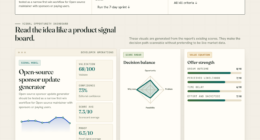

📊 Full opportunity report: India: Build the Rails First on ThorstenMeyerAI.com — validation score, market gap, and execution plan.
TL;DR
India has developed the world’s most extensive digital infrastructure—Aadhaar, UPI, and Direct Benefit Transfer—to deliver targeted benefits efficiently. This strategy emphasizes building scalable, low-cost rails first, rather than traditional welfare systems. The approach aims to reach nearly everyone, but the benefits remain modest, raising questions about last-mile inclusion.
India has constructed an extensive digital infrastructure—comprising Aadhaar, UPI, and Direct Benefit Transfer—that now reaches over a billion people, enabling direct delivery of benefits with minimal leakage. This approach, focused on building scalable, low-cost ‘rails,’ marks a departure from traditional welfare models used by wealthier nations, and aims to address the needs of a large, resource-constrained population.
The Indian government has developed the India Stack, a layered digital infrastructure starting with Aadhaar, the world’s largest biometric ID system, and extending through UPI, the largest real-time payments network, and Direct Benefit Transfer (DBT), which channels subsidies directly into bank accounts. These systems have facilitated the transfer of approximately ₹49–50 lakh crore directly to citizens, while reducing leakage by an estimated ₹3.48 lakh crore, according to government estimates.
This infrastructure enables targeted, efficient delivery of benefits such as subsidies, social security, and employment guarantees, primarily through digital identities and interoperable payment systems. The strategy emphasizes ‘plumbing’—the infrastructure—over the amount of benefits, which remain modest and targeted. For example, the rural employment guarantee scheme (MGNREGA) was expanded in late 2025 to provide 125 days of paid work per household annually, but the benefits are still focused on rural, unskilled workers with limited coverage.
India’s approach is rooted in the insight that, for resource-limited countries, building scalable, digital infrastructure is more feasible and effective than traditional welfare systems, which are costly and bureaucratic. The government is now extending this logic to AI, with initiatives like the IndiaAI Mission, aiming to develop inclusive, multilingual AI models for informal workers.
Build the Rails First
The Global South’s answer is infrastructure: the plumbing, not the payment. India built the world’s best welfare-delivery rails — thin benefits, but delivered to a billion-plus people, with the leakage squeezed out.
Aadhaar~1.42B biometric IDs
UPI payments + Jan Dhan accounts185B+ txns/yr · ~577M accounts
Direct Benefit Transfer (DBT)450+ schemes
Reaches 1.4B citizens directly~₹3.48L cr leakage squeezed out
Independent commentary, produced with AI assistance under human editorial oversight. The views are the author’s own and may change. This is analysis, not policy, economic, investment, or legal advice. Descriptions of Aadhaar, UPI, the JAM trinity and DBT, the rural employment guarantee and its 2025 successor act, the IndiaAI Mission, and BharatGen reflect publicly reported information as of mid-2026 and may change; figures are indicative and several are official self-reported estimates. This phase maps differing approaches and endorses none; characterizations of contested arrangements present competing views, not a verdict. Country, program, and company names are referenced for analysis and imply no affiliation.
Implications of India’s Infrastructure-First Welfare Model
India’s focus on building scalable digital infrastructure to deliver benefits directly has significant implications for social policy in resource-constrained settings. It demonstrates that effective delivery can be achieved with minimal expenditure on broad benefits, potentially transforming how large populations access social programs. However, the modest nature of benefits and potential exclusion issues highlight ongoing challenges in ensuring equitable inclusion and adequate support for all citizens.
This model offers a blueprint for other developing countries seeking cost-effective ways to reach large populations, emphasizing infrastructure over large benefit amounts. Yet, questions remain about how this approach can evolve to provide more comprehensive support as fiscal capacity grows and how to address exclusions caused by biometric lockouts or digital divides.

VeriMark Guard 2.1 USB-C Fingerprint Security Key
Supports FIDO2 biometric authentication services and FIDO U2F services requiring security key functionality. Secure and flexible authentication across…
As an affiliate, we earn on qualifying purchases.
As an affiliate, we earn on qualifying purchases.
India’s Digital Infrastructure and Welfare Strategy Development
Over the past decade, India has prioritized building a digital infrastructure—referred to as the India Stack—to leapfrog traditional welfare delivery mechanisms. Key components include Aadhaar, established in 2009 as the world’s largest biometric ID system; UPI, launched in 2016 as an interoperable payments platform; and Direct Benefit Transfer (DBT), rolled out to channel subsidies directly into bank accounts. These systems have collectively transformed social benefit delivery, reducing leakage and improving targeting.
Recent developments include the expansion of the rural employment guarantee scheme (MGNREGA) in late 2025, increasing paid work days, and the launch of the IndiaAI Mission, which aims to develop inclusive AI models for India’s diverse languages and informal workforce. These efforts signal a continued focus on infrastructure as the foundation for social programs, contrasting with traditional welfare models prevalent in wealthier nations.
While India’s infrastructure is considered world-class, the benefits delivered remain modest—targeted, thin, and primarily rural—highlighting the country’s resource limitations and strategic priorities.
“Our focus is on plumbing—ensuring benefits reach the right person—more than on the size of the benefits themselves.”
— Indian government official

Quarantine 2: Terminal
As an affiliate, we earn on qualifying purchases.
As an affiliate, we earn on qualifying purchases.
Challenges in Last-Mile Inclusion and Benefit Adequacy
It remains unclear how effectively the digital infrastructure will address last-mile exclusion issues, such as biometric lockouts or digital divides, which could prevent some citizens from accessing benefits. Additionally, the modest benefit amounts and limited coverage raise questions about whether this model can meet broader social needs as resource availability increases.
Further, the long-term impact of AI initiatives like IndiaAI on social welfare and employment is still uncertain, with ongoing developments and evaluations needed to assess effectiveness.

BioScrypt/L-1 Identity 4GFXS V-Flex 4G (S) Fingerprint Reader w/Secugen Sensor
As an affiliate, we earn on qualifying purchases.
As an affiliate, we earn on qualifying purchases.
Future Developments in India’s Digital Welfare Infrastructure
India is likely to continue expanding and refining its digital infrastructure, including further integration of AI tools and broader coverage of social programs. The government may also address exclusion issues by improving biometric systems and expanding digital literacy efforts. Monitoring the impact of recent scheme expansions, such as the increased rural employment guarantee, will be key in assessing the model’s effectiveness.
International interest in India’s infrastructure-first approach could lead to knowledge sharing or adaptation by other developing nations, while domestic debates may focus on balancing infrastructure development with increased benefit levels and inclusion measures.
![Free Fling File Transfer Software for Windows [PC Download]](https://m.media-amazon.com/images/I/41Vq6ZqHfjL._SL500_.jpg)
Free Fling File Transfer Software for Windows [PC Download]
Intuitive interface of a conventional FTP client
As an affiliate, we earn on qualifying purchases.
As an affiliate, we earn on qualifying purchases.
Key Questions
What is the core strategy behind India’s welfare approach?
India focuses on building scalable digital infrastructure—like Aadhaar, UPI, and DBT—to deliver targeted benefits directly to citizens, prioritizing plumbing over large benefit amounts.
How effective has India’s infrastructure been in reducing leakage?
According to government estimates, India’s digital systems have reduced leakage by approximately ₹3.48 lakh crore, making benefit delivery more efficient and targeted.
Are the benefits provided through this system sufficient?
Currently, the benefits are modest and targeted, focusing on rural and unskilled workers. The model emphasizes infrastructure over benefit size, which raises questions about adequacy for broader social needs.
What are the main challenges facing this approach?
Key challenges include potential exclusion due to biometric lockouts, digital literacy gaps, and ensuring benefits are sufficient and inclusive for all citizens.
India’s AI efforts aim to make welfare delivery smarter and more inclusive, but their long-term impact remains uncertain pending ongoing development and evaluation.
Source: ThorstenMeyerAI.com