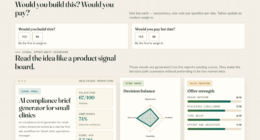

📊 Full opportunity report: The Model Is Only 10%: The Real Lesson of the New SDLC on ThorstenMeyerAI.com — validation score, market gap, and execution plan.
TL;DR
A recent whitepaper from Google reveals that AI models constitute only about 10% of the system’s behavior. The focus shifts to harnessing and verifying AI outputs, which are now the core skills for effective AI-driven development.
A new whitepaper from Google, authored by Addy Osmani, Shubham Saboo, and Sokratis Kartakis, states that the AI model accounts for only about 10% of a system’s behavior. Instead, the harness and verification processes determine the system’s effectiveness, shifting the focus from model development to configuration, testing, and context management. This insight challenges common assumptions in AI development and underscores where teams should invest effort.
The whitepaper, titled The New SDLC With Vibe Coding, highlights that the most significant shift in software engineering is moving from writing code to expressing intent and trusting machines to execute it. As of early 2026, approximately 85% of professional developers use AI coding agents regularly, with 51% doing so daily, and roughly 41% of new code generated by AI.
Crucially, the authors argue that the core of effective AI systems lies not in the model itself but in the harness—the prompts, tools, rules, and observability layers that surround it. Evidence from benchmarks shows that changing only the harness, with the same model, can significantly improve performance, sometimes by over 13 points on evaluation scores. This demonstrates that configuration and scaffolding are where most failures and improvements originate.
The paper also emphasizes that cost efficiency in AI development favors investing in harness and context engineering over chasing the latest model upgrades. While vibe coding appears inexpensive initially, it incurs high operational costs through token wastage, maintenance, and security vulnerabilities, making disciplined, structured approaches more economical in the long run.
The model is only 10%
A Google whitepaper argues software’s biggest shift is from writing code to expressing intent. Its sharpest claim: the model you obsess over is the smallest part of the system — the scaffolding around it does the real work.
The clearest map yet of how serious AI development works — and mostly tool-agnostic. But it’s a Google funnel: the concepts are neutral, the on-ramps point to Gemini, Jules & the ADK. If the harness is 90% and it’s yours, your moat and your costs both live there — so own your scaffolding, route across models, and remember: AI amplifies whatever engineering culture it lands in.
Why Focus on Harness and Verification Matters
This shift in understanding has profound implications for AI teams and organizations. By recognizing that 90% of behavior depends on configuration, companies can allocate resources more effectively, improving system robustness and reducing costs. The insight encourages a move away from model-centric strategies towards building durable, configurable systems that leverage the full potential of AI while managing risks and costs.
For practitioners, mastering harness design and verification processes becomes essential, transforming the skill set needed in AI development from model tuning to system architecture and context engineering. This approach promises more predictable, secure, and cost-effective AI deployment.
AI Model Risk Blueprint: Model Validation Testing | Ethical Considerations in AI Models | Integrating AI with Business Risk Plans | Real-World AI Model … Strategies | AI Governance Tools & Resource
As an affiliate, we earn on qualifying purchases.
As an affiliate, we earn on qualifying purchases.
Background on the Evolution of AI Development Practices
Historically, AI development focused heavily on training and improving models, with the assumption that the model’s quality dictated system performance. However, recent trends show that the rapid proliferation of AI tools has shifted the emphasis towards configuration, prompt engineering, and system integration. The whitepaper builds on this evolution, emphasizing that the real challenge is managing the entire system environment around the model.
Earlier in 2025, industry discussions centered on vibe coding—quick, less structured prompts—highlighting its limitations. Now, the focus is on moving towards agentic engineering, where AI operates within a framework of rules, tests, and guardrails, making the system more reliable and manageable.
This development aligns with reports that AI-generated code now constitutes 41% of new software, underscoring the need for disciplined, scalable approaches rather than ad hoc prompt tuning.
“The biggest shift in software engineering isn’t a new language or framework; it’s moving from writing code to expressing intent and trusting machines to execute it.”
— Addy Osmani
AI harness configuration software
As an affiliate, we earn on qualifying purchases.
As an affiliate, we earn on qualifying purchases.
Unresolved Questions About Implementation and Adoption
While the whitepaper emphasizes the importance of harness and verification, it remains unclear how quickly organizations will adopt these principles at scale. Specific strategies for transitioning from vibe coding to agentic engineering are still being developed, and the relative costs of re-engineering existing systems versus building new ones are not yet fully understood. Additionally, the impact on smaller teams or those with limited resources is still being evaluated.
AI observability and monitoring tools
As an affiliate, we earn on qualifying purchases.
As an affiliate, we earn on qualifying purchases.
Next Steps for AI Development and Industry Adoption
Organizations are likely to begin prioritizing system configuration, testing, and context engineering as core skills. Expect further research and case studies demonstrating how harness design improves performance and reduces costs. Industry leaders may also develop tools and frameworks to facilitate this shift, making disciplined system engineering more accessible. Monitoring how these practices influence AI reliability and security will be key in the coming months.
AI testing and verification platforms
As an affiliate, we earn on qualifying purchases.
As an affiliate, we earn on qualifying purchases.
Key Questions
Why is the model only 10% of the system’s behavior?
The whitepaper states that the majority of an AI system’s behavior depends on how the model is integrated, configured, and verified through prompts, tools, and guardrails, not just the model itself.
What is harness in AI systems?
Harness refers to the surrounding infrastructure—prompts, rules, tools, observability, and configuration—that guides and controls the AI model’s behavior.
How does this shift affect AI development costs?
Focusing on harness and verification can lower long-term costs by reducing token wastage, improving security, and increasing system reliability, despite higher upfront investment in system design.
What skills should AI teams prioritize now?
Teams should focus on system architecture, context engineering, verification, and configuration management rather than solely model tuning or prompt engineering.
Will this change how AI products are built?
Yes, organizations will likely adopt more disciplined, modular approaches, emphasizing system robustness and cost efficiency over chasing the latest model upgrades.
Source: ThorstenMeyerAI.com