
📊 Full opportunity report: Inside The AI World Of 'SINGULARITY': Particle Geometry Mapping Explained on ThorstenMeyerAI.com — validation score, market gap, and execution plan.
TL;DR
The ‘SINGULARITY’ project demonstrates advanced Particle Geometry Mapping techniques to craft immersive AI environments. This development highlights new possibilities in design and AI interaction, with technical details still emerging.
The ‘SINGULARITY’ project employs Particle Geometry Mapping, a groundbreaking technique that converts complex data structures into immersive visual environments, as detailed in the original analysis, marking a significant step in AI-driven design. This innovation is designed to challenge conventional notions of form and function, creating spaces that are both visually compelling and technically sophisticated.
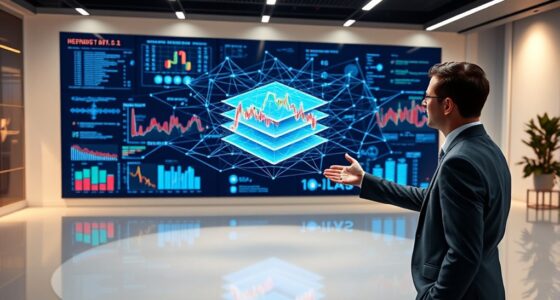
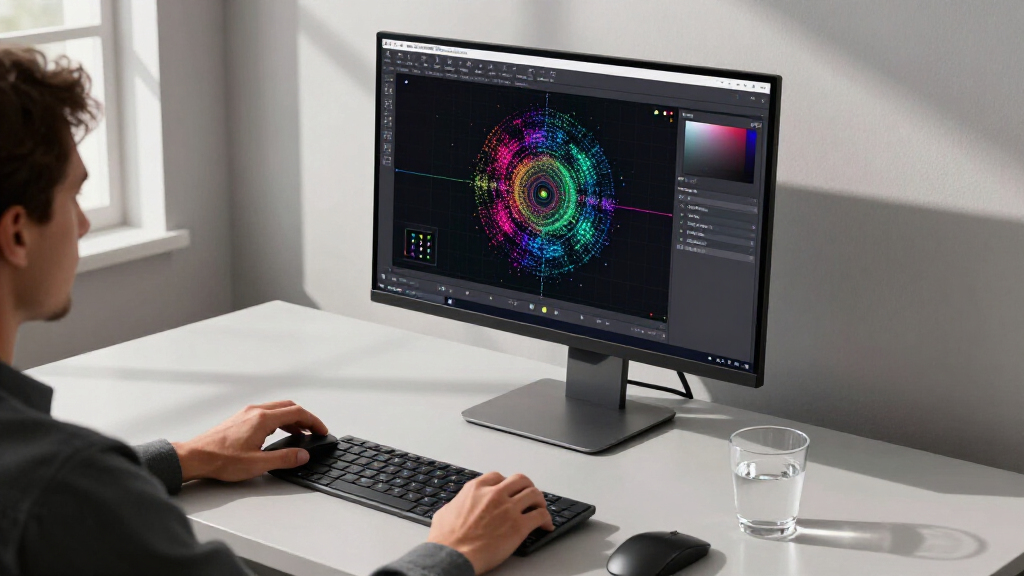
According to Thorsten Meyer, the ‘SINGULARITY’ space integrates Particle Geometry Mapping to transform abstract data into dynamic, three-dimensional visual structures. This method involves mapping data points onto geometric particles, which are then manipulated through algorithms to produce intricate spatial formations. The result is an environment that visually represents complex data relationships, offering an immersive experience for viewers and AI users alike.
Thorsten Meyer describes the process as a fusion of art, technology, and advanced algorithms. The project’s design process navigated significant technical challenges, including rendering high-density particle systems in real-time while maintaining aesthetic coherence. The final installation transforms a stark black room into a ‘visual symphony of data and geometry,’ creating a space that both stimulates curiosity and demonstrates the potential of AI in spatial design.
Inside the AI World of ‘SINGULARITY’
Particle Geometry Mapping turns abstract data into dynamic, three-dimensional formations—combining algorithmic structure, visual design and immersive spatial interaction.
‘SINGULARITY’ demonstrates an advanced visual method: data points become geometric particles, algorithms organize them into spatial formations, and the resulting environment makes hidden relationships explorable. The concept is compelling; key technical details remain undisclosed.
How data becomes an environment
Particle Geometry Mapping is presented as a pipeline rather than a single visual effect. Information is translated into particles, shaped through algorithmic rules and rendered as a coherent spatial experience.
Structure the data
Complex relationships are represented as points, values, categories or connections.
Map particles
Each data element receives geometric position, scale, density or visual behavior.
Apply algorithms
Rules manipulate the particle field into formations that reveal patterns and hierarchy.
Render the space
The formation becomes a dynamic environment designed for observation and interaction.
A fusion of data, art and AI
The project’s challenge is not merely to display more particles. It must preserve meaning, responsiveness and aesthetic coherence while transforming a stark black room into a visual field of data and geometry.
Data as material
Abstract structures become the raw material of the installation. Relationships can influence position, proximity, movement and density.
Algorithms as choreographers
Procedural rules organize particle behavior, balancing complex motion with the need for legible visual formations.
Space as interface
The viewer encounters information at environmental scale, shifting data interaction from flat screens toward embodied experience.
Beyond conventional visualization
Particle Geometry Mapping extends familiar data visualization principles into a continuous, spatial medium—but public evidence is not yet sufficient to confirm production-scale performance.
| Capability | Standard dashboard | Particle geometry environment | Evidence status |
|---|---|---|---|
| Represents complex relationships | ~ Charts and networks | ✓ Spatial particle formations | Concept described |
| Environmental immersion | ✗ Screen-bound | ✓ Room-scale experience | Project claim |
| Real-time responsiveness | ✓ Common in software | ~ Targeted capability | Benchmarks undisclosed |
| Scalability across datasets | ✓ Established patterns | ~ Still experimental | Validation pending |
| Public technical documentation | ✓ Widely available | ✗ Limited detail | Further release needed |
Status key: ✓ established or reported capability / ~ partial or developing / ✗ absent or not publicly demonstrated
What is known—and what is not
The broad design framework is clear. The implementation details needed for independent reproduction, benchmarking and peer review are still emerging.
The documented concept
- Abstract data is mapped onto geometric particles.
- Algorithms manipulate particles into spatial structures.
- The environment combines technical and artistic goals.
- High-density rendering created a major design challenge.
- The intended output is immersive and visually coherent.
The open technical questions
- Which algorithms generate and control the formations?
- What data sources and schemas drive the installation?
- What particle counts and frame rates are sustainable?
- How adaptable is the method across environments?
- Can the approach scale beyond an experimental project?
From raw signal to human meaning
The value chain connects machine-readable information to a spatial experience that viewers can perceive, explore and interpret.
Where the method could lead
If documentation, optimization and validation follow, the technique could influence several fields where complex information benefits from spatial expression.
Immersive analytics
Large, interconnected datasets could be explored as navigable structures rather than compressed into two-dimensional panels.
AI-assisted design
Generative systems could manipulate particle fields to produce adaptive environments, forms and spatial prototypes.
Virtual environments
Particle mappings could give virtual and mixed-reality users an intuitive way to encounter abstract relationships.
Art and architecture
Installations and built spaces could respond to live information while retaining deliberate visual composition.
Innovative Approach to Data-Driven Environments
This development matters because it exemplifies how advanced data visualization techniques can redefine spatial design and AI interaction. By translating complex information into tangible visual forms, ‘SINGULARITY’ pushes the boundaries of what AI-driven environments can achieve. It offers a glimpse into future applications where data becomes an integral part of immersive experiences, impacting fields from art to architecture and beyond.
3D particle visualization software
As an affiliate, we earn on qualifying purchases.
As an affiliate, we earn on qualifying purchases.
Evolution of AI in Design and Visualization
The concept of using data-driven visuals in immersive environments has been evolving over recent years, with projects increasingly blending artistic expression and technological innovation. ‘SINGULARITY’ builds on prior advancements in particle systems and real-time rendering, now applying these to create environments that serve both aesthetic and functional purposes. The technique of Particle Geometry Mapping has emerged as a key tool in this progression, enabling designers to translate vast data sets into spatial forms that are both meaningful and engaging.
This project reflects a broader trend in AI-assisted design, where algorithms are used to generate and manipulate complex visual data, leading to new forms of creative expression and interaction. It also highlights ongoing efforts to make AI environments more intuitive and visually compelling for users across disciplines.
“Particle Geometry Mapping allows us to convert abstract data into immersive spatial experiences, fundamentally changing how we interact with information.”
— Thorsten Meyer

TOPDON ONE Bidirectional Scan Tool, 10.1" Professional Diagnostic Tool
- Dual WiFi & Touchscreen: Fast wireless connection with a responsive display
- J2534 Pass-Thru Support: Enables dealer-level coding with OEM software
- OE Topology Mapping: Visualizes ECU network for precise diagnostics
As an affiliate, we earn on qualifying purchases.
As an affiliate, we earn on qualifying purchases.
Unconfirmed Aspects of Particle Geometry Mapping
While the technical framework of Particle Geometry Mapping is described in broad terms, specific details about the algorithms, data sources, and real-time rendering capabilities remain undisclosed. It is not yet clear how scalable or adaptable this technique is for different types of environments or data sets, and whether it can be widely implemented beyond this project.
Further technical validation and peer review are still pending, and the full scope of potential applications has yet to be demonstrated publicly.

Silkland 80Gbps Right Angle USB 4 Cable for Thunderbolt 5 Cable 240W 1.6FT
- High-Speed Data Transfer: 80Gbps bidirectional transfer rate
- Multi-Display Support: 120Gbps bandwidth for multiple displays
- Fast Charging Capability: 240W power delivery for quick charging
As an affiliate, we earn on qualifying purchases.
As an affiliate, we earn on qualifying purchases.
Future Developments and Broader Applications
The next steps involve expanding the technical understanding of Particle Geometry Mapping through detailed documentation and academic dissemination. Additional showcase events or demonstrations are expected to reveal how this technique can be integrated into other AI-driven design projects, virtual environments, or data visualization tools. Researchers and designers are also exploring how to optimize the process for larger-scale implementations and real-time interactivity, which could significantly influence future AI environments in multiple industries.

Unreal Engine 5 VFX Cookbook: Production-ready recipes for Niagara, Niagara Fluids, Chaos, and cinematic rendering
As an affiliate, we earn on qualifying purchases.
As an affiliate, we earn on qualifying purchases.
Key Questions
What is Particle Geometry Mapping?
It is a technique that converts complex data structures into geometric particles, which are then manipulated algorithmically to create immersive visual environments.
How does ‘SINGULARITY’ use this technology?
The project uses Particle Geometry Mapping to transform abstract data into a visual, spatial experience, turning a black room into a dynamic environment of data and geometry.
Is this technique ready for widespread use?
While promising, the full technical details and scalability are still under development, and broader application remains in the experimental phase.
What are potential applications of Particle Geometry Mapping?
Potential uses include immersive data visualization, AI-assisted design, virtual reality environments, and artistic installations that require complex spatial representations.
Who developed this technique?
The technique was developed within the context of the ‘SINGULARITY’ project, with insights provided by Thorsten Meyer, emphasizing its innovative nature in AI and design.
Source: ThorstenMeyerAI.com