

To build your own blockchain in Python step-by-step, you’ll start by understanding cryptography fundamentals like hashing and digital signatures. Then, you’ll define the block structure, including data, timestamp, and hashes linking each block. Next, you’ll implement a consensus mechanism such as Proof of Work to secure the network. Finally, you’ll code the entire process, creating an immutable, decentralized ledger. Keep exploring these steps, and you’ll uncover how cryptography and consensus work together to power blockchain technology.
Key Takeaways
- Understand the fundamental blockchain components: blocks, hashes, previous block references, and cryptographic functions.
- Learn to implement hash functions and link blocks securely using cryptography libraries like hashlib.
- Incorporate consensus mechanisms such as Proof of Work to simulate network validation.
- Develop functions to create, add, and validate blocks, ensuring the chain’s integrity.
- Test and refine your Python code to build a functional, tamper-proof blockchain step-by-step.

Creating your own blockchain in Python is an excellent way to understand how this revolutionary technology works under the hood. At its core, a blockchain relies heavily on cryptography fundamentals to secure data and guarantee integrity. You’ll need to grasp concepts like hashing, digital signatures, and encryption to build a trustworthy system. Hash functions, for example, generate a fixed-size string from data, making each block uniquely identifiable. When you link blocks together, you’ll use these hashes to create an unbreakable chain—any change in a block alters its hash, alerting everyone to tampering. Understanding cryptography fundamentals isn’t just theoretical; it’s essential for creating a secure and tamper-proof ledger.
Building a blockchain in Python teaches cryptography essentials like hashing and ensuring data integrity.
Next, you’ll explore into consensus mechanisms, which are crucial for maintaining agreement across distributed nodes. These mechanisms determine how your blockchain agrees on the current state of the ledger, preventing double-spending and ensuring consistency. Proof of Work (PoW) is a popular example, where nodes solve complex puzzles to validate new blocks. Alternatively, Proof of Stake (PoS) relies on validators’ stakes, making the process more energy-efficient. When you design your own blockchain, choosing the right consensus mechanism depends on your goals—whether you prioritize security, speed, or decentralization. Implementing these mechanisms helps you understand how distributed networks maintain integrity without a central authority.
As you start coding, you’ll create a basic block structure that includes data, a timestamp, a hash of the previous block, and its own hash. You’ll write functions to generate hashes using cryptographic libraries, such as hashlib in Python. Each new block must reference the previous one’s hash, forming a chain that’s resistant to modification. To simulate consensus, you might implement a simple proof-of-work algorithm where nodes compete to find a hash that meets certain criteria, mimicking real-world mining. This process demonstrates how decentralization and cryptography work together to secure the network.
Throughout this process, you’ll see firsthand how cryptography fundamentals and consensus mechanisms combine to create a resilient, decentralized ledger. By building your own blockchain in Python, you gain practical insight into the mechanics that underpin major cryptocurrencies and blockchain-based systems. It’s a powerful way to demystify the technology, giving you the skills to experiment further or develop your own decentralized applications. Ultimately, understanding these foundational elements arms you with the knowledge to innovate and participate confidently in the blockchain space.

OSOYOO IoT Smart Robot Car Kit for Arduino – Classroom STEM Robotics Kit with WiFi & Bluetooth Control, Coding & Electronics Learning Platform for Schools
SMART IOT & MULTI-MODE CONTROL: Experience the future of robotics with the OSOYOO V2.1. This advanced IoT Robot...
As an affiliate, we earn on qualifying purchases.
Frequently Asked Questions
How Secure Is a Blockchain Built in Python?
Your blockchain built in Python can be quite secure if you properly implement cryptography techniques like hashing and digital signatures. However, Python’s inherent limitations mean it’s less resilient against sophisticated attacks compared to lower-level languages. Relying on strong consensus mechanisms, such as proof-of-work or proof-of-stake, also boosts security. Ultimately, the security depends on your implementation’s robustness and how well you safeguard the cryptography and consensus processes.
Can I Integrate Smart Contracts Into My Python Blockchain?
Think of your Python blockchain as a blank canvas ready for innovation—you can definitely integrate smart contracts into it. Smart contract integration allows your Python blockchain to automate and enforce agreements securely. While it’s not as straightforward as on platforms like Ethereum, you can build or embed smart contract functionality by coding the logic directly into your blockchain’s code. This makes your Python blockchain more versatile and capable of complex, automated transactions.
What Are Common Challenges Faced When Building Blockchains in Python?
When building blockchains in Python, you often face challenges like performance optimization and dependency management. You need to guarantee your code runs efficiently as the blockchain grows, which can be tricky with Python’s inherent speed limitations. Managing dependencies also becomes critical, as incompatible libraries can cause bugs or security issues. Staying vigilant about these aspects helps you create a robust, scalable blockchain that performs well and remains maintainable.
How Scalable Is a Python-Based Blockchain for Real-World Use?
You might find that a Python-based blockchain isn’t highly scalable for real-world use due to performance limitations and language flexibility. While Python’s ease of use helps you develop quickly, it can struggle with speed and handling large transaction volumes. Coincidentally, this means your blockchain may face challenges in high-demand environments. To improve scalability, consider integrating Python with faster languages or optimizing your code for better performance.
What Are the Best Practices for Maintaining and Updating My Blockchain?
For effective blockchain maintenance, you should regularly monitor network health and performance. Implement update strategies like hard forks or soft forks carefully, ensuring consensus among participants. Keep your codebase secure by applying patches promptly and testing updates thoroughly before deployment. Document all changes, maintain clear communication with your network, and prioritize security to prevent vulnerabilities. Consistent maintenance and thoughtful update strategies keep your blockchain reliable, scalable, and resilient over time.

YonPhsy Robot Tracked Tank Car Chassis, Shock Absorbing Robot Chassis Full-Metal Robotic Moving Platform Track for Raspberry Pi Arduino Jetson Microb DIY Maker Smart Car Learning Kit
【More extended functions】The tank robot chassis contains multiple expansion ports and is fully compatible with popular controllers on...
As an affiliate, we earn on qualifying purchases.
Conclusion
Now that you’ve built your own blockchain, you see how simple yet powerful it is. It’s funny how a few lines of code can create something that mimics real-world security and transparency. Coincidences happen—just like how blocks link seamlessly, your understanding now links perfectly with real-world applications. Keep experimenting, and who knows? Maybe one day you’ll create a blockchain that changes everything, proving that sometimes, the smallest projects lead to the biggest innovations.
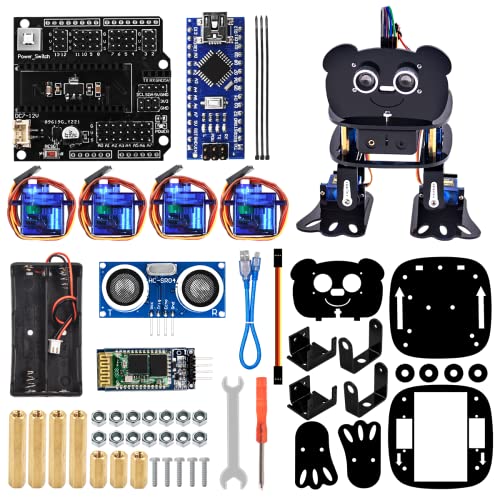
LAFVIN DIY 4-DOF Panda Robot Kit Programmable Dancing Robot Kit Support Android APP Control Compatible with Arduino IDE
You can control the Panda Bot with APP.
As an affiliate, we earn on qualifying purchases.

Gearotons Line Following Robot Kit Smart Robot Assembly Project Kit Obstacle Avoidance Robot with Music DIY Kit Educational Robot Toy, Medium
Advanced Technology: Features line following, obstacle avoidance, backward movement, path tracking and music playing functionalities for endless fun...
As an affiliate, we earn on qualifying purchases.