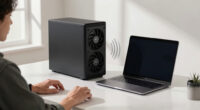
📊 Full opportunity report: Acoustic Dampening, Placement, and the “Rig in the Closet” Setup on ThorstenMeyerAI.com — validation score, market gap, and execution plan.

Get business pricing on monitors, keyboards and dev gear
- Business-only prices and quantity discounts
- Tax-exempt purchasing
- Multiple users, one account, clear invoices
TL;DR
This article explains how to significantly reduce AI workstation noise by strategically placing equipment, using acoustic treatments, and ensuring proper ventilation, including the pros and cons of a ‘rig in the closet’ setup.
Putting high-power AI workstations in a closet or separate room, combined with proper ventilation, is an effective way to drastically reduce noise levels at the workstation, according to recent expert guidance.
Experts emphasize that the most effective way to reduce noise from AI workstations is to move the equipment away from the user, ideally into another room or closet, and operate it headless over a network connection. This approach eliminates the need for acoustic treatment and addresses the core issue of airborne and structure-borne noise.
The ‘rig in the closet’ setup involves placing the machine in a sealed or semi-sealed space. While this can significantly cut noise, it introduces the challenge of heat management. Trapped heat can cause the system to throttle or overheat unless active ventilation is implemented. Proper airflow, including passive vents and quiet exhaust fans, is essential for maintaining safe temperatures.
Additional measures include using soundproof cabinets that combine acoustic foam lining with temperature-controlled exhaust systems, and employing anti-vibration pads to minimize structure-borne noise. These techniques, when combined, can make a high-power AI rig effectively silent and cool, even in a small or enclosed space.
Acoustic dampening
& the rig in the closet.
The most powerful noise fix isn’t a material — it’s a floor plan. A rig you can’t hear because it’s in another room beats any amount of foam. Tap the approaches in Part 1 to see what actually works.
(another room)
(levers 1–4)
(door / barrier)
(acoustic foam)
Contain the noise, not the heat
Why Proper Placement and Ventilation Matter for AI Rigs
Effective noise reduction techniques are crucial for maintaining a quiet workspace, especially for those working in shared environments or recording spaces. Moving the rig into another room or closet not only minimizes noise but also reduces thermal stress on the hardware, extending its lifespan and performance.
Implementing proper ventilation in enclosed setups prevents overheating, which can cause hardware throttling or damage. As AI workloads grow more demanding, understanding these strategies becomes essential for sustainable operation and productivity.
As an affiliate, we earn on qualifying purchases.
Background on Noise Management for High-Power Workstations
Traditionally, noise mitigation focused on acoustic foam and soundproofing within the workspace. However, recent guidance highlights that the most effective method is to physically distance the equipment from the user. This shift aligns with the increasing use of network-based workflows, where the workstation's physical location becomes less critical.
The 'rig in the closet' approach has gained popularity among AI practitioners seeking quiet environments, but it requires careful attention to airflow and heat dissipation. Experts warn that sealed spaces without proper cooling can lead to thermal throttling and hardware failure, making ventilation strategies vital.
"The most effective noise reduction isn't acoustic foam—it's moving the rig away from your workspace into another room or closet, and controlling heat with proper ventilation."
— Thorsten Meyer, AI hardware expert
As an affiliate, we earn on qualifying purchases.
Remaining Challenges in Quiet AI Workstation Setups
While the principles of placement and ventilation are clear, the optimal configuration varies depending on room size, hardware load, and budget. Specific designs for soundproof cabinets and cooling solutions are still evolving, and the long-term reliability of some DIY setups remains unverified.
It is also unclear how much noise reduction can be achieved in extremely compact or budget-constrained environments without compromising hardware safety.
acoustic foam panels for computer room
As an affiliate, we earn on qualifying purchases.
As an affiliate, we earn on qualifying purchases.
Next Steps in Implementing Quiet AI Workstation Solutions
Practitioners are expected to experiment with different ventilation and placement configurations, including custom soundproof enclosures with integrated cooling. Manufacturers may develop more advanced, affordable soundproof cabinets tailored for high-power hardware.
Further research and real-world testing will clarify best practices for balancing noise reduction, heat management, and cost, making quiet AI workstations more accessible.
As an affiliate, we earn on qualifying purchases.
Key Questions
Is placing my AI workstation in a closet safe?
It can be safe if proper ventilation is provided. Active airflow, exhaust fans, and temperature monitoring are essential to prevent overheating and hardware damage.
Does acoustic foam help if I put my rig in another room?
No, acoustic foam mainly reduces reflections within a room. Moving the rig away from your workspace is more effective for noise reduction than foam alone.
What are the best ventilation options for a closet setup?
Quiet exhaust fans with ducting, passive vents, and temperature-controlled airflow systems are recommended to keep the hardware cool and prevent overheating.
Can I completely seal a closet for noise reduction?
Sealing a closet is possible but requires careful design to ensure adequate ventilation. Without proper airflow, heat buildup can damage hardware.
Are soundproof cabinets worth the cost?
Yes, especially for high-power rigs in shared or noise-sensitive environments. They combine acoustic treatment with cooling solutions, providing effective noise reduction and thermal management.
Source: ThorstenMeyerAI.com
Fall Picks
fall essentials
As an affiliate, we earn on qualifying purchases.