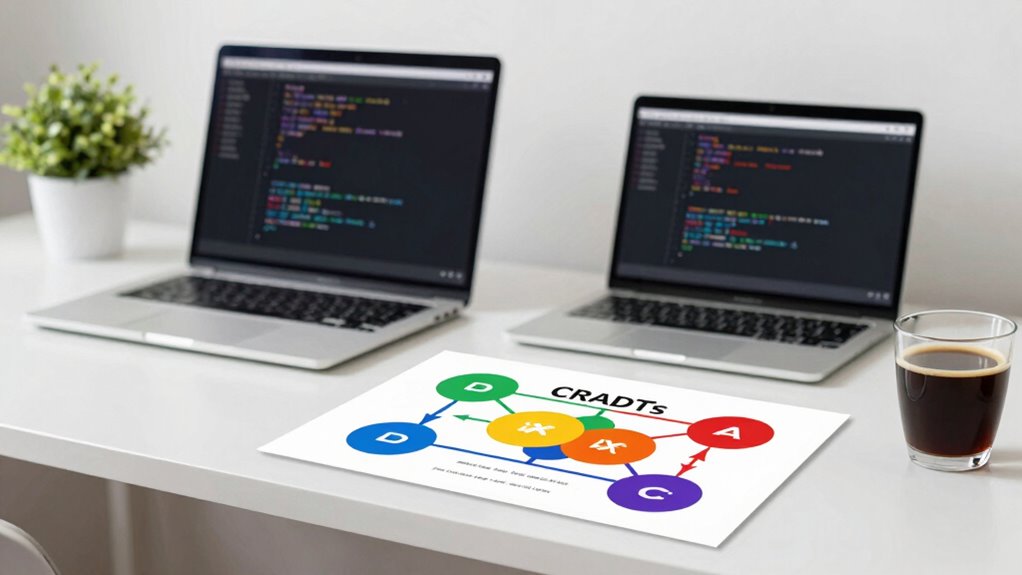

CRDTs are tools that help your devices sync data smoothly without conflicts or manual fixes. They let you update your files offline or asynchronously, and then automatically merge changes when you reconnect. Think of them as clever systems that prioritize your data’s consistency and integrity, no matter how many devices you’re using. If you want to understand how they keep everything in sync effortlessly, there’s plenty more to discover below.
Key Takeaways
- CRDTs are tools that let multiple devices update shared data independently without conflicts.
- They automatically merge changes when devices reconnect, ensuring everyone sees the latest info.
- CRDTs use math principles so updates can happen in any order without breaking data consistency.
- They simplify real-time collaboration by handling complex data conflicts behind the scenes.
- CRDTs make distributed apps more reliable, scalable, and easy to maintain across many devices.

Imagine you’re working with multiple copies of the same data across different devices, and you want them to stay consistent without constant coordination. That scenario is common in today’s digital landscape, especially with cloud apps, collaborative tools, and mobile devices. The challenge is ensuring that each device’s data remains synchronized, even when changes happen offline or asynchronously. That’s where Conflict Resolution and Data Synchronization come into play, and CRDTs—short for Conflict-free Replicated Data Types—offer a clever solution.
CRDTs are designed to make data synchronization seamless and conflict-free. Unlike traditional methods that require complex locking or centralized control, CRDTs allow devices to update data independently and still guarantee eventual consistency. Imagine you and a friend editing a shared document on different devices. With CRDTs, both of you can make changes offline, and when your devices reconnect, the system automatically merges your updates without conflicts or data loss. It’s like having a smart middleman that understands how to combine changes logically, even if they happen at different times.
The secret lies in how CRDTs handle conflict resolution. They’re built with mathematical properties that ensure all updates can be merged without contradictions. Each change is stored as an operation that can be commutatively combined with others, meaning the order of updates doesn’t matter. This property is essential for maintaining data consistency across multiple devices—regardless of when or where changes occur. When the devices sync, the CRDT’s algorithms automatically reconcile differences, resolving conflicts in a way that preserves user intent and data integrity. Moreover, their mathematical properties guarantee that the merging process is reliable and predictable, further enhancing system robustness. Additionally, CRDTs are often designed to be scalable, allowing them to perform efficiently even in large, distributed systems.
Because of this, CRDTs significantly simplify data synchronization in distributed systems. You don’t need to worry about locking, version conflicts, or complicated reconciliation processes. Instead, the system handles it all behind the scenes, making the user experience smoother and more reliable. Whether you’re collaborating on a spreadsheet, editing a note, or managing shared settings, CRDTs ensure that everyone’s updates are incorporated correctly, no matter how many devices are involved.
In essence, CRDTs remove the headache of conflicting changes and complex synchronization protocols. They provide a robust foundation for real-time collaboration and distributed data management, where consistency is maintained effortlessly. By understanding how CRDTs handle conflict resolution through their smart design, you can appreciate how they make modern, decentralized applications both practical and resilient. They’re not just a technical innovation—they’re a way to keep your data harmonized across all your devices, no matter how or when changes occur. Recognizing the underlying distributed systems principles helps clarify why CRDTs are such a powerful tool for modern data synchronization.

Building Real-Time Collaboration Tools with WebSockets and Node.js: Creating Interactive Document Editing, Live Chat Systems, and Synchronization Services for Enhanced User Collaboration in Web Apps
As an affiliate, we earn on qualifying purchases.
As an affiliate, we earn on qualifying purchases.
Frequently Asked Questions
How Do CRDTS Handle Conflict Resolution in Real-Time Collaboration?
CRDTs handle conflict resolution through their design for seamless, real-time synchronization. When conflicts arise, CRDTs automatically merge changes without user intervention, ensuring data consistency. They do this by applying mathematical rules that prioritize or combine updates, so everyone sees the latest, most accurate version. This approach guarantees conflict resolution is swift and efficient, allowing you to collaborate smoothly without worrying about data conflicts disrupting your workflow.
Are CRDTS Suitable for Large-Scale Distributed Systems?
Yes, CRDTs are suitable for large-scale distributed systems, but you should watch out for consistency challenges and scalability concerns. They handle data conflicts well, allowing your system to stay responsive even during network splits. However, as your system grows, managing the increased state and ensuring eventual consistency can become complex. Proper design and understanding of CRDTs are essential to maintain performance and reliability at scale.
What Are Common Use Cases for CRDTS Outside of Databases?
Ever wondered where else CRDTs shine apart from databases? You’ll find them vital in real-time messaging apps, ensuring seamless updates without conflicts. They also excel in IoT synchronization, where devices need to stay consistent despite unreliable networks. With CRDTs, you get eventual consistency, making them perfect for collaborative tools, distributed caches, and even peer-to-peer communication, where avoiding conflicts and maintaining data integrity is essential.
How Do CRDTS Compare to Traditional Version Control Systems?
You’ll find CRDTs differ from traditional version control systems because they prioritize data consistency across distributed nodes without requiring conflict detection or manual merges. Unlike systems that need user intervention for conflicts, CRDTs automatically resolve conflicts, ensuring seamless data synchronization. This means your data remains consistent even when updates happen simultaneously. Traditional version controls excel in code collaboration but aren’t designed for real-time, conflict-free data synchronization like CRDTs.
What Are the Potential Drawbacks of Using CRDTS?
While CRDTs sound perfect for seamless collaboration, they have their quirks. You might face consistency challenges, as keeping data perfectly synchronized isn’t always straightforward. Plus, managing their complexity can be a headache, especially as your system grows. Ironically, the very features that make CRDTs attractive—like eventual consistency—can also complicate debugging and maintenance, making you wish you’d stuck with simpler, traditional methods sometimes.

REAL-TIME COLLABORATIVE SOFTWARE DESIGN: Operational transforms synchronization models and distributed state consistency
As an affiliate, we earn on qualifying purchases.
As an affiliate, we earn on qualifying purchases.
Conclusion
So, now you see how CRDTs keep data consistent without a central authority. But here’s the twist—what happens when these clever systems face unexpected conflicts or scale beyond what you imagined? The future of CRDTs isn’t just about smooth syncing; it’s about revealing even more possibilities. Are you ready to explore what’s next? Because, trust me, the most exciting breakthroughs might be just around the corner—and you won’t want to miss them.

Database Systems: Introduction to Databases and Data Warehouses, Edition 2.0
As an affiliate, we earn on qualifying purchases.
As an affiliate, we earn on qualifying purchases.
As an affiliate, we earn on qualifying purchases.