
📊 Full opportunity report: Enhance Data Center Performance By Planning Equipment Replacements on IdeaNavigator AI — validation score, market gap, and execution plan.

Get business pricing on monitors, keyboards and dev gear
- Business-only prices and quantity discounts
- Tax-exempt purchasing
- Multiple users, one account, clear invoices
TL;DR
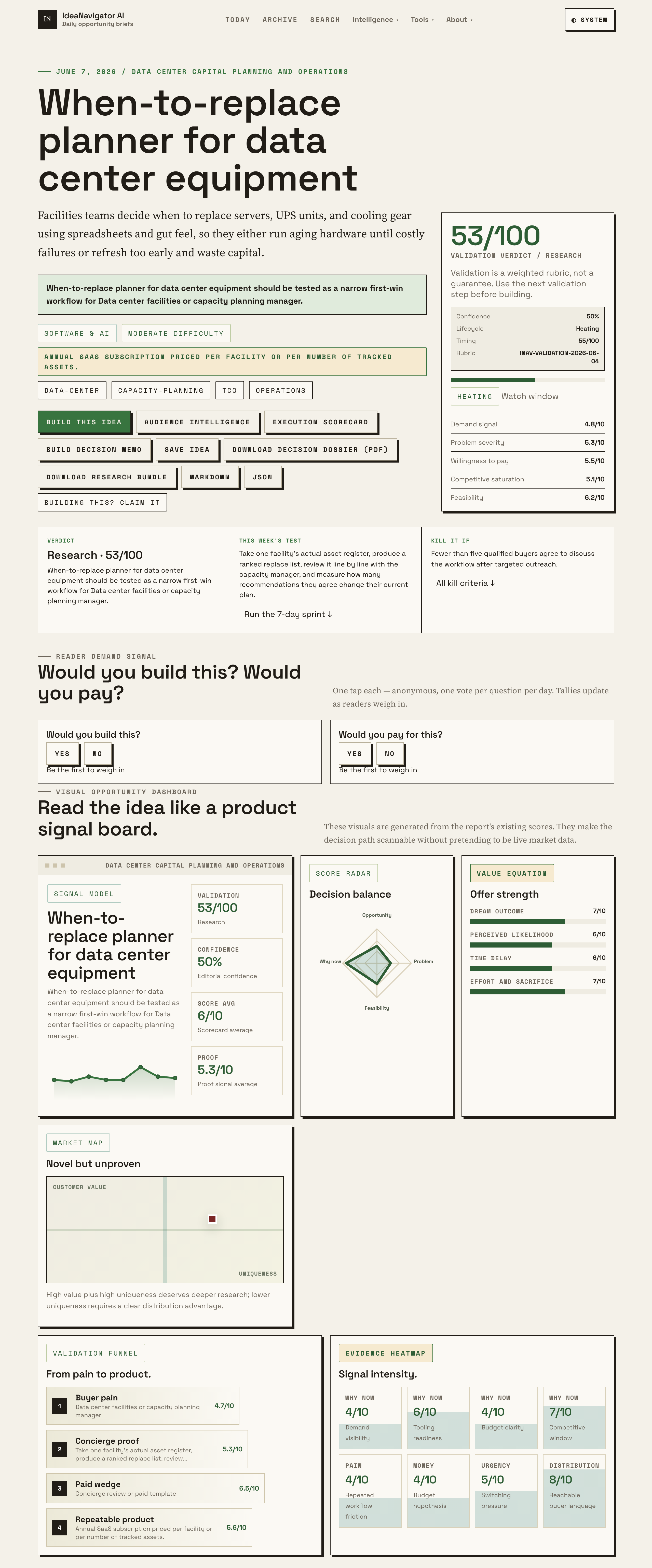
A new software tool is being tested to help data center managers decide when to replace servers, UPS units, and cooling systems. It uses asset data to generate recommendations, potentially saving costs and enhancing performance. The development is in early testing with real facilities.
A new equipment replacement planning tool for data centers is entering testing, offering data-driven recommendations to facilities managers. The tool aims to address the longstanding challenge of deciding when to replace aging hardware, which has traditionally relied on spreadsheets and gut feel. This development could significantly impact data center operations by optimizing hardware refresh cycles amid rising energy costs and increasing hardware density.
The proposed when-to-replace planner ingests asset data such as age, power consumption, and maintenance costs from a facility’s inventory. It then ranks equipment based on a score comparing the rising costs of energy and potential failures against the efficiency gains of new hardware. The initial validation involves testing the tool on an actual facility’s asset register, with capacity managers reviewing the recommended replacement list line by line. Early feedback will determine how well the tool aligns with current planning practices and whether it can improve decision accuracy.
This approach aims to replace the current reliance on manual spreadsheets and intuition, which often lead to either premature replacements or costly hardware failures. By providing a clear, data-backed ranking, the tool could help facilities extend equipment life where appropriate, while identifying when replacements are economically justified. The SaaS-based solution is priced per facility or per number of assets tracked, targeting the data center capital planning and operations market.
Implications for Data Center Cost and Efficiency Management
This development matters because it addresses a key challenge for data center facilities teams: balancing hardware longevity with operational reliability and energy efficiency. As energy costs rise and hardware becomes more efficient, making precise replacement decisions can lead to substantial cost savings and reduced environmental impact. If validated successfully, the tool could become a standard part of data center capacity planning, helping organizations optimize their capital expenditures and improve overall operational resilience.
As an affiliate, we earn on qualifying purchases.
Growing Need for Data-Driven Equipment Lifecycle Management
Data centers face increasing pressure to improve efficiency and reduce costs amid rising energy prices and higher hardware densities. Traditionally, equipment replacements have been based on manual assessments, often leading to suboptimal timing. Recently, there has been a push toward automation and data-driven approaches, with several vendors exploring predictive maintenance and lifecycle analytics. The new replacement planner represents a focused effort to provide actionable insights, starting with a narrow but impactful workflow that can be integrated into broader capacity planning strategies.
“Using asset data to inform replacement timing can significantly reduce unnecessary capital expenditures and prevent costly failures.”
— an anonymous researcher
uninterruptible power supply (UPS) units
As an affiliate, we earn on qualifying purchases.
As an affiliate, we earn on qualifying purchases.
Validation and Adoption Challenges Remain
It is still unclear how accurately the tool’s recommendations will align with actual operational needs across diverse data center environments. The initial validation is limited to a single facility, and broader testing is needed to confirm effectiveness. Additionally, the willingness of facilities teams to adopt new, automated decision-making tools remains uncertain, especially if they are accustomed to manual processes.
data center server replacement hardware
As an affiliate, we earn on qualifying purchases.
As an affiliate, we earn on qualifying purchases.
Next Steps in Validation and Market Rollout
The next phase involves deploying the tool in multiple data centers to compare recommendations with current practices and measure cost savings. Feedback from facilities managers will inform further refinements. If successful, the vendor plans to expand the product’s availability, integrating it into existing capacity planning workflows and marketing it to larger enterprise data centers. Continued validation will determine its role in future hardware lifecycle strategies.
energy-efficient data center cooling systems
As an affiliate, we earn on qualifying purchases.
As an affiliate, we earn on qualifying purchases.
Key Questions
How does the replacement planning tool work?
The tool analyzes asset data such as age, power consumption, and maintenance costs to generate a ranked list of equipment for potential replacement, balancing energy costs, failure risks, and hardware efficiency gains.
Is this tool ready for widespread use?
Not yet. It is currently in the testing phase with initial validation in one facility. Broader deployment and validation are planned before wider adoption.
What benefits can data centers expect from using this tool?
Potential benefits include optimized replacement timing, reduced capital expenditures, lower energy costs, and improved operational reliability.
Will this replace manual decision-making entirely?
The tool aims to support, not replace, human judgment by providing data-driven recommendations that facilities managers can review and adjust as needed.
How is the tool priced?
It is offered as a SaaS subscription, priced per facility or per number of tracked assets.
Source: IdeaNavigator AI
Halloween Picks
halloween
As an affiliate, we earn on qualifying purchases.