
TL;DR

Get business pricing on monitors, keyboards and dev gear
- Business-only prices and quantity discounts
- Tax-exempt purchasing
- Multiple users, one account, clear invoices
Nord Quantique co-founder and CEO Julien Camirand Lemire discussed the company’s approach to quantum error correction using microwave photons in superconducting cavities in an interview published by The Quantum Insider on Oct. 31, 2026. He described prior GKP and Tesseract code demonstrations, a four-qubit system expected to enter operation this year, and a company roadmap targeting error rates of 10^-7 to 10^-9 by 2032; those targets are plans, not achieved results.
Nord Quantique CEO Julien Camirand Lemire has outlined the company’s effort to build quantum error correction into a single cavity, using microwave photons stored in superconducting resonators rather than relying only on large numbers of physical qubits. In an interview published by The Quantum Insider on Oct. 31, 2026, he discussed earlier GKP and Tesseract code demonstrations, a four-qubit system planned to enter operation this year, and a longer-term target of error rates between 10^-7 and 10^-9 by 2032.
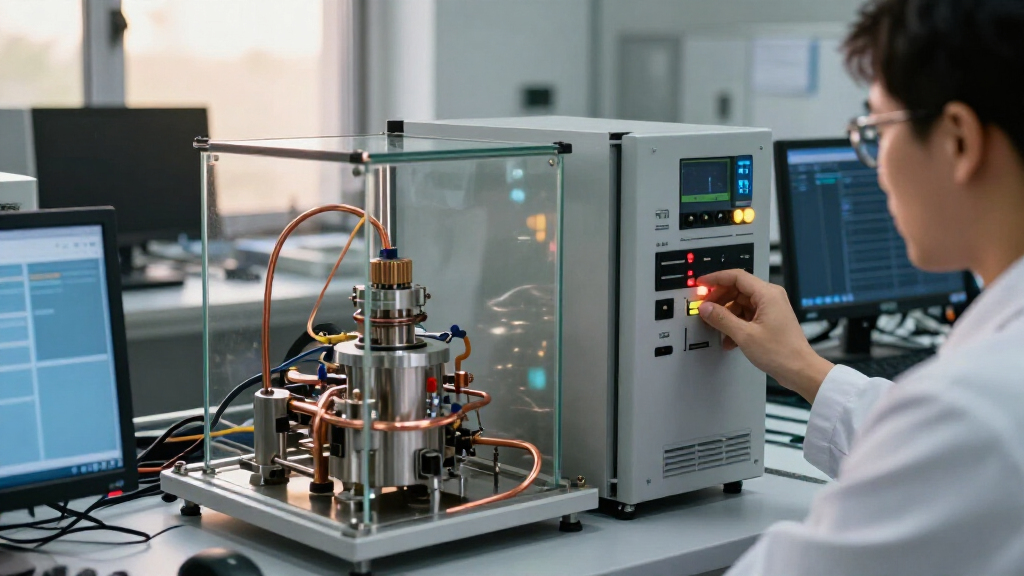
Lemire described Nord Quantique’s design as a bosonic-code approach: multiple microwave photons are held in a superconducting cavity, with information encoded in their states. The company’s premise is that this physical system can supply redundancy for error correction within a cavity, potentially reducing the need to add large numbers of separate qubits. Lemire contrasted that strategy with conventional approaches in which error correction can require substantial physical-qubit overhead.
He said Nord Quantique demonstrated a GKP qubit in 2024, with the company’s work addressing correction of both X and Z errors, and described a Tesseract-code demonstration released in 2025. Lemire also said the company’s quantum error-correction gain has more than doubled since 2024. The interview does not provide the underlying metric, measurement conditions or independent verification for that comparison, so it should be treated as the CEO’s account rather than a separately established performance result.
The company is based in Sherbrooke, Quebec, and also has offices in Montreal. Lemire said a four-qubit system is entering operation in 2026 and described a roadmap aiming for error rates in the 10^-7 to 10^-9 range by 2032. These are company plans and targets; the interview does not establish that the system is already operating or that the target rates have been reached.
Reducing the Qubit Overhead
Quantum computers are affected by noise, and useful computations are expected to require methods that detect and correct errors. Many error-correction schemes use many physical qubits to encode one logical qubit, which can make a sufficiently reliable machine demanding to build. Nord Quantique’s approach is relevant because it seeks to use the photon states inside a cavity as part of that redundancy, rather than relying exclusively on a much larger count of separate qubits.
If the company can demonstrate reliable error correction and scale the architecture, it could offer a different route to building useful quantum processors. But a claimed reduction in overhead is not, by itself, evidence of a practical advantage: performance depends on measured error rates, control requirements, operating conditions and how systems grow. The interview gives a view of the company’s strategy and goals, not a direct comparison establishing that its hardware outperforms other approaches.
Products Worth Considering

DJI Osmo Mobile 7P Phone Gimbal with Mic Mini Transmitter, Infinity Black

LG UltraGear 27GX704A-B 27-inch QHD OLED Gaming Monitor

Bose QuietComfort Wireless Noise-Cancelling Headphones, Petal Pink
As an affiliate, we earn on qualifying purchases.
From Grid States to a Hardware Roadmap
Nord Quantique was incorporated in 2020 as a spin-off from the Sherbrooke quantum ecosystem, according to Lemire. He said the company chose to focus on quantum hardware designed around error correction, rather than treating error management as an additional layer that can be addressed only after increasing the number of qubits.
The interview distinguishes Nord Quantique’s use of grid states, including GKP and Tesseract codes, from other bosonic-code approaches. Lemire referred to cat qubits developed by Alice & Bob as an example of a different strategy aimed at reducing one error channel. The comparison is his description of the approaches; the interview does not provide a shared benchmark or full technical evaluation across companies.
“The thing that you need for quantum error correction is a form of redundancy.”
— Julien Camirand Lemire, Nord Quantique co-founder and CEO
Performance Claims and Open Questions
The interview does not give detailed experimental data for the stated increase in quantum error-correction gain, including the definition of “gain,” the comparison baseline or test conditions. It also does not establish whether the four-qubit system is currently operational, what capabilities it will have when it enters operation, or how its performance will be assessed.
The 2032 error-rate range is a roadmap target, not a reported result. The discussion also leaves open how the architecture will scale, what engineering constraints arise in operating the cavities, and how its performance compares with other error-correction strategies under consistent tests. The interview is a company executive’s account and does not provide independent confirmation of the technical claims.
The Four-Qubit System Ahead
The next stated milestone is the four-qubit system planned for operation in 2026. Public details on its operating status, design and results would help clarify how the company’s demonstrations translate into a larger hardware system. Later evidence would need to show measured error-correction performance and how that performance changes as the architecture is expanded.
Nord Quantique’s longer-term marker is its stated aim of reaching 10^-7 to 10^-9 error rates by 2032. The company’s progress toward that goal remains to be demonstrated; the interview does not specify interim milestones or a schedule for releasing further experimental results.
Key Questions
What did Nord Quantique announce?
The source is an interview, not an announcement of a newly completed experiment. CEO Julien Camirand Lemire discussed the company’s bosonic-code strategy, previous GKP and Tesseract demonstrations, and its hardware plans.
What does “one cavity, one error-corrected qubit” mean?
Nord Quantique aims to encode information in multiple microwave photons held in a superconducting cavity, using their states to provide redundancy for error correction. The phrase describes the company’s approach; it does not mean that all error-correction overhead or scaling challenges have been eliminated.
What demonstrations did Lemire describe?
He referred to a GKP qubit demonstration in 2024 and a Tesseract-code demonstration released in 2025. The interview does not include the detailed data needed to independently evaluate those results.
Has Nord Quantique reached its target error rates?
No such achievement is established in the interview. The 10^-7 to 10^-9 range is a company target for 2032, not a reported present-day result.
What is the next stated milestone?
Lemire said a four-qubit system is expected to enter operation in 2026. Its operating status, capabilities and performance results are not detailed in the source.
Source: thequantuminsider.com