
To speed up your local AI, you should consider model quantization techniques that reduce model size and inference time without sacrificing accuracy. You can convert floating-point weights into lower bit formats like INT8 or even INT4, making the model more efficient on resource-constrained hardware. Make sure your device supports the chosen quantization method to avoid compatibility issues. Exploring advanced strategies like quantization-aware training can help you optimize performance further—keep going to discover how these approaches fit your needs.
Listen free for 30 days with Audible
Thousands of audiobooks and originals — cancel anytime.
As an affiliate, we earn on qualifying purchases.
Key Takeaways
- Quantization reduces model size and increases inference speed by converting weights and activations into lower-precision formats like INT8 or INT4.
- Compatibility with target hardware is crucial; verify device support for specific quantization formats before deployment.
- Balancing precision and accuracy involves choosing appropriate levels such as INT8 or FP16 to optimize performance without significant accuracy loss.
- Quantization-aware training can maintain model accuracy while benefiting from lower-precision inference.
- Post-training quantization offers simplicity but may require validation to ensure speed gains do not compromise accuracy.
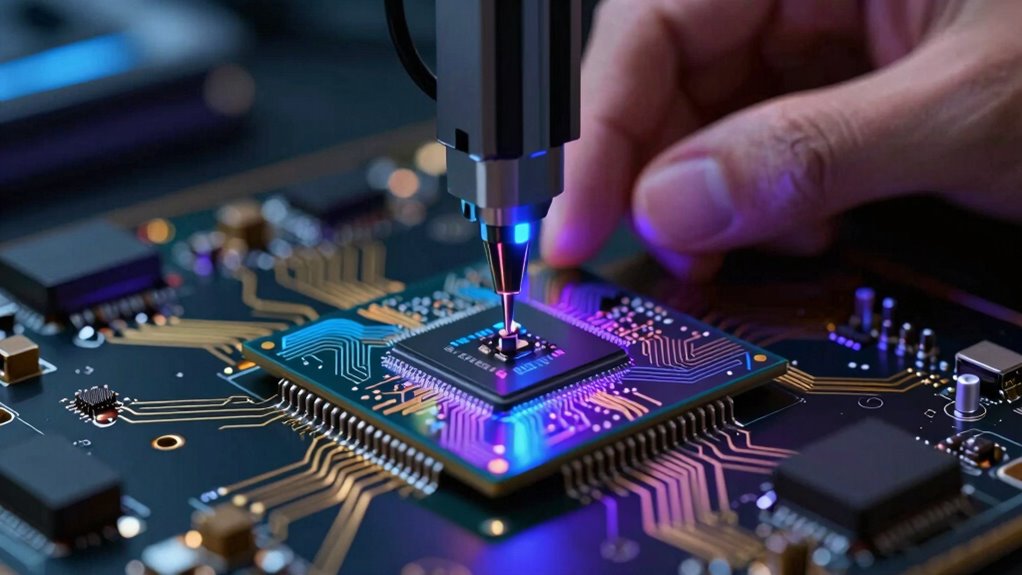
As local AI applications become more widespread, optimizing model performance without sacrificing accuracy is essential. One of the most effective ways to achieve this is through model quantization, which reduces the size of neural networks and speeds up inference times. When implementing quantization techniques, you need to consider hardware compatibility carefully. Not all devices support the same quantization methods or data types, so choosing a compatible approach ensures your model runs efficiently without requiring extensive hardware modifications. For example, some edge devices are optimized for INT8 operations, making lower precision quantization highly effective. Others may only support FP16, which influences how you approach quantization precision.
Quantization precision plays a pivotal role in balancing model size, speed, and accuracy. By converting floating-point weights and activations into lower bit representations, you decrease the computational load. This can significantly boost inference speed, especially on resource-constrained hardware. However, reducing precision too aggressively might cause a drop in accuracy. To prevent this, you can experiment with different levels of quantization, such as INT8 or even lower, and evaluate how each impacts your model’s performance. Fine-tuning the quantization parameters allows you to find the sweet spot where speed gains are maximized without an unacceptable loss in accuracy.
You’ll find that choosing the right quantization precision depends heavily on your specific application and hardware. For instance, if you’re deploying on a smartphone, INT8 quantization often provides a good balance, offering substantial speed improvements while maintaining most of the original accuracy. On specialized edge devices, some hardware supports even lower precision formats, such as INT4, which can lead to further acceleration. To make the most of these options, you should verify your target device’s hardware capabilities beforehand. This ensures that the quantization technique you select is not only effective but also fully supported, avoiding compatibility issues during deployment. Additionally, understanding hardware compatibility is crucial to ensure the chosen quantization method aligns with your device’s capabilities and limitations.
Furthermore, integrating quantization into your model training or post-training process requires careful planning. Post-training quantization is usually simpler and faster but might slightly reduce accuracy, whereas quantization-aware training can help preserve performance by simulating lower precision during training. Whichever method you choose, always validate your model thoroughly on real hardware to confirm that the speed improvements do not come at the cost of unacceptable accuracy degradation. By understanding hardware compatibility and selecting the appropriate quantization precision, you can efficiently accelerate your local AI applications without compromising their effectiveness.
AI model quantization hardware support
As an affiliate, we earn on qualifying purchases.
As an affiliate, we earn on qualifying purchases.
Frequently Asked Questions
How Does Quantization Impact AI Model Accuracy?
Quantization impacts AI model accuracy through precision trade-offs, often causing some accuracy degradation. When you reduce the number of bits used to represent weights and activations, you speed up processing but may lose detail, leading to minor errors. While the trade-off is usually acceptable for faster, more efficient models, you need to balance quantization levels carefully to minimize accuracy loss without sacrificing performance.
Which Hardware Benefits Most From Model Quantization?
Think of hardware as a finely tuned orchestra; some instruments shine brighter. Hardware with high compatibility benefits most from model quantization, as it adapts seamlessly, boosting energy efficiency and performance. Mobile devices and edge AI hardware especially gain, conserving power while maintaining speed. If your hardware harmonizes well with quantization, you’ll enjoy faster AI responses and longer battery life, turning complex tasks into smooth, effortless symphonies.
Can Quantization Be Reversed or Updated Later?
Quantization is generally not reversible, so you can’t simply undo it once applied, raising reversibility concerns. However, you can update or re-quantize your model later if needed, especially with flexible frameworks that support future updates. Keep in mind, though, that some loss of precision might occur during re-quantization, so plan your deployment with potential future updates in mind to maintain peak performance and accuracy.
What Are Common Challenges in Implementing Quantization?
You might find that implementing quantization can be a delicate dance, often leading to subtle quantization artifacts that challenge your model’s accuracy. Additionally, managing the training complexity can feel overwhelming, as balancing precision loss with performance gains requires careful tuning. These hurdles can evoke frustration, but with patience and experience, you’ll learn to navigate them, ultimately releasing faster, more efficient AI models that serve your needs beautifully.
How Does Quantization Compare to Other Model Compression Methods?
Quantization stands out from other model compression methods by primarily focusing on model size reduction and enhancing computation efficiency. While techniques like pruning or knowledge distillation aim to remove parameters or transfer knowledge, quantization directly reduces the precision of weights and activations. This results in faster inference and lower memory usage, making it ideal for deploying models on resource-constrained devices without considerably sacrificing accuracy.
As an affiliate, we earn on qualifying purchases.
Conclusion
You’ve now unleashed the power of pruning, precision reduction, and other quantization techniques to quickly and efficiently bring AI models to life locally. By blending these methods, you can boost speed, slash size, and streamline performance—all while maintaining accuracy. So, seize these strategies, sharpen your skills, and set your local AI soaring smoothly and swiftly. With mastery in model quantization, you’ll make your machine learning marvels more manageable, more mobile, and more mighty.
edge device AI acceleration hardware
As an affiliate, we earn on qualifying purchases.
As an affiliate, we earn on qualifying purchases.
quantization-aware training software
As an affiliate, we earn on qualifying purchases.
As an affiliate, we earn on qualifying purchases.
NFL season / tailgating Picks
team gear
As an affiliate, we earn on qualifying purchases.