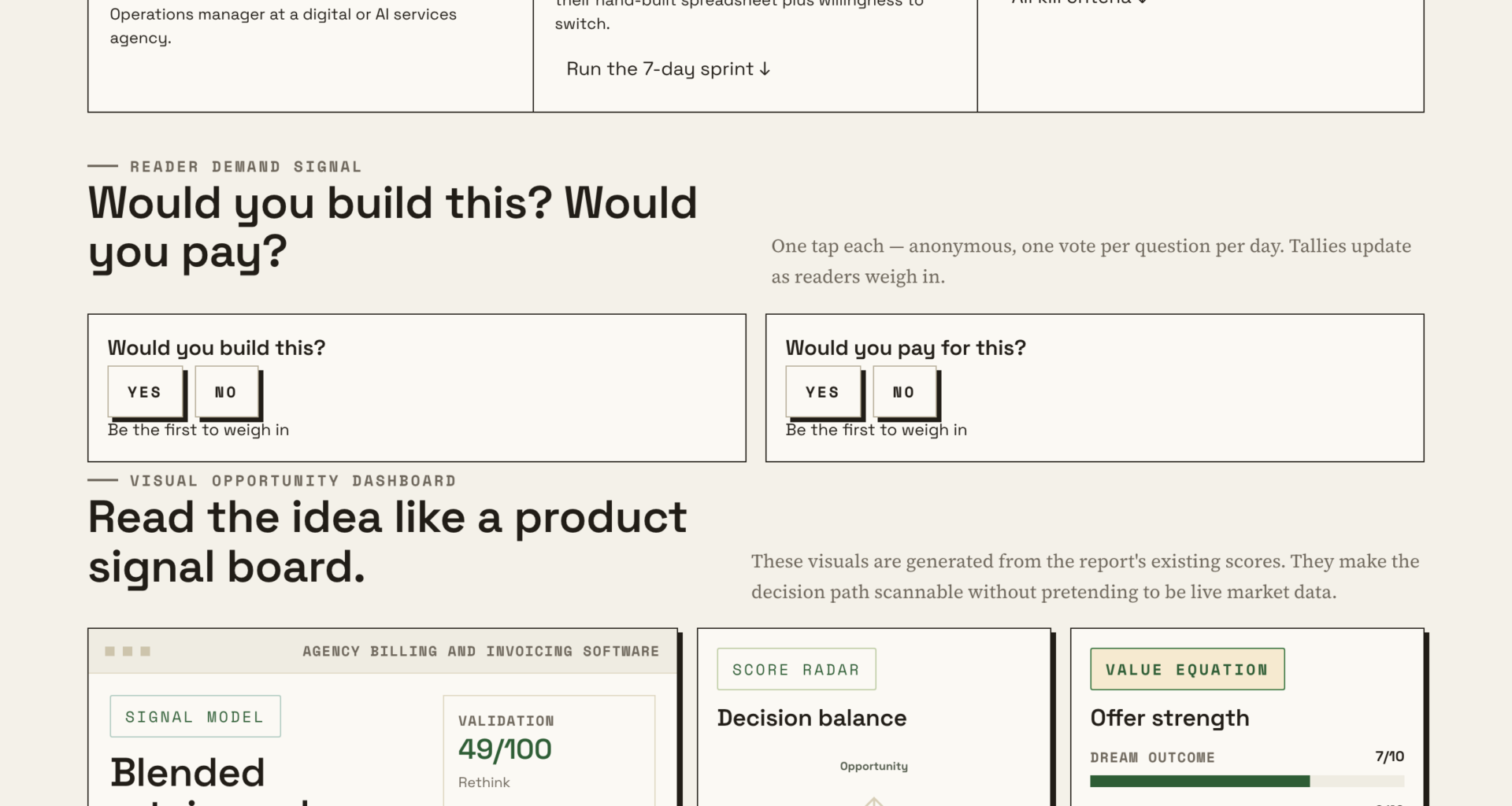

📊 Full opportunity report: Tips For Seamless Integration Of Usage Data Into Agency Billing on IdeaNavigator AI — validation score, market gap, and execution plan.
TL;DR
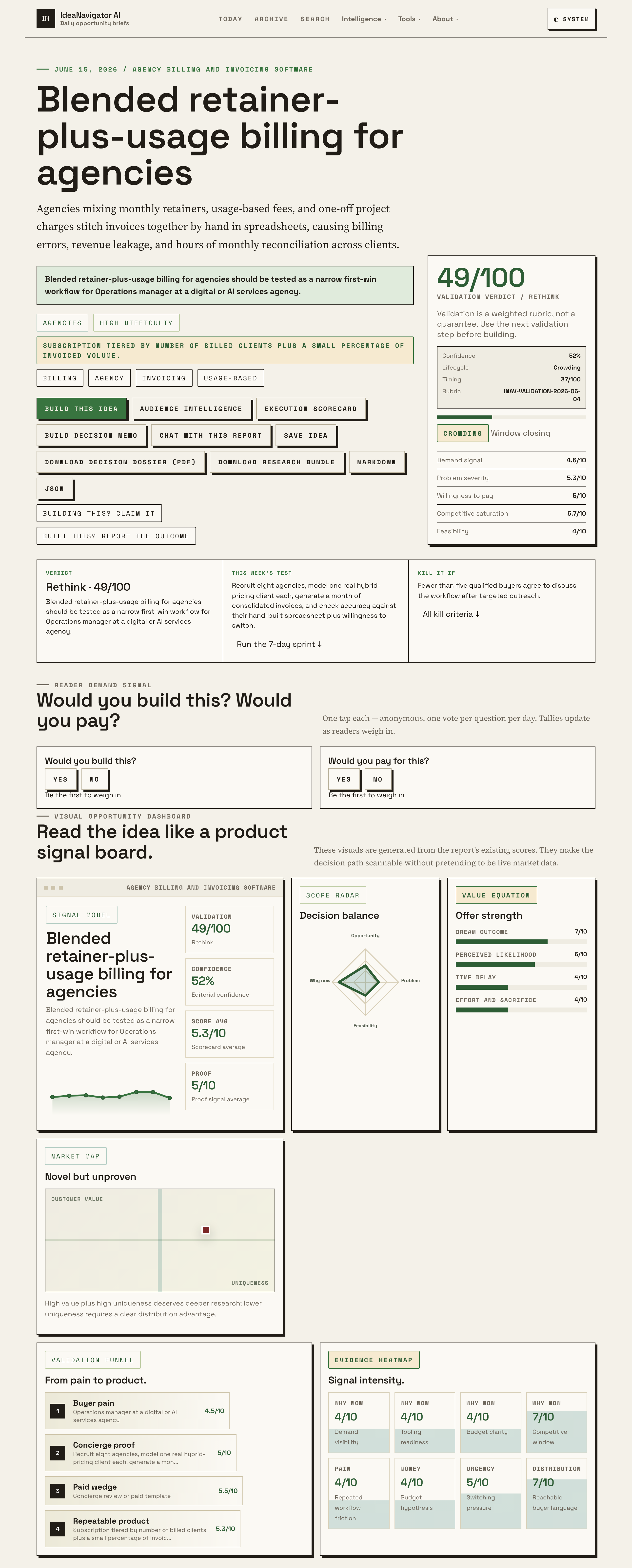
Agencies are testing new workflows to automate hybrid billing that combines retainers, usage fees, and one-off charges. A new billing workspace prototype aims to streamline this process, promising increased accuracy and efficiency.
Agencies are actively testing a new billing workspace designed to automatically consolidate retainer, usage-based, and ad hoc charges into a single invoice, addressing longstanding manual reconciliation issues and revenue leakage. This development is significant for digital and AI service providers seeking more efficient revenue management and accurate invoicing processes.
The initiative targets operations managers at agencies that bundle services with a mix of monthly retainers, metered usage, and one-off project fees. Currently, these agencies manually stitch together invoices using spreadsheets, which leads to errors, delays, and lost revenue. The new billing workspace prototype allows users to define a client with multiple billing components—retainer, usage meter, and ad hoc charges—and then generate a consolidated invoice automatically.
According to an anonymous researcher involved in the testing, the prototype has been modeled with eight agencies, each simulating a real hybrid-pricing client. Preliminary results show that the automated invoices closely match the manual, spreadsheet-based calculations, with some agencies reporting improved accuracy and reduced reconciliation time. The goal is to validate this approach further before scaling it into a full product offering.
Potential Impact on Agency Revenue Management
This development could significantly reduce billing errors and revenue leakage for agencies that currently rely on manual processes. Automating the integration of usage data into invoices enhances accuracy, saves time, and enables agencies to better capture revenue from usage-based services. As agencies increasingly bundle AI and digital services into retainers, this streamlined approach addresses a critical gap in existing billing tools, which often cannot model complex, hybrid billing scenarios effectively.

As an affiliate, we earn on qualifying purchases.
Growing Need for Hybrid Billing Solutions in Agencies
Many digital and AI agencies now combine monthly retainers with usage-based fees and one-off charges, reflecting the complexity of their service offerings. Traditional subscription billing tools fall short in modeling these mixed billing scenarios, forcing agencies to manually compile invoices, which is error-prone and time-consuming. This challenge has prompted startups and software providers to explore new billing workflows that automate the process. The prototype under testing by IdeaNavigator AI represents a targeted solution aimed at this specific market need, with early validation efforts underway.
“The prototype has shown promising results in matching manual invoices with automated ones, reducing reconciliation time significantly.”
— an anonymous researcher

P3 International P4456 Kill A Watt Flex Electricity Usage Monitor – Advanced Power Meter with Data Memory, CO₂ Tracking & Cost Calculator – Upgrade from P4400 Watt Meter
- Next-generation energy monitor: Enhanced tracking and data storage
- Stores usage data: Retains readings when switching outlets
- Environmental impact tracking: Estimates CO₂ emissions from usage
As an affiliate, we earn on qualifying purchases.
As an affiliate, we earn on qualifying purchases.
Unconfirmed Aspects of the Billing Workspace’s Scalability
It remains unclear how well the prototype will perform across different agency sizes, billing complexities, and client types as it moves beyond initial testing. Further validation is needed to determine if the automated system can handle diverse scenarios without introducing errors or requiring manual adjustments. Additionally, the long-term integration with existing agency management and accounting software is still under consideration.

SaaS Pricing & Packaging Playbook: Hybrid & usage-based models, AI monetization & multi-year deals – Benchmarks for 2026.
As an affiliate, we earn on qualifying purchases.
As an affiliate, we earn on qualifying purchases.
Next Steps in Validation and Product Development
The next phase involves recruiting additional agencies to test the billing workspace over a full billing cycle, with a focus on measuring accuracy and user experience. Success in these pilots could lead to a broader rollout, with features expanded based on user feedback. Industry watchers expect further updates on product refinement and potential commercial launch within the coming months.
automated invoicing system for agencies
As an affiliate, we earn on qualifying purchases.
As an affiliate, we earn on qualifying purchases.
Key Questions
How does the new billing workspace improve upon existing tools?
The workspace automates the consolidation of multiple billing components—retainer, usage, and ad hoc charges—into a single invoice, reducing manual effort and errors.
Will this solution work for all types of agencies?
It is designed primarily for agencies with hybrid billing models; broader applicability will depend on further testing and development.
When will this tool be available commercially?
A full product launch is not yet scheduled; ongoing pilot testing aims to validate the solution before commercial release.
What challenges remain before full deployment?
Ensuring compatibility with existing agency software, handling diverse billing scenarios, and scaling the solution are key challenges under review.
How will agencies benefit from adopting this new system?
Agencies can expect more accurate invoices, less manual reconciliation, and improved revenue capture from usage-based services.
Source: IdeaNavigator AI