
TL;DR

Get business pricing on monitors, keyboards and dev gear
- Business-only prices and quantity discounts
- Tax-exempt purchasing
- Multiple users, one account, clear invoices
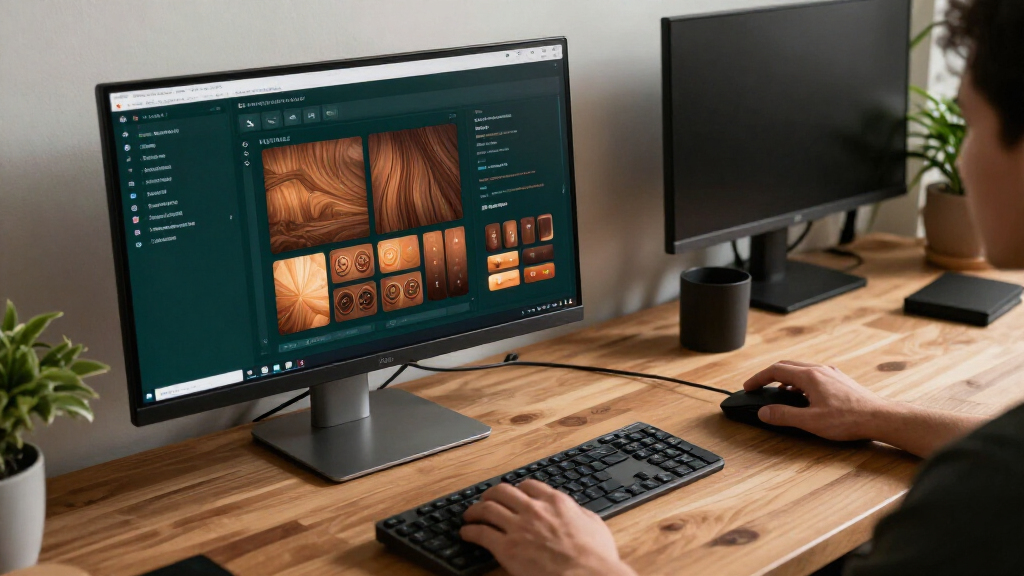
DEsk is a beta Linux desktop environment for Wayland that renders a realistic desk as its interface, with paper windows, a drawer dock and a bookshelf-style app launcher. Its GitHub project lists v0.1.2, a release following the first public version that includes fixes and a Fedora installer; the project also provides installation scripts for several other distributions.
DEsk, a beta desktop environment for Linux and Wayland, has made its first public release and lists version 0.1.2 with fixes and an installer for Fedora. The project replaces conventional desktop imagery with a rendered desk: windows appear as sheets of paper, applications sit in bookshelf binders, and notifications arrive in a post box.
The project describes DEsk as realistic skeuomorphism, likening its visual approach to iOS 6: interface elements are drawn to resemble physical objects rather than using icons that merely stand for them. Paper windows have visible fibres and folded corners. Their corner menus offer actions named Fold, Unfold or Refold, and Discard for minimizing, maximizing or restoring, and closing a window.
Other functions are built into the same setting. A drawer acts as the dock, a bookshelf organizes apps in ring binders, and an index book lists programs alphabetically with a search field. A post box contains notifications. The Control Panel is presented as a machine built into the desk, with controls for volume, networking, Bluetooth, lighting, screen brightness and power options. Keyboard shortcuts include Super+D for the drawer, Super+A for apps, Super+N for notifications and Super+C for the control panel.
DEsk says its room is ray-traced on the GPU using GLES 3, with a CPU-based tracer available as a fallback. It renders and caches the room for each screen size; the first login can take a few seconds with a GPU and longer without one, according to the project. Install scripts are listed for Debian 13, Ubuntu 24.04 and 26.04, Linux Mint, Pop!_OS, Arch Linux, EndeavourOS, Manjaro, Fedora 43 and 44, and Nobara. The installer displays proposed changes and asks for confirmation.
A desktop built as a physical workspace
DEsk is a distinct attempt to make the desktop itself feel like a single physical workspace, rather than a collection of panels, icons and menus. That design could appeal to Linux users interested in highly themed interfaces or experimental ways to organize common tasks. The project’s many custom objects also make it more than a visual skin: the drawer, binder shelves, paper windows and notification post box define how users reach and manage applications.
The practical trade-off is not yet established. DEsk is explicitly marked beta, and its own release notes warn that rough edges and changes should be expected. The GPU rendering, CPU fallback and initial scene-building time are relevant to people deciding whether the desktop suits their hardware, but the source provides no performance benchmarks or compatibility results beyond the listed distributions and hardware paths.
Linux desktop environment with skeuomorphic design
As an affiliate, we earn on qualifying purchases.
As an affiliate, we earn on qualifying purchases.
From DeskWM to DEsk
The project says the name DEsk combines “Desktop Environment” and “desk” and came from the Reddit community. It was previously called DeskWM. The project states that commands have changed to names such as desk, desk-session and desk-settings, while existing settings, data and DESKWM_* variables carry over automatically.
The GitHub project describes v0.1 as the first public release and v0.1.2 as a beta update with fixes and a Fedora installer. Its author says DEsk is used day to day on their own machines and refers readers to an architecture document for additional technical details. That is the developer’s account, not independent testing. Users can download a release or build from the repository; the project also directs bug reports and feature suggestions to its documentation and Discord server.
“A Wayland desktop for Linux in realistic skeuomorphism—the kind iOS 6 had, where everything on screen is drawn to look like the real thing.”
— The DEsk project’s GitHub description
Wayland compatible desktop customization tools
As an affiliate, we earn on qualifying purchases.
As an affiliate, we earn on qualifying purchases.
Beta limits and hardware support
The available project material does not provide independent reviews, benchmark results or a complete compatibility matrix. It does not establish how DEsk performs across different GPUs, processors, screen configurations or applications, nor how accessible its interface is for users who rely on assistive technologies. The project says the CPU tracer is a fallback but gives no comparative performance figures.
It is also unclear how quickly the beta will change, what features are planned, or whether the distribution installers have been tested across every listed release and derivative. The developer says settings and data carry over from DeskWM, but users should consult the project’s release notes and documentation for migration details before installing.
GPU ray tracing hardware for Linux
As an affiliate, we earn on qualifying purchases.
As an affiliate, we earn on qualifying purchases.
Install, test and report issues
The immediate next step for interested users is to review the v0.1.2 release notes, download the appropriate package or source, and follow the installation instructions for their distribution. The project says users should log out after installation and select DEsk from the login screen. It advises rerunning the same installation command to update, with settings preserved.
Further development is not dated in the supplied material. The project invites users to report bugs and suggest features through its support channels, so testing and feedback are the clearest stated routes for shaping the beta. Whether the next release will add features, broaden compatibility or focus on stability has not been announced.
Linux application launcher bookshelf
As an affiliate, we earn on qualifying purchases.
As an affiliate, we earn on qualifying purchases.
Key Questions
What is DEsk?
DEsk is a beta Linux desktop environment for Wayland that presents common interface elements as objects on a realistic desk, including paper windows, a drawer dock and a bookshelf app launcher.
Which Linux distributions are listed for installation?
The project lists scripts for Debian 13; Ubuntu 24.04 and 26.04; Linux Mint; Pop!_OS; Arch Linux and its listed derivatives; and Fedora 43 and 44, including Nobara. The source does not provide independent compatibility testing for each system.
Does DEsk require a GPU?
The project says the room is ray-traced on a GPU using GLES 3, with a CPU tracer as a fallback. It warns that first-time rendering takes longer without a GPU, but supplies no hardware requirements or performance benchmarks.
Is DEsk ready for everyday use?
The developer says DEsk is used day to day on their own machines, but describes the public release as a beta and warns users to expect rough edges and changes. That account is not an independent assessment of reliability.
Source: hn
Fall Picks
fall essentials
As an affiliate, we earn on qualifying purchases.