
Starting with Python is a great choice for beginners because of its simple syntax and focus on clarity. You’ll learn how to write clean, readable code by understanding basic syntax rules like indentation and data types. Using variables, numbers, strings, and collections becomes straightforward, thanks to Python’s dynamic typing. As you progress, you’ll see how easy it is to create programs that work effectively—if you keep exploring, you’ll discover more ways to build your skills and confidence.
Key Takeaways
- Python’s simple syntax and indentation make it easy for beginners to learn programming fundamentals.
- Understanding basic data types like integers, floats, and strings is essential for effective coding.
- Python’s dynamic typing allows flexible variable assignment without explicit type declarations.
- Proper use of indentation defines code blocks, promoting clean and readable programs.
- Starting with simple projects helps build confidence and grasp core programming concepts quickly.
Have you ever wondered how to start programming? If you’re new to coding, Python is an excellent choice because of its simplicity and readability. To begin, you’ll need to understand the basics of Python syntax, which is the set of rules that define how Python code is written and interpreted. Python syntax is straightforward, making it easier for beginners to grasp concepts without getting overwhelmed by complex rules. For example, Python uses indentation to define blocks of code instead of braces or keywords, so paying attention to indentation is *fundamental*. You’ll also learn that Python code is written in a clean, human-readable style, which helps you focus on solving problems rather than deciphering complicated syntax. Additionally, understanding how a projector’s color accuracy affects visual quality can help you appreciate the importance of calibration in creating an optimal viewing experience.
Once you’re familiar with the syntax, it’s important to explore Python’s data types. Data types are the building blocks of any programming language; they determine what kind of data you can store and manipulate. Python offers a variety of data types, each suited for different tasks. For starters, there are numeric types like integers and floating-point numbers, which are used for calculations. Strings are another fundamental data type, representing sequences of characters, perfect for handling text. Lists, tuples, and dictionaries are collections that allow you to store multiple items, making data organization more manageable. Understanding these data types is essential because they influence how you write your programs and process information.
As you begin coding, you’ll notice that Python’s syntax encourages clear and concise expressions. For example, defining a variable is as simple as writing `x = 10`, and Python automatically detects that `x` is an integer. When working with data types, you’ll often perform operations like addition on numbers or concatenation on strings. Knowing which data type to use and how to manipulate it is key to writing effective Python programs. Additionally, Python is dynamically typed, meaning you don’t have to declare data types explicitly — Python figures it out during execution. This feature makes coding faster and more flexible, especially when you’re just starting out.
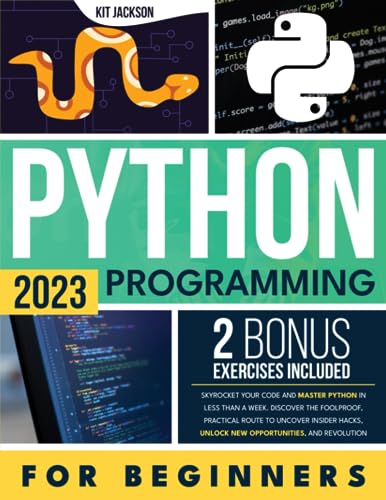
Python Programming for Beginners: Skyrocket Your Code and Master Python in Less than a Week. Discover the Foolproof, Practical Route to Uncover Insider Hacks, Unlock New Opportunities, and Revolution
- Number of chapters: 1
As an affiliate, we earn on qualifying purchases.
As an affiliate, we earn on qualifying purchases.
Frequently Asked Questions
How Long Does It Take to Learn Python Basics?
It usually takes about a few weeks to a month to learn Python basics, depending on your learning curve and practice schedule. If you dedicate consistent time each day, you’ll grasp fundamental concepts faster. Regular practice helps reinforce your skills and build confidence. Keep at it, and you’ll find yourself comfortable with Python basics sooner than you expect, making your coding journey more enjoyable and rewarding.
What Are Common Mistakes Beginners Make in Python?
You often make syntax errors or indentation mistakes when starting out, like forgetting a colon after a function or misaligning code blocks. For example, imagine you forget to indent a loop, causing Python to crash. These common mistakes happen because beginners overlook syntax rules or misjudge indentation, which is vital in Python. Paying attention to proper syntax and consistent indentation helps you avoid these errors and write error-free code.
Is Python Suitable for Mobile App Development?
Yes, Python can be used for mobile app development, especially with cross-platform tools like Kivy and BeeWare. These tools let you build apps that run on both Android and iOS, making Python a versatile choice. While it might not be as popular as Java or Swift for mobile development, Python’s simplicity and extensive libraries can help you create functional apps efficiently across different platforms.
How Do I Choose the Right Python IDE?
Honestly, choosing the right Python IDE is like picking a favorite ice cream — personal and subjective. You should look for code editors with robust IDE features like debugging, auto-completion, and syntax highlighting. Popular options like PyCharm or VS Code offer both power and flexibility. Test a few, see which interface feels intuitive, and remember, the best IDE is the one that makes coding enjoyable, not a chore.
Can I Use Python for Data Science Without Prior Experience?
Yes, you can use Python for data science without prior experience. Many data science tools like Pandas, NumPy, and scikit-learn are beginner-friendly and come with extensive documentation. While programming prerequisites help, you can start learning Python basics alongside data science concepts. Focus on understanding data manipulation and analysis, and practice with real datasets. With dedication, you’ll build skills quickly and apply Python effectively in data science projects.

Python Programming for Beginners: The Complete Python Coding Crash Course – Boost Your Growth with an Innovative Ultra-Fast Learning Framework and Exclusive Hands-On Interactive Exercises & Projects
As an affiliate, we earn on qualifying purchases.
As an affiliate, we earn on qualifying purchases.
Conclusion
As you step into the world of Python, remember that every master was once a beginner, much like the first dawn that breaks the darkness. With patience and curiosity, you’re building a foundation that can open endless possibilities, just as a single drop creates ripples across a vast pond. Keep exploring, and soon you’ll see how your small beginnings can lead to extraordinary journeys—your own story of discovery, waiting to unfold.

Python for Absolute Beginners: A Step by Step Guide to Learn Python Programming from Scratch, with Practical Coding Examples and Exercises
As an affiliate, we earn on qualifying purchases.
As an affiliate, we earn on qualifying purchases.

Freenove ESP32 S3 ESP32-S3 Kit Dev CAM Ultimate Starter Kit, Dual-core 32-bit 240 MHz Microcontroller, Onboard Camera WiFi+BT, 783-Page Tutorial, Python C Java, 116 Projects, 243 Items
- Microcontroller: Dual-core 32-bit 240 MHz processor
- Onboard Camera: Built-in camera module
- Wireless Connectivity: WiFi 2.4 GHz and Bluetooth 5
As an affiliate, we earn on qualifying purchases.
As an affiliate, we earn on qualifying purchases.