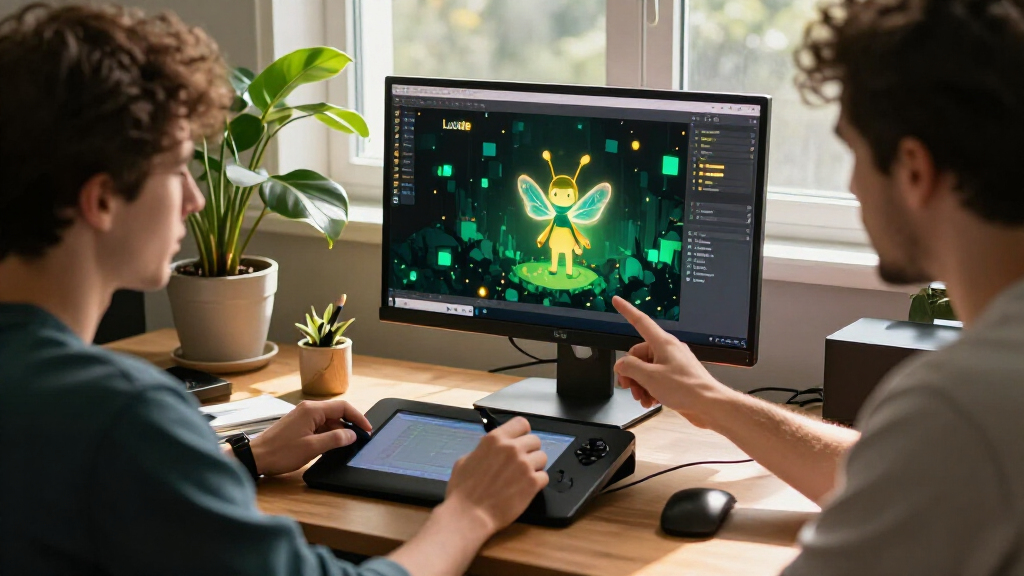

🔍 Read the full analysis: How Creators Turned A Firefly Concept Into “Luciole” on ThorstenMeyerAI.com

Get business pricing on monitors, keyboards and dev gear
- Business-only prices and quantity discounts
- Tax-exempt purchasing
- Multiple users, one account, clear invoices
TL;DR
“Luciole — The Synchronous Fireflies of Vallon Creux” is an AI-built interactive exhibition piece in the FABLE/175 series. Its 96 simulated fireflies use a Kuramoto-style oscillator model to show flashes moving from scattered timing toward a shared rhythm, with visitor interaction able to disrupt the pattern.
The FABLE/175 exhibition’s Room 155 presents “Luciole — The Synchronous Fireflies of Vallon Creux,” an AI-built interactive website where visitors can watch 96 simulated fireflies move from scattered flashes toward a shared rhythm, as detailed in the original project account. The fictional field notebook makes the underlying synchronization model part of the experience: visitors can change how strongly the insects influence nearby neighbors and disturb the pattern to see how it responds.
According to the project description on ThorstenMeyerAI.com, Luciole and Vallon Creux are invented for the exhibit; they do not refer to a real company, location or field study. The website is also described as AI-built, with the process itself included in the presentation. The supplied material identifies the room as number 155 of 175 in the FABLE/175 series.
At the center is a simulation in which each firefly is represented by an oscillator with its own phase and tempo, linked to nearby neighbors. The model updates those phases over time. A control for coupling changes the strength of local influence, while a live coherence measure reports how closely the simulated flashes align. Pointer interaction scatters the phases; a trace records the measured drop and recovery, and a phase diagram is drawn from the simulation.
The visual treatment reinforces the notebook premise rather than presenting the work as a conventional science dashboard. Forest-dark green forms the background, chartreuse marks the flashes, and muted mauve separates annotations and other human details. The project says the visual elements are made with HTML, CSS, SVG and canvas, without downloaded image assets or prerecorded firefly footage. It also describes reduced-motion handling, focus styling, mobile-oriented presentation and pausing the simulation when relevant views are offscreen or the browser tab is hidden.
FABLE/175 · Room 155 · Interactive exhibition
How Creators Turned a Firefly Concept Into “Luciole”
A fictional field notebook becomes a living model of synchronization: 96 simulated fireflies, local influence, and a visitor who can send the rhythm scattering.
“Click anywhere to perturb — inject chaos and watch order re-emerge.”
The central interaction · Art-direction briefMake a hidden rhythm visible
The exhibition pairs a notebook-style story with an interactive simulation. Visitors see flashes begin out of step, influence one another, and sometimes settle into a shared rhythm.
A field notebook
“Luciole — The Synchronous Fireflies of Vallon Creux” frames the page as a naturalist’s record, with invented species and observations shaping the experience.
Coupled oscillators
Each firefly has a phase and tempo. A Kuramoto-style model updates those phases as nearby simulated insects exert influence.
A pattern you can disturb
Change the coupling strength or interact with the field. Flashes scatter; a coherence reading and trace show how the simulated order changes.
From scattered flashes to shared timing
At low alignment, each oscillator flashes on its own schedule. As local coupling brings phases together, more of the field flashes in step. The coherence measure reports alignment in the simulation, while the phase diagram and trace make the changing state visible.
Brief to browser exhibit
The brief called for a single-page experience with a forest-at-night palette, a notebook voice, and a central moment visitors could alter for themselves.
What the project says—and what it does not
The exhibit explains a modeled phenomenon through interaction. The available account also draws clear boundaries around its fictional setting and its unverified production claims.
| Project account | Available record |
|---|---|
| Luciole and Vallon Creux | ✓Invented for the exhibit |
| 96 fireflies and live coherence | ✓Described as part of the simulation |
| AI-built website | ✓Creation process is part of the presentation |
| Performance and accessibility | ~Described features; no independent review cited |
| Scientific validation or field data | —Not established by the supplied material |
“Luciole and Vallon Creux are fictional, created for the exhibit—not a real company, place, or field study.”
FABLE/175 project descriptionInterpretation: Coherence readings describe the model on screen. They are not measurements of wild firefly populations. The available account does not verify the brief’s target timing or performance requirements.
One exhibit, two stories
Visitors can explore how a synchronization model behaves and how an AI-made page turns a creative brief into an interactive presentation.
Observe the behavior
Follow phase alignment, disturbance, and recovery through the animation and its readings.
Inspect the framing
The project account says a “Prompt” link in the room footer exposes the original art-direction brief.
Keep claims in scope
The supplied text mentions a three-pass process but ends before detailing the passes or documenting independent evaluation.
Making Synchronization Visible
Luciole’s value lies in turning an abstract process into something visitors can observe and manipulate. Rather than showing synchronization only as a finished, coordinated animation, the exhibit presents a changing system: individual signals begin at different times, influence one another locally and can be pushed out of alignment. The coherence measure and trace connect the visual effect to readings from the simulation, according to the project description.
That design gives the piece a second subject alongside fireflies: how an AI-made website can communicate an idea. The source describes both the finished room and the prompt used to create it as part of the exhibit. Readers can therefore examine not only the modeled behavior but also the creative brief and production framing behind the page. The approach is relevant to digital exhibitions and educational interfaces, where an interactive model can let audiences test a process rather than simply read a definition.
The distinction between a fictional setting and a modeled phenomenon matters. Vallon Creux and the notebook narrative are invented, while the project says the simulation is based on a Kuramoto-style model of coupled oscillators. The site should be understood as an art-and-interaction piece, not as evidence from field research or a report of observed firefly populations.
interactive firefly simulation software
As an affiliate, we earn on qualifying purchases.
As an affiliate, we earn on qualifying purchases.
From Brief to Browser Exhibit
The supplied material identifies the work as Room 155 of 175 and names its original art-direction brief as “Luciole.” The brief called for a single-page showcase with a forest-at-night palette, a notebook-like voice and a central moment in which fireflies synchronize while a visitor watches. It also specified an interaction: clicking should disturb the pattern so that viewers can see whether order returns.
The brief describes a broader set of intended details, including invented species and flash-pattern notes, a seasonal calendar, and an explanation of the model in a margin note. It calls for a self-contained implementation using HTML, CSS and JavaScript, with no frameworks, external requests or image assets. The project description says the live room uses generated visual elements and includes accessibility and performance measures, but the provided material does not document an independent review of those features.
The source also says the original brief is available through a “Prompt” link in the room’s footer and identifies the site as part of the FABLE/175 pipeline. It mentions a three-pass creation process, but the supplied text ends before detailing each pass. That limits what can be reported about how the site was reviewed or revised.
““Luciole and Vallon Creux are fictional, created for the exhibit—not a real company, place, or field study.””
— FABLE/175 project description
synchronization visualization tools
As an affiliate, we earn on qualifying purchases.
As an affiliate, we earn on qualifying purchases.
Limits of the Project Record
The source material does not provide a dated publication announcement, traffic figures, visitor feedback or an independent technical assessment. It describes the page as AI-built and outlines its interaction and implementation, but does not identify which AI tools produced particular components or how much human editing and testing took place.
There is also a difference between the reproduced brief and the description of the finished room. The brief calls for hundreds of fireflies and says synchronization should take about 20 seconds; the account of the live exhibit specifies 96 simulated fireflies but does not confirm that timing. The actual behavior may depend on visitor settings or implementation details not included in the supplied text. Claims about 60-frame-per-second performance and exact behavior across device sizes are requirements in the brief, not independently verified results in the available account.
Finally, the material does not establish how closely the simulation represents real firefly behavior beyond using a coupled-oscillator model. The exhibit is explicitly fictional, and no field observations or scientific validation are cited. Its coherence readings describe the model on screen, not measurements of insects in nature.
AI-driven interactive exhibit equipment
As an affiliate, we earn on qualifying purchases.
As an affiliate, we earn on qualifying purchases.
What Visitors Can Verify
The room is presented as a live browser experience at the URL named in the source: fable-25-830.netlify.app/sites/luciole/. Visitors can test the interaction directly by changing the coupling control and disturbing the field, then compare the animation with the coherence trace and phase diagram. The project description says the “Prompt” link in the footer exposes the art-direction brief behind the work.
No later release, update or evaluation is announced in the supplied material. The next useful information would be a dated account from the project’s creators documenting the build process, the testing behind the accessibility and performance claims, and any changes between the original brief and the published room.
As an affiliate, we earn on qualifying purchases.
Key Questions
What is Luciole?
Luciole is Room 155 in the FABLE/175 exhibition: an AI-built interactive website presented as a field notebook about simulated fireflies synchronizing their flashes.
Is Vallon Creux a real place?
No. The project description says Vallon Creux and Luciole are fictional, and the site is not a real field study or company.
How does the firefly simulation work?
Each simulated firefly is represented by an oscillator with its own phase and tempo. Nearby oscillators influence one another; a coupling control changes the strength of that influence, and the display tracks how closely the flashes align.
Can visitors change the synchronization?
Yes. The project description says visitors can adjust coupling and use pointer interaction to disturb the phases, then watch the simulation respond. The page also presents a coherence measure and trace of the change.
Does Luciole document real firefly research?
No real field observations are cited in the supplied material. The exhibit uses a modeled synchronization process in a fictional setting, so its visual readings should not be treated as measurements of wild fireflies.
Source: ThorstenMeyerAI.com
Fall Picks
fall essentials
As an affiliate, we earn on qualifying purchases.