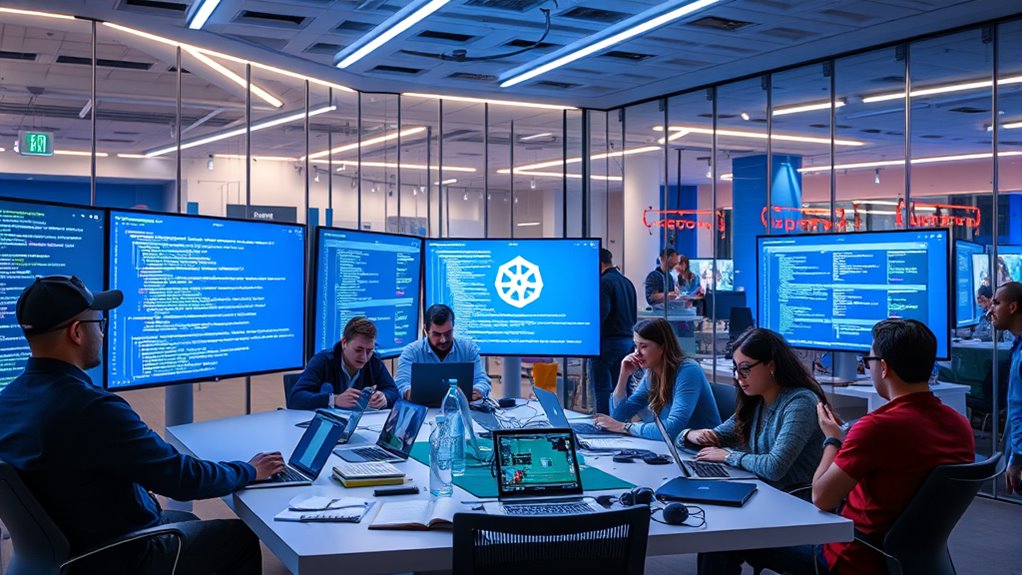

Inside Kubernetes, you’ll find a thriving open-source community that sustains growth through a clear governance structure, inclusive onboarding, and transparent decision-making. Multiple stakeholders, like steering committees and interest groups, work together to guide the project, making sure everyone’s input counts. New contributors are welcomed with open arms and easy-to-follow resources. If you continue exploring, you’ll uncover how these practices keep the project innovative, resilient, and ready for future challenges.
Key Takeaways
- Kubernetes employs a community governance structure with steering committees and special interest groups to guide project direction collaboratively.
- Its open decision-making process fosters collective ownership and transparency, aligning development with community needs.
- The contributor onboarding process includes clear documentation, mentoring, and beginner-friendly issues to facilitate rapid integration.
- Kubernetes supports large-scale growth through effective collaboration, transparent practices, and community-driven initiatives.
- The project’s success exemplifies how inclusive governance and shared responsibility enable resilience and sustainable open source development.

Open source has transformed from niche projects into a driving force behind modern technology, especially at scale. Take Kubernetes, for example. It’s now a cornerstone of cloud infrastructure, powering countless applications worldwide. Behind this success lies a vibrant community that sustains its growth and innovation. As someone involved or considering joining this community, understanding how community governance operates and how contributor onboarding is managed gives you insight into its remarkable scale and sustainability.
Community governance in Kubernetes is a carefully structured system designed to guarantee fairness, transparency, and effective decision-making. You’re likely to find that decisions aren’t made by a single entity but through a collaborative process involving various stakeholders. This structure includes steering committees, special interest groups, and designated maintainers, all working together to guide the project’s direction. As a contributor or newcomer, you’re encouraged to participate in this governance process, which often involves discussions on mailing lists, community meetings, and open proposals. This openness not only helps distribute power but also nurtures a sense of collective ownership, assuring the project evolves according to the community’s needs rather than a handful of individuals.
Contributor onboarding in Kubernetes is another crucial aspect that supports its large-scale success. You don’t need to be an expert to start contributing; instead, the community is committed to welcoming new members and making their integration smooth. When you first join, you’ll find clear documentation, beginner-friendly issues, and mentoring programs designed to guide you through the process. The onboarding process typically involves understanding the project’s contribution guidelines, setting up your development environment, and gradually taking on more complex tasks. The community actively encourages newcomers to submit patches, review code, or improve documentation. This structured onboarding assures that new contributors quickly become productive and feel valued, which sustains community growth at scale.
Additionally, the community’s emphasis on effective collaboration ensures that contributions are coordinated efficiently, which is vital at such a large scale. The combination of robust community governance and streamlined contributor onboarding creates a self-sustaining ecosystem where innovation flourishes. You’re empowered to participate at any level, knowing there’s a transparent process for your ideas or concerns to be heard. This inclusiveness helps Kubernetes adapt rapidly to technological changes and user needs while maintaining quality and stability. It’s a model that balances structured leadership with open participation, making sure the project remains resilient as it grows. If you’re considering becoming part of this community, understanding these processes highlights how a well-managed open source project can thrive at an unprecedented scale, driven by collective effort and shared vision.

Kubernetes Made Easy: A Hands-On Guide for Absolute Beginners: Go from Zero to Hero in Kubernetes. Your Practical Guide to Building, Deploying, and Managing Applications.
As an affiliate, we earn on qualifying purchases.
As an affiliate, we earn on qualifying purchases.
Frequently Asked Questions
How Does Kubernetes Manage Contributor Diversity Globally?
You can see Kubernetes manages contributor diversity globally through its emphasis on global collaboration, encouraging participation from developers worldwide. They streamline contributor onboarding by providing clear documentation, mentorship programs, and inclusive communication channels. These efforts make it easier for newcomers from different backgrounds to join, collaborate, and contribute effectively. As a result, Kubernetes benefits from diverse perspectives, fostering innovation and ensuring the project remains flexible and adaptable to various use cases around the world.
What Challenges Arise in Maintaining Open Source Project Security?
You face challenges in maintaining open source project security, like ensuring thorough code review and conducting regular security audits. These processes help identify vulnerabilities early, but can be time-consuming and require dedicated resources. You also need to manage diverse contributor access and prevent malicious code from slipping in. Staying vigilant and fostering a security-focused community are essential to protect the project’s integrity and trustworthiness.
How Are Decision-Making Processes Handled Within the Community?
Imagine a ship steering through open waters — that’s how your community navigates decisions. You’re part of a meritocracy governance, where contributions and expertise weigh heavily. Decisions are made through consensus building, ensuring everyone’s voice matters. Leaders are earned, not appointed, fostering trust. This collaborative approach keeps the project aligned, transparent, and inclusive, guiding the community smoothly toward shared goals while balancing diverse perspectives effectively.
What Are the Key Metrics for Measuring Community Impact?
You measure community impact through contributor engagement and code review efficiency. High engagement indicates active participation and collaboration, while efficient reviews show streamlined processes that foster faster development. Tracking the number of new contributors, pull requests, and response times helps gauge growth and responsiveness. These metrics reveal how well the community supports its members and sustains project momentum, ultimately reflecting its health and influence.
How Does Kubernetes Handle Conflicting Contributions or Feature Requests?
Imagine a bustling marketplace where voices clash over stalls. Kubernetes handles conflicting contributions through conflict resolution, encouraging open dialogue among contributors. Maintainers facilitate discussions, weighing each feature request’s importance during prioritization meetings. They seek consensus, balancing innovation with stability. By transparently reviewing proposals and making data-driven decisions, Kubernetes guarantees that the most valuable features rise to the top, keeping the community aligned and focused on shared goals.

Entrepreneurship in Innovation Communities: Insights from 3D Printing Startups and the Dilemma of Open Source Hardware (Contributions to Management Science)
As an affiliate, we earn on qualifying purchases.
As an affiliate, we earn on qualifying purchases.
Conclusion
By embracing open source at scale, you foster collaboration, fuel innovation, and build community. You share knowledge, solve problems, and create solutions together. You contribute code, learn from others, and grow stronger as a collective. You participate actively, support openly, and evolve constantly. In doing so, you don’t just develop software; you shape a vibrant ecosystem. Open source isn’t just a way to work; it’s a way to connect, create, and advance together.
developer onboarding kits
As an affiliate, we earn on qualifying purchases.
As an affiliate, we earn on qualifying purchases.

Managing Distributed Cloud Applications and Infrastructure: A Self-Optimising Approach (Palgrave Studies in Digital Business & Enabling Technologies)
As an affiliate, we earn on qualifying purchases.
As an affiliate, we earn on qualifying purchases.