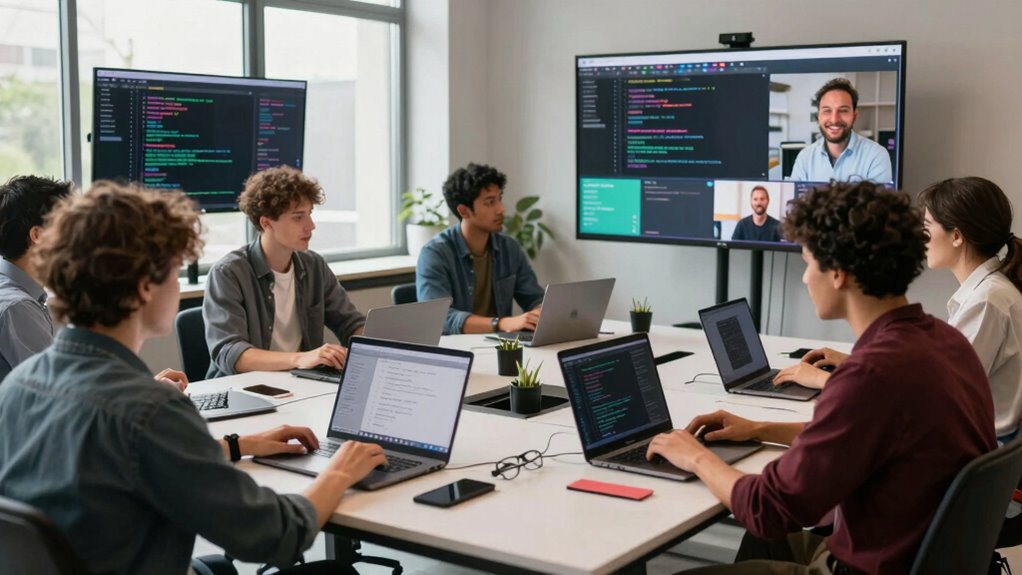

The latest remote work shift means you’ll collaborate more flexibly and asynchronously, breaking down geographical barriers. You’ll rely on digital tools for communication and project management, making it easier to stay aligned across time zones. Building trust and team cohesion requires virtual activities, while clear messaging guarantees productivity stays high. As you adapt to new tools and workflows, you’ll find your team working more autonomously. Stick around to discover how these changes can boost your developer collaboration game.
Key Takeaways
- Developers now collaborate across diverse locations, leveraging virtual tools to maintain productivity and team cohesion.
- Asynchronous communication reduces meeting overload, emphasizing clear documentation and updates.
- Time zone differences require thoughtful planning of meetings and workflows to ensure continuous progress.
- Self-motivation and accountability are vital, with transparent goals fostering independent yet aligned work.
- Mastering new collaboration tools and practices enhances remote teamwork and supports ongoing skill development.

The rise of remote work has transformed how developers collaborate, breaking down geographical barriers and enabling teams to operate from anywhere. This shift means you no longer need to be in the same office to contribute effectively, but it also introduces new challenges in maintaining team cohesion and clear communication. To keep everyone aligned, you might find yourself relying more on virtual team building activities that foster trust and camaraderie despite physical separation. These activities could range from casual virtual coffee breaks to structured team games, helping you and your colleagues feel connected and engaged.
At the same time, asynchronous communication has become an essential part of your daily workflow. Instead of depending solely on real-time meetings, you communicate through emails, project management tools, and messaging platforms where responses can come at different times. This flexibility allows you to work when you’re most productive, but it also requires you to be more deliberate about how you share information. Clear, concise messages are key to avoid misunderstandings, and you need to be proactive in checking updates and providing feedback. Over time, this approach can improve your efficiency, but it demands a heightened level of discipline and organization. Incorporating tools that support project visibility can further streamline this process and keep everyone on the same page.
Remote work has also pushed you to develop new strategies to collaborate effectively across time zones. You learn to plan meetings thoughtfully, accommodating different schedules while ensuring everyone’s voice is heard. When synchronous meetings are necessary, they might be shorter and more focused, with a clear agenda to maximize productivity. Meanwhile, asynchronous tools enable you to document decisions and progress, creating a record that everyone can review at their convenience. This way, your team maintains momentum without being hamstrung by conflicting schedules. Additionally, understanding digital safety practices becomes more important as your team relies heavily on online tools and platforms to protect sensitive information. Embracing these safety protocols helps safeguard your team’s data and maintains trust across all remote interactions.
Moreover, the shift emphasizes the importance of self-motivation and accountability. Without direct supervision, you rely on transparent workflows and shared goals to stay on track. You might find yourself participating in virtual team building exercises designed to boost morale and reinforce team identity, which are more essential than ever in a remote setting. These activities help bridge the gap created by physical distance, making you feel part of a unified team despite being scattered across different locations. Developing accountability practices is crucial to ensure everyone remains committed to their roles and responsibilities.
Ultimately, this latest remote work shift means you need to adapt and embrace new tools and methods for collaboration. By leveraging virtual team building and mastering asynchronous communication, you can continue to work productively and connect meaningfully with your team. It’s a continuous learning process, but one that offers the flexibility and autonomy that many developers value. As you grow more comfortable with these practices, you’ll find remote collaboration becomes not just feasible but also highly effective. Incorporating vacuum knowledge into your understanding of tools and best practices can also help you streamline workflows and improve overall team efficiency.

Leading Without Walls The Complete Guide to Remote Team Management: Strategy, Culture, Tools, and Human Dynamics in the Distributed Workplace (Business and Investments)
As an affiliate, we earn on qualifying purchases.
As an affiliate, we earn on qualifying purchases.
Frequently Asked Questions
How Has Remote Work Impacted Developer Onboarding Processes?
Remote work has streamlined developer onboarding by enabling virtual mentorship, which helps new hires connect with experienced team members online. You find that onboarding automation tools facilitate smooth, consistent processes, reducing manual tasks and onboarding time. This shift allows you to onboard remotely more effectively, fostering quicker integration into the team and improving overall collaboration. As a result, new developers adapt faster and become productive sooner, despite physical distance.
What Tools Are Most Effective for Remote Developer Communication?
You’ll find that tools like Slack, Microsoft Teams, and Discord excel for remote developer communication, supporting both asynchronous updates and real-time collaboration. These platforms enable quick messaging, organized channels, and video calls, making teamwork seamless. You’ll appreciate their ability to keep everyone on the same page, whether in quick check-ins or deep discussions, ensuring your projects stay on track regardless of time zones or schedules.
How Does Remote Work Influence Code Review Practices?
Remote work transforms code review practices by emphasizing asynchronous feedback and peer review. You can review code at your own pace, providing detailed feedback without interrupting workflows. This flexibility encourages thorough peer review, leading to higher-quality code. Asynchronous feedback helps you catch issues early, improve collaboration, and maintain productivity across different time zones. Overall, remote work fosters more thoughtful, all-encompassing code reviews, enhancing team cohesion and software quality.
Are Remote Teams More Prone to Security Vulnerabilities?
You might worry that remote teams are more prone to security vulnerabilities, and indeed, cybersecurity challenges can be more complex outside the office. With dispersed data access, protecting sensitive information becomes harder, risking breaches. Yet, it’s not inevitable. By prioritizing data protection, implementing robust security protocols, and staying vigilant, you can safeguard your team’s projects and counteract the vulnerabilities that remote work can introduce.
How Can Managers Measure Remote Developer Productivity Effectively?
You can measure remote developer productivity by tracking clear performance metrics like code quality, task completion rates, and project milestones. Use collaboration strategies such as regular check-ins, peer reviews, and collaborative tools to gauge engagement and teamwork. These approaches help you get an accurate picture of individual and team performance, ensuring you recognize achievements and identify areas needing support, ultimately fostering a productive remote work environment.

Team Building Games for Work – 200 Conversation Cards for Team Building. Fun Office Games and Conversation Starter Cards for Meetings and Group Activities. Ice Breakers Perfect for Work and School
✅ BUILD STRONGER TEAMS – FUN, EFFECTIVE & EASY. Spark collaboration with 200+ engaging questions crafted for team…
As an affiliate, we earn on qualifying purchases.
As an affiliate, we earn on qualifying purchases.
Conclusion
As you navigate this new remote landscape, remember that collaboration is the lighthouse guiding your team through the fog. Embrace the tools and rituals that keep your collective ship steady, even when oceans apart. The shift isn’t just about working remotely; it’s about forging a brighter beacon of connection and innovation. Keep your focus on these shared lights, and you’ll chart a course toward success—together, no matter how distant the horizon.

Concurrency in C# Cookbook: Asynchronous, Parallel, and Multithreaded Programming
As an affiliate, we earn on qualifying purchases.
As an affiliate, we earn on qualifying purchases.
Leading Without Walls The Complete Guide to Remote Team Management: Strategy, Culture, Tools, and Human Dynamics in the Distributed Workplace (Business and Investments)
As an affiliate, we earn on qualifying purchases.
As an affiliate, we earn on qualifying purchases.