
📊 Full opportunity report: Track What Changes During TRT: Symptoms And Lab Results on IdeaNavigator AI — validation score, market gap, and execution plan.

Get business pricing on monitors, keyboards and dev gear
- Business-only prices and quantity discounts
- Tax-exempt purchasing
- Multiple users, one account, clear invoices
TL;DR
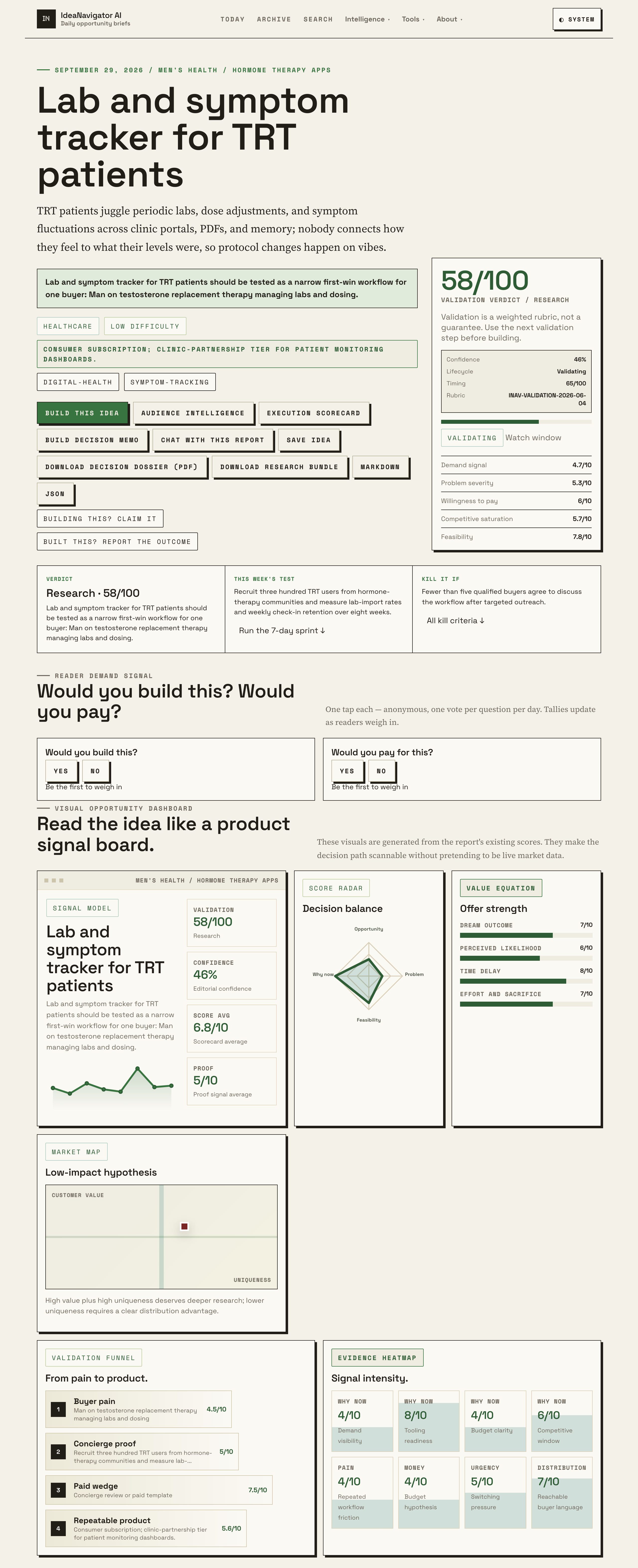
IdeaNavigator AI proposes a subscription app for men on testosterone replacement therapy that imports lab results and charts them against dose changes and daily symptom check-ins. TRT prescriptions and telehealth clinics have grown quickly, leaving a large self-managing population with fragmented records. Validation would require recruiting 300 TRT users and measuring lab-import rates and eight-week retention.
A newly published product proposal from IdeaNavigator AI makes the case for a lab-and-symptom tracker aimed at a single user group: men on testosterone replacement therapy (TRT) who manage periodic blood work, dose adjustments, and fluctuating symptoms largely on their own. The concept, framed as a “narrow first-win workflow” for an indie developer, would import lab PDFs, chart hormone panels against dose changes and daily check-ins, and flag values drifting outside target ranges. It has not been built or tested with patients.
The problem the proposal identifies is fragmentation. TRT patients receive lab results across clinic portals, PDF attachments, and their own recollection, according to the IdeaNavigator AI write-up. Because nothing connects how patients feel to what their hormone levels actually were, the proposal argues, protocol changes too often happen “on vibes” — that is, without a documented relationship between symptoms, measured values, and dose timing.
The minimum viable product described has four concrete components. First, the app imports lab PDFs. Second, it charts hormone panel results over time and overlays them with dose changes and daily symptom check-ins. Third, it generates trend summaries intended to be brought to clinic visits, giving physicians a compact record rather than a stack of disconnected reports. Fourth, it flags lab values that drift outside target ranges, giving patients an early signal that a follow-up conversation with their provider may be warranted.
The commercial model is straightforward: a consumer subscription for individual patients, plus a clinic-partnership tier that would give hormone-therapy practices monitoring dashboards across their patient base. The proposed validation plan is equally narrow — recruit 300 TRT users from hormone-therapy communities and measure two metrics over eight weeks: how many actually import lab results, and how many keep up weekly symptom check-ins. Those two rates would determine whether the workflow earns a place in a patient’s routine or joins the pile of abandoned health apps.
Why Fragmented TRT Records Matter
The proposal lands amid a documented surge in TRT prescriptions and telehealth men’s-health clinics. According to the IdeaNavigator AI analysis, that growth has produced a large population of self-managing patients whose care is fragmented across providers by design — patients may use a telehealth prescriber, a local lab draw site, and a primary care physician who never see each other’s records. A tool that consolidates lab history and symptom data addresses a gap that no single clinic has an incentive to fill.
There is also a practical safety angle. Testosterone therapy involves repeated dose adjustments informed by blood work, including hematocrit, estrogen markers, and testosterone levels themselves. A patient who can show a clinician a clear chart of values over time against dose changes is better positioned for an evidence-based adjustment than one working from memory. The flagging feature matters here: drift outside target ranges is exactly the signal that warrants a provider’s attention rather than self-directed dose changes.
For builders, the significance is strategic. The proposal deliberately avoids a broad “men’s health platform” pitch and targets one buyer with one recurring pain point, betting that a narrow wedge — labs plus symptoms for TRT — is the shortest path to retention and, eventually, the clinic-tier revenue.
The Rise of Telehealth TRT Prescribing
Testosterone replacement therapy has moved from a niche endocrinology treatment to a product widely advertised and prescribed through online clinics, many of which ship medications directly to patients after remote consultations and periodic lab draws. That shift, as the IdeaNavigator AI analysis notes, is what created the self-managing patient population the proposed app targets: men who follow their own protocols, order their own follow-up labs in some cases, and coordinate across multiple vendors.
The proposed product sits within the broader men’s health and hormone-therapy app category, which includes telehealth platforms, at-home lab testing services, and general symptom trackers. What the concept claims as its distinguishing feature is the explicit join between two data streams — objective lab values and subjective symptom reports — matched against the timing of dose changes.
What the Proposal Hasn’t Proven
Nothing in the concept has been validated with patients. The 300-user, eight-week validation study is a plan, not a result, and the two retention metrics it would measure — lab-import rate and weekly check-in retention — remain unmeasured. It is not yet clear what threshold would count as success.
Several practical questions are unresolved. Lab PDF formats vary widely by provider and testing company, and the reliability of automated import is unknown. Regulatory posture is also unaddressed: an app that interprets lab values and flags out-of-range results may edge toward territory that regulators treat differently from a passive diary. Whether hormone-therapy communities will tolerate product recruitment, whether clinics will pay for a monitoring tier, and whether patients will sustain daily check-ins past the novelty period are all open questions.
Testing the Lab-Import Assumption
The stated next step is the validation study itself: recruiting 300 TRT users from hormone-therapy communities and running the eight-week measurement of lab-import rates and check-in retention. Only if those numbers hold up, according to the proposal’s logic, would building the full MVP — charting, trend summaries for clinic visits, and out-of-range flags — be justified.
Anyone pursuing the concept would also need to settle the PDF-import question early, since a tracker that cannot reliably ingest lab results has no core loop. A subsequent milestone, contingent on consumer traction, would be piloting the clinic-partnership tier with one or two telehealth practices. No timeline for any of these steps has been set.
Source: IdeaNavigator AI
Key Questions
Does a TRT lab and symptom tracker app exist yet?
No. What has been published is a product proposal by IdeaNavigator AI. The concept has not been built, and its validation plan — 300 users over eight weeks — has not been carried out.
What would the app actually do for a TRT patient?
Per the proposal, it would import lab PDFs, chart hormone panels over time, overlay dose changes and daily symptom check-ins, generate trend summaries for clinic visits, and flag lab values drifting outside target ranges.
Why would patients need this instead of their clinic’s portal?
The proposal’s argument is that TRT care is split across telehealth prescribers, lab companies, and local physicians, with no single system linking symptoms to lab values and dose timing. Existing portals store results but do not connect them to how patients felt at the time.
How would the app be tested before being built?
The plan is to recruit 300 TRT users from hormone-therapy communities and measure two things over eight weeks: how many import their lab results and how many keep completing weekly symptom check-ins.
How would the product make money?
Through a consumer subscription for individual patients, with an additional clinic-partnership tier offering patient-monitoring dashboards for hormone-therapy practices.
Source: IdeaNavigator AI
Fall Picks
fall essentials
As an affiliate, we earn on qualifying purchases.