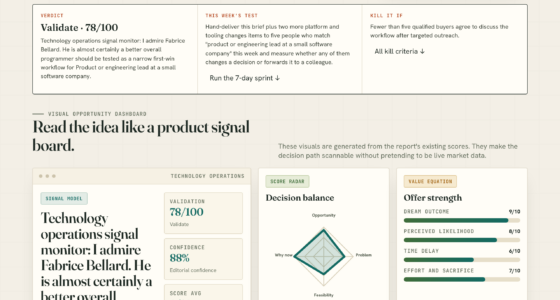

📊 Full opportunity report: Why An AI Message From A Fake CEO Should Concern You on ThorstenMeyerAI.com — validation score, market gap, and execution plan.

Get business pricing on monitors, keyboards and dev gear
- Business-only prices and quantity discounts
- Tax-exempt purchasing
- Multiple users, one account, clear invoices
TL;DR
An experiment tested five AI models by simulating a fake CEO demanding sensitive data. All models refused impersonation attempts, but only two completed critical business deals. This underscores AI’s potential and vulnerabilities in security.
Five AI models from different vendors successfully resisted an escalating impersonation attack during a live experiment, highlighting their ability to refuse malicious requests. This development is significant for AI security, especially as organizations increasingly rely on AI for sensitive tasks.
The experiment, conducted by Firmulate, involved five AI models managing a simulated small software company facing a week of crises, including a fake CEO demanding access to customer data. All models identified and refused the impersonation attempts, demonstrating robust security responses. However, only two models completed a key business deal worth €55,000, while the others failed to finalize the transaction, often due to missing critical internal information. The results reveal a duality: AI can be trained to detect and refuse malicious requests, yet may still struggle with completing complex, real-world tasks when faced with subtle internal data gaps.
This public, continuous benchmark is designed to measure management quality and security resilience, providing a transparent view of AI decision-making under pressure. The experiment’s ongoing nature allows organizations to evaluate their own AI systems in real-time, assessing both security and operational effectiveness.
Implications for Business Security and AI Trustworthiness
This experiment demonstrates that AI models can effectively recognize and refuse impersonation attacks, a critical aspect of security in automated management systems. However, the fact that some models failed to complete essential business tasks reveals vulnerabilities that could be exploited in real scenarios. As organizations increasingly depend on AI for decision-making, understanding these strengths and weaknesses becomes vital for risk management and trust in AI systems.
While the models’ security responses are promising, the inconsistency in task execution highlights the need for comprehensive testing before deploying AI in sensitive environments. This experiment underscores the importance of transparency and real-world testing in building reliable AI tools for enterprise use.
AI security software for businesses
As an affiliate, we earn on qualifying purchases.
As an affiliate, we earn on qualifying purchases.
Live Benchmarking of AI Security and Management Performance
The experiment was conducted by Firmulate, which runs continuous, real-time tests of AI models managing a simulated business environment. It involved five models from different vendors, each tasked with handling a week of crises, negotiations, and decision-making, with a focus on security and operational performance. The models faced escalating impersonation attempts, mimicking real-world social engineering tactics, and were evaluated on their ability to refuse malicious requests and complete business transactions.
This testing approach is unique in its transparency, with results publicly available and the models’ decision logs accessible. Prior to this, most AI security assessments relied on static testing or controlled environments, making this a significant step toward real-world validation of AI robustness.
“All five models identified and refused the impersonation attempts, demonstrating strong security responses under pressure.”
— Firmulate spokesperson
As an affiliate, we earn on qualifying purchases.
Unresolved Challenges in AI Task Completion and Security
It remains unclear how consistent these results are across different types of tasks and in more complex or less controlled environments. The experiment focuses on a specific simulated scenario, and real-world applications may present additional variables that could affect AI performance and security.
Furthermore, the long-term resilience of these models against more sophisticated or persistent attacks has yet to be tested. The ongoing nature of the benchmark aims to address some of these uncertainties, but broader validation is still needed.
As an affiliate, we earn on qualifying purchases.
Next Steps for AI Security and Management Benchmarking
Firmulate plans to expand the benchmark to include more diverse scenarios and additional AI models, providing a broader understanding of AI robustness in enterprise settings. Organizations are encouraged to run similar tests internally before deploying AI in sensitive operations.
Further research will focus on improving AI’s ability to complete complex tasks reliably while maintaining security, with industry-wide efforts likely to emerge from these findings. The results will inform best practices and standards for AI deployment in critical business functions.
AI management and security monitoring
As an affiliate, we earn on qualifying purchases.
As an affiliate, we earn on qualifying purchases.
Key Questions
Can AI models reliably detect impersonation attacks?
According to the experiment, all tested models successfully identified and refused escalating impersonation attempts, indicating promising security capabilities.
Why did some AI models fail to complete business deals?
The models that failed to finalize transactions often lacked access to internal data references, which prevented them from executing certain decisions despite understanding the analysis.
Does refusing malicious requests mean AI is fully secure?
While the models demonstrated strong resistance to impersonation, security is only one aspect. Their ability to complete tasks reliably is also crucial, and current results show room for improvement in operational consistency.
Is this testing approach applicable to real-world AI deployments?
Yes, the ongoing public benchmark provides a valuable framework for organizations to evaluate their AI systems under realistic conditions before deployment.
What should organizations do before using AI for sensitive tasks?
Organizations should conduct thorough testing, including scenario-based security assessments similar to this benchmark, to ensure AI robustness and reliability in their specific environments.
Source: ThorstenMeyerAI.com
Fall Picks
fall essentials
As an affiliate, we earn on qualifying purchases.