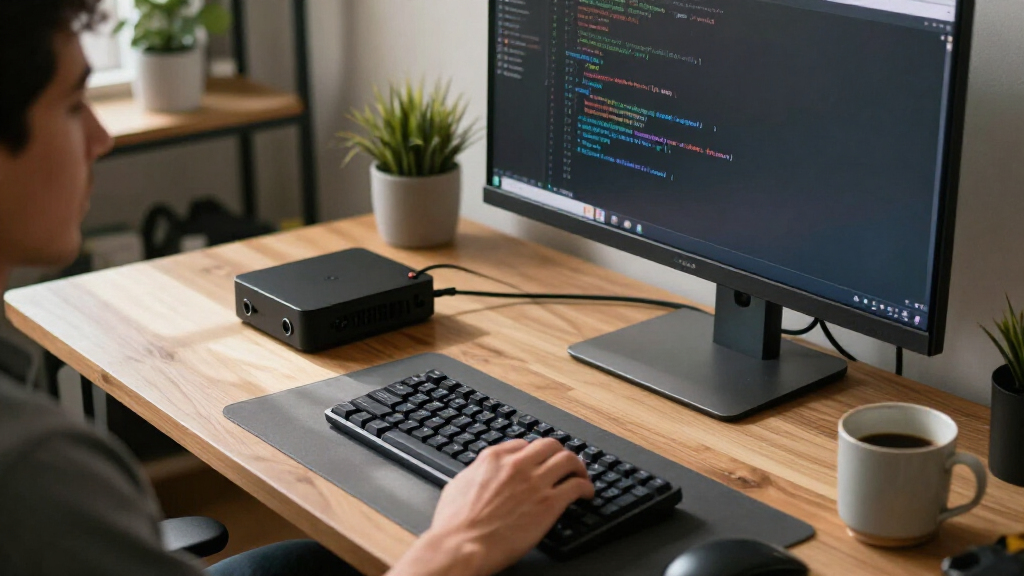
For most software developers, the GEEKOM A8 Max is the best overall pick in this lineup, pairing a Ryzen 7 8745HS with 16GB of DDR5 memory and a 1TB expandable SSD. The GMKtec Nucbox M6 Ultra stands out for developers who want 32GB of RAM for containers and virtual machines, while the GEEKOM A9 Mega offers a higher-memory route for demanding AI and local model work. The main tradeoffs are processing headroom, memory capacity, upgrade options, and the limits of fitting powerful hardware into a small chassis. Lower-powered models can handle lighter coding, but may feel constrained as projects and tools grow. Continue reading for the full breakdown and guidance on matching a mini PC to your development workload.

Get business pricing on monitors, keyboards and dev gear
- Business-only prices and quantity discounts
- Tax-exempt purchasing
- Multiple users, one account, clear invoices
Key Takeaways
- The GEEKOM A8 Max is the best-balanced choice: its Ryzen 7 8745HS and 1TB expandable SSD suit general development, though its 16GB of RAM may call for an upgrade as workloads expand.
- The GMKtec Nucbox M6 Ultra offers a more comfortable starting point for multitasking with 32GB of DDR5 and a Ryzen 5 7640HS, while giving up the A8 Max’s higher-tier processor.
- The two Ryzen AI Max+ 395 systems lead on memory capacity: AX9 Ultra and BOSGAME M5 each list 128GB and 2TB, making them the distinct picks for memory-heavy local workloads.
- Entry-level processors come with clear workload limits: the Pentium Gold 7505 in the GEEKOM Air12 and two-core Ryzen 3 3200U in the Beelink SER3 are better suited to lighter coding than sustained builds and multiple virtual machines.
- Several specs need verification before purchase: the TOPCtec TA1 listing omits memory and storage details, and the AX9 Ultra’s unified memory differs from ordinary upgradeable system RAM.
| ACEMAGIC K1 Mini PC Win 11 Pro, AMD Ryzen 5 7530U, 16GB RAM, 512GB SSD |  | Best Overall | Processor: AMD Ryzen 5 7530U, 6 cores / 12 threads, up to 4.5 GHz | Memory: 16GB LPDDR4X, 3733 MT/s | Storage: 512GB SSD | VIEW LATEST PRICE | See Our Full Breakdown |
| KAMRUI Pinova P2 Mini PC with AMD Ryzen 5 5425U, 16GB RAM, 256GB SSD |  | Best Value for a Multi-Monitor Starter Setup | Processor: AMD Ryzen 5 5425U, 4 cores / 8 threads, 2.7–4.1 GHz | Memory: 16GB LPDDR4 | Storage: 256GB M.2 SSD | VIEW LATEST PRICE | See Our Full Breakdown |
| GEEKOM Air12 Mini PC with Intel Pentium Gold 7505, 8GB RAM, 256GB SSD |  | Best for Lightweight Coding and Learning | Processor: Intel Pentium Gold 7505 | Memory: 8GB DDR4; upgradeable to 64GB | Memory slots: Two SODIMM slots | VIEW LATEST PRICE | See Our Full Breakdown |
| GEEKOM A8 Max Mini PC – AMD Ryzen 7 8745HS, 16 GB DDR5, 1 TB SSD (Expandable) |  | Best Premium Build-Workstation Pick | Processor: AMD Ryzen 7 8745HS, 8 cores / 16 threads | Memory: 16GB DDR5; expandable to 128GB | Storage: 1TB M.2 NVMe SSD; upgradeable to 4TB | VIEW LATEST PRICE | See Our Full Breakdown |
| Beelink SER3 Mini PC, Ryzen 3 3200U 2C/4T 3.5GHz, 16GB DDR4 RAM, 500GB SSD |  | Best for a Simple Dual-Monitor Desk | Processor: AMD Ryzen 3 3200U, 2 cores / 4 threads, up to 3.5 GHz | Graphics: Radeon Vega 3, 3-core, 1200 MHz | Memory: 16GB DDR4 2400 MHz; expandable to 32GB | VIEW LATEST PRICE | See Our Full Breakdown |
| VZMORE AX9 Ultra Mini PC, Ryzen AI Max+ 395, 128GB Unified Memory, 2TB SSD |  | Best for Memory-Heavy Local AI Development | Processor: AMD Ryzen AI Max+ 395, 16 cores and 32 threads, up to 5.1GHz | Graphics: Integrated AMD Radeon 8060S, 40 compute units | Memory: 128GB LPDDR5x unified memory | VIEW LATEST PRICE | See Our Full Breakdown |
| GEEKOM A9 Mega Super AI Mini PC, Ryzen AI Max+ 388, 64GB LPDDR5X RAM, 1TB SSD |  | Best for Local AI Development Without 128GB | Processor: AMD Ryzen AI Max+ 388 | Graphics: AMD Radeon 8060S integrated graphics, 40 compute units | Memory: 64GB LPDDR5X unified memory | VIEW LATEST PRICE | See Our Full Breakdown |
| Glorlin Mini PC with AMD Ryzen 7 6800H, 16GB LPDDR5 RAM, 512GB NVMe SSD, and Radeon 680M |  | Best Compact Pick for Lightweight Development | Processor: AMD Ryzen 7 6800H, 8 cores and 16 threads, up to 4.7GHz | Graphics: Integrated AMD Radeon 680M | Memory: 16GB dual-channel LPDDR5, 6400 MT/s | VIEW LATEST PRICE | See Our Full Breakdown |
| MINISFORUM MS-03 Mini PC Workstation, Intel Core Ultra 9 386H, 32GB DDR5 RAM, 1TB SSD |  | Best for Networked Workstations and Expansion | Processor: Intel Core Ultra 9 386H, 16 cores and 16 threads, up to 4.9GHz | Memory: 32GB DDR5, 5600MHz | Maximum memory: 128GB | VIEW LATEST PRICE | See Our Full Breakdown |
| BOSGAME P3 Lite Mini PC, AMD Ryzen 7 6800H, 32GB DDR5 RAM, 1TB NVMe SSD |  | Best Value for Everyday Development | Processor: AMD Ryzen 7 6800H, 8 cores and 16 threads, up to 4.75GHz | Graphics: Integrated AMD Radeon 680M | Memory: 32GB dual-channel DDR5, expandable to 64GB | VIEW LATEST PRICE | See Our Full Breakdown |
| TOPCtec TA1 AI Mini PC with AMD Ryzen AI 9 365 |  | Best Balanced Developer Mini PC | Processor: AMD Ryzen AI 9 365, 10 cores and 20 threads, up to 5.0GHz | Graphics: Integrated AMD Radeon 880M | Memory: 32GB LPDDR5X 5500MHz | VIEW LATEST PRICE | See Our Full Breakdown |
| BOSGAME Mini PC M5, Ryzen AI Max+ 395, 128GB LPDDR5 RAM, 2TB NVMe SSD |  | Best for Local AI and Heavy Workloads | Processor: AMD Ryzen AI Max+ 395, 16 cores and 32 threads, up to 5.1GHz | Graphics: Radeon 8060S with 40 RDNA 3.5 CUs | Memory: 128GB LPDDR5X-8000 unified | VIEW LATEST PRICE | See Our Full Breakdown |
| GMKtec Nucbox M6 Ultra Mini PC with Ryzen 5 7640HS, 32GB DDR5 RAM, and 1TB SSD |  | Best for Upgrade-Friendly Development | Processor: AMD Ryzen 5 7640HS, 6 cores and 12 threads, up to 5.0GHz | Graphics: AMD Radeon 760M integrated graphics | Memory: 32GB dual-channel DDR5-4800 | VIEW LATEST PRICE | See Our Full Breakdown |
| mini PCs for software development | Processor | Memory | Storage | Display support |
|---|---|---|---|---|
| ACEMAGIC K1 Mini PC Win 11 Pro | AMD Ryzen 5 7530U, 6 cores / 12 threads, up to 4.5 GHz | 16GB LPDDR4X, 3733 MT/s | 512GB SSD | Up to three 4K displays at 60Hz |
| KAMRUI Pinova P2 Mini PC with | AMD Ryzen 5 5425U, 4 cores / 8 threads, 2.7–4.1 GHz | 16GB LPDDR4 | 256GB M.2 SSD | Up to three 4K displays at 60Hz |
| GEEKOM Air12 Mini PC with Inte | Intel Pentium Gold 7505 | 8GB DDR4; upgradeable to 64GB | 256GB SSD | Up to three 4K displays |
| GEEKOM A8 Max Mini PC | AMD Ryzen 7 8745HS, 8 cores / 16 threads | 16GB DDR5; expandable to 128GB | 1TB M.2 NVMe SSD; upgradeable to 4TB | — |
| Beelink SER3 Mini PC | AMD Ryzen 3 3200U, 2 cores / 4 threads, up to 3.5 GHz | 16GB DDR4 2400 MHz; expandable to 32GB | 500GB M.2 PCIe 3.0 x4 SSD | Dual HDMI, up to 3840 × 2160 at 60Hz |
| VZMORE AX9 Ultra Mini PC | AMD Ryzen AI Max+ 395, 16 cores and 32 threads, up to 5.1GHz | 128GB LPDDR5x unified memory | 2TB PCIe 4.0 SSD | Up to four displays via two HDMI 2.1 and two USB4 Type-C ports |
| GEEKOM A9 Mega Super AI Mini P | AMD Ryzen AI Max+ 388 | 64GB LPDDR5X unified memory | 1TB M.2 2280 PCIe SSD | Up to four displays via dual HDMI 2.1 and dual USB4 |
| Glorlin Mini PC with AMD Ryzen | AMD Ryzen 7 6800H, 8 cores and 16 threads, up to 4.7GHz | 16GB dual-channel LPDDR5, 6400 MT/s | 512GB NVMe SSD | Up to three 4K displays via HDMI, DisplayPort, and USB Type-C |
| MINISFORUM MS-03 Mini PC Works | Intel Core Ultra 9 386H, 16 cores and 16 threads, up to 4.9GHz | 32GB DDR5, 5600MHz | 1TB SSD | — |
| BOSGAME P3 Lite Mini PC | AMD Ryzen 7 6800H, 8 cores and 16 threads, up to 4.75GHz | 32GB dual-channel DDR5, expandable to 64GB | 1TB NVMe PCIe 4.0 SSD | Triple 4K at 60Hz or one 8K display |
| TOPCtec TA1 AI Mini PC with AM | AMD Ryzen AI 9 365, 10 cores and 20 threads, up to 5.0GHz | 32GB LPDDR5X 5500MHz | 1TB PCIe 4.0 NVMe SSD | Up to 3 displays; maximum resolution 7680 × 4320 |
| BOSGAME Mini PC M5 | AMD Ryzen AI Max+ 395, 16 cores and 32 threads, up to 5.1GHz | 128GB LPDDR5X-8000 unified | 2TB PCIe 4.0 NVMe SSD; second M.2 slot for expansion | Up to 4 displays; 8K resolution support |
| GMKtec Nucbox M6 Ultra Mini PC | AMD Ryzen 5 7640HS, 6 cores and 12 threads, up to 5.0GHz | 32GB dual-channel DDR5-4800 | 1TB M.2 2280 SSD; dual-slot expansion stated, up to 8TB PCIe 4.0 SSD | Up to three displays; USB4 up to 8K@60Hz, HDMI 2.0 and DisplayPort up to 4K@60Hz |
More Details on Our Top Picks
ACEMAGIC K1 Mini PC Win 11 Pro, AMD Ryzen 5 7530U, 16GB RAM, 512GB SSD
The ACEMAGIC K1 is my most balanced pick here for developers who want a ready-to-work machine without giving up room for a multi-monitor desk. Its six-core Ryzen 5 7530U, 16GB of memory, and 512GB SSD give it a stronger starting point for everyday coding, browser tabs, and local tools than the four-core KAMRUI Pinova P2. Windows 11 Pro comes preinstalled, and Linux support gives developers another environment to use. Three 4K display outputs and two M.2 slots also make it easier to build out a workspace or add project storage. The tradeoff is that its memory is LPDDR4X, and the supplied 16GB is less flexible than the GEEKOM A8 Max’s upgradeable DDR5 memory. This is a practical general-purpose choice, not a high-end build or graphics workstation.
Pros:- Six-core, 12-thread processor offers more parallel capacity than the KAMRUI Pinova P2’s four-core CPU.
- 512GB SSD provides more starting room for tools and project files than the 256GB KAMRUI and GEEKOM Air12.
- Supports up to three 4K displays through HDMI, DisplayPort, and USB-C.
- Two M.2 slots allow storage expansion.
Cons:- 16GB LPDDR4X memory is less expandable than the GEEKOM A8 Max’s upgradeable DDR5 memory.
- Integrated Radeon graphics are not suited to demanding GPU workloads.
- The supplied data does not specify memory expansion or a detailed Linux configuration.
Best for: Developers who want a compact Windows and Linux capable desktop with enough memory, storage, and display connections for everyday coding.
Not ideal for: Developers running memory-heavy virtual machines or large local builds who need more than 16GB of memory and an upgrade path.
- Processor:AMD Ryzen 5 7530U, 6 cores / 12 threads, up to 4.5 GHz
- Memory:16GB LPDDR4X, 3733 MT/s
- Storage:512GB SSD
- Storage expansion:Two M.2 2280 slots; up to 4TB stated
- Operating system:Windows 11 Pro; Linux support stated
- Display support:Up to three 4K displays at 60Hz
- Video outputs:HDMI 2.0, DisplayPort 1.4, USB-C with DisplayPort 1.4
- Networking:Wi-Fi 6, Bluetooth 5.2, Ethernet
- Dimensions:5 × 5 × 1.6 inches
Our verdict“Choose the ACEMAGIC K1 for a balanced coding desktop with Windows, Linux support, and three-display flexibility, provided 16GB of memory is enough.”
KAMRUI Pinova P2 Mini PC with AMD Ryzen 5 5425U, 16GB RAM, 256GB SSD
The KAMRUI Pinova P2 suits developers building a modest desk setup who value display and port flexibility more than a large included drive. Its three 4K display support, six USB-A ports, USB-C, and two M.2 slots make it easy to connect peripherals and add project storage. The four-core, eight-thread Ryzen 5 5425U is a step below the ACEMAGIC K1’s six-core processor, so parallel builds and heavier local services may take longer. Its 16GB of memory gives it a more workable starting point than the GEEKOM Air12’s 8GB, but the 256GB SSD can fill quickly once development tools, containers, and repositories accumulate. The operating system is listed only as preinstalled, so I would check that detail before choosing it for a specific Windows or Linux workflow.
Pros:- 16GB memory is a more useful starting point for development multitasking than the GEEKOM Air12’s 8GB.
- Supports up to three 4K displays at 60Hz.
- Two M.2 slots allow a second drive to be added.
- Six USB-A ports plus USB-C provide room for peripherals and external drives.
Cons:- Four-core Ryzen 5 processor has less parallel capacity than the ACEMAGIC K1’s six-core CPU.
- 256GB SSD leaves limited space for development tools and local project data.
- The supplied specs do not identify the preinstalled operating system.
Best for: New developers or students who need a compact machine for coding practice, web work, and multiple displays, with plans to add storage later.
Not ideal for: Developers who want a clearly specified operating system or need ample included SSD space for containers, virtual machines, and local datasets.
- Processor:AMD Ryzen 5 5425U, 4 cores / 8 threads, 2.7–4.1 GHz
- Memory:16GB LPDDR4
- Storage:256GB M.2 SSD
- Storage expansion:Two M.2 2280 slots; up to 4TB total stated
- Graphics:Integrated AMD Radeon Graphics, 1600 MHz
- Display support:Up to three 4K displays at 60Hz
- Ports:USB-C, 6 USB-A, Gigabit Ethernet, HDMI 2.0, DisplayPort 1.4, 3.5mm audio
- Operating system:Preinstalled; specific OS not stated
- Dimensions:5.05 × 5.05 × 1.73 inches
Our verdict“Pick the KAMRUI Pinova P2 for a port-rich, multi-display starter desktop if its smaller SSD and unspecified operating system fit your plans.”
GEEKOM Air12 Mini PC with Intel Pentium Gold 7505, 8GB RAM, 256GB SSD
The GEEKOM Air12 is the entry-level learning machine in this group: its compact case, low 15-watt power figure, and Linux and Ubuntu compatibility suit basic programming, command-line practice, and lightweight editors. Its clearest advantage over the Beelink SER3 is that the 8GB memory can be upgraded to 64GB across two SODIMM slots, giving an owner a path beyond its modest starting configuration. Still, the Pentium Gold 7505 is a dual-core processor, and 8GB is restrictive for modern IDEs, browser-heavy work, containers, or virtual machines. The KAMRUI Pinova P2 starts with twice the memory and a four-core CPU, making it the safer pick for broader multitasking. The Air12 makes most sense when small size and upgrade potential matter more than strong out-of-box performance.
Pros:- Two SODIMM slots support memory upgrades up to 64GB.
- Compact 4.6 × 4.4 × 1.35-inch case fits a crowded desk.
- Supports up to three 4K displays.
- Compatible with Linux and Ubuntu and includes Wi-Fi 6.
Cons:- 8GB included memory can bottleneck IDEs and multitasking until upgraded.
- Dual-core Pentium processor is a substantial step down from the Ryzen 5 options.
- 256GB SSD offers limited room for local development environments and files.
Best for: Students learning programming or Linux users who mainly run lightweight editors, terminals, and browser-based tools, with the option to upgrade memory.
Not ideal for: Developers who regularly use containers, virtual machines, large IDEs, or compile substantial projects on the machine.
- Processor:Intel Pentium Gold 7505
- Memory:8GB DDR4; upgradeable to 64GB
- Memory slots:Two SODIMM slots
- Storage:256GB SSD
- Graphics:Intel UHD Graphics, 48 execution units
- Display support:Up to three 4K displays
- Video outputs:HDMI 2.0, Mini DisplayPort 1.4, USB-C
- Wireless:Wi-Fi 6, Bluetooth 5.2
- Dimensions:4.6 × 4.4 × 1.35 inches
Our verdict“Choose the GEEKOM Air12 for learning and lightweight coding if you are prepared to upgrade its memory for broader development work.”
GEEKOM A8 Max Mini PC – AMD Ryzen 7 8745HS, 16 GB DDR5, 1 TB SSD (Expandable)
For developers whose everyday work includes parallel builds, local services, or large toolchains, the GEEKOM A8 Max offers the most capable processor in this batch. Its eight-core, 16-thread Ryzen 7 8745HS and DDR5 memory give it more headroom than the ACEMAGIC K1 or KAMRUI Pinova P2, while the 1TB NVMe SSD provides substantially more working space than their included drives. The RAM can expand to 128GB, which makes this the clearest choice here for growing local workloads. Dual 2.5Gb Ethernet ports also help developers who need separate wired networks. Those strengths come with a compact-PC ceiling: there is no dedicated GPU, and expansion is limited chiefly to memory and storage. Its 16GB starting configuration may call for an upgrade sooner than the larger capacity suggests.
Pros:- Eight-core, 16-thread Ryzen 7 offers more build capacity than the Ryzen 5 processors in the ACEMAGIC K1 and KAMRUI Pinova P2.
- 1TB NVMe SSD provides more included workspace than the other four products in this batch.
- Memory can be expanded up to 128GB for heavier local workloads.
- Dual 2.5Gb Ethernet ports enable separate wired network connections.
Cons:- Starts with 16GB RAM, which may be limiting for multiple virtual machines before an upgrade.
- Integrated graphics are not suited to demanding GPU compute or intensive graphics work.
- Compact design limits upgrade options mainly to memory and storage.
Best for: Developers compiling larger projects or running multiple local services who want a powerful CPU, fast storage, and a substantial memory upgrade path.
Not ideal for: GPU-focused developers or buyers seeking a machine with more expansion options beyond RAM and SSD upgrades.
- Processor:AMD Ryzen 7 8745HS, 8 cores / 16 threads
- Memory:16GB DDR5; expandable to 128GB
- Storage:1TB M.2 NVMe SSD; upgradeable to 4TB
- Operating system support:Linux, Ubuntu
- Power consumption:45W
- Video outputs:2 × HDMI 2.0, 2 × USB-4
- Networking:Dual 2.5Gb Ethernet
- Additional connectivity:UHS-II SD reader
Our verdict“Choose the GEEKOM A8 Max for CPU-heavy development and upgrade headroom, if integrated graphics and a limited expansion path suit your work.”
Beelink SER3 Mini PC, Ryzen 3 3200U 2C/4T 3.5GHz, 16GB DDR4 RAM, 500GB SSD
The Beelink SER3 is a straightforward option for basic coding and office-style development, especially if you want 16GB RAM and a 500GB SSD without relying on an immediate memory upgrade. Its dual HDMI outputs make a two-screen setup simple, though the ACEMAGIC K1 and KAMRUI Pinova P2 support three 4K displays and offer more output variety. The Ryzen 3 3200U has just two cores and four threads, so it is less suited to parallel builds or running several local services than the six-core ACEMAGIC K1. Memory can expand to 32GB, but the machine’s older Wi-Fi 802.11ac and lack of USB-C video keep connectivity simpler than the newer alternatives. I would pick it for lighter workloads, not as a long-term workstation for demanding development.
Pros:- 16GB RAM and a 500GB SSD provide a stronger starting configuration than the GEEKOM Air12.
- Supports two 4K displays at 60Hz through dual HDMI.
- Memory is expandable to 32GB.
- Gigabit Ethernet and a three-year warranty are listed.
Cons:- Two-core, four-thread processor has limited capacity for parallel builds and heavier multitasking.
- No USB-C video or DisplayPort output.
- Wi-Fi 802.11ac is older than the Wi-Fi 6 listed for the ACEMAGIC K1 and GEEKOM Air12.
Best for: Developers with a basic coding workflow who need two HDMI monitors, 16GB of memory, and a larger included SSD for everyday files.
Not ideal for: Developers building large projects, running several containers or virtual machines, or needing three displays and modern USB-C video.
- Processor:AMD Ryzen 3 3200U, 2 cores / 4 threads, up to 3.5 GHz
- Graphics:Radeon Vega 3, 3-core, 1200 MHz
- Memory:16GB DDR4 2400 MHz; expandable to 32GB
- Storage:500GB M.2 PCIe 3.0 x4 SSD
- Operating system:Windows 11 Pro
- Display support:Dual HDMI, up to 3840 × 2160 at 60Hz
- Connectivity:Gigabit Ethernet, Wi-Fi 802.11ac, Bluetooth
- Ports:4 × USB 3.2, 2 × HDMI, audio jack, DC power input
- Warranty:3 years
Our verdict“Choose the Beelink SER3 for light development on a dual-HDMI desk, but select a six-core option for heavier builds or local services.”
VZMORE AX9 Ultra Mini PC, Ryzen AI Max+ 395, 128GB Unified Memory, 2TB SSD
The AX9 Ultra is the clearest fit here for developers whose local AI or data workflows need more memory than a typical mini PC can provide. Its 128GB unified memory gives the CPU and Radeon 8060S graphics a shared pool, while the 16-core Ryzen AI Max+ 395 and dual M.2 slots support demanding builds and growing project files. Compared with the GEEKOM A9 Mega, it doubles the listed memory and offers dual 10GbE instead of dual 2.5GbE, which better suits large local datasets and network storage. That capacity comes with a tradeoff: for routine coding, web development, and modest containers, it is likely more system than needed. The compact chassis also has to cool a configurable system rated up to 120W, so sustained heavy loads may bring more fan activity than light desktop work.
Pros:- 128GB shared memory gives demanding CPU and GPU workloads substantial capacity
- 16-core Ryzen AI Max+ 395 supports parallel builds and compute-heavy tasks
- Dual 10GbE ports suit fast NAS or lab connections
- Two M.2 slots allow storage expansion up to 8TB
Cons:- Memory capacity is excessive for many everyday software development workloads
- High-power workloads may increase fan noise in the compact chassis
- LPDDR5x memory is shared and not listed as user-upgradeable
Best for: Developers running memory-intensive local AI models, large datasets, or multiple demanding development environments on one machine.
Not ideal for: Web developers and students whose work fits comfortably in 32GB to 64GB of memory and who would rather have a simpler, lower-power setup.
- Processor:AMD Ryzen AI Max+ 395, 16 cores and 32 threads, up to 5.1GHz
- Graphics:Integrated AMD Radeon 8060S, 40 compute units
- Memory:128GB LPDDR5x unified memory
- Storage:2TB PCIe 4.0 SSD
- Storage expansion:Two M.2 2280 slots, up to 8TB total
- Networking:Dual 10GbE, Wi-Fi 7, Bluetooth 5.4
- Display support:Up to four displays via two HDMI 2.1 and two USB4 Type-C ports
- Operating system:Windows 11 Pro
Our verdict“Choose the AX9 Ultra if your development work genuinely needs 128GB of shared memory, and skip it for conventional coding workloads.”
GEEKOM A9 Mega Super AI Mini PC, Ryzen AI Max+ 388, 64GB LPDDR5X RAM, 1TB SSD
For developers who want a capable local AI and coding machine but do not need the AX9 Ultra’s 128GB pool, the A9 Mega makes the more restrained choice. Its 64GB unified memory can serve compatible local models alongside an IDE, containers, and other tools, while the Ryzen AI Max+ 388 and Radeon 8060S provide substantial CPU and graphics resources. GEEKOM lists a performance mode up to 154W, though that figure is a system setting rather than a guarantee of sustained performance. Compared with the MINISFORUM MS-03, this model emphasizes shared memory and integrated graphics over the MS-03’s PCIe x16 expansion and unusually broad high-speed networking. Its memory is still fixed LPDDR5X, so buyers needing more than 64GB should look toward the AX9 Ultra; storage starts at 1TB and has room to expand.
Pros:- 64GB unified memory supports more demanding multitasking than entry-level mini PCs
- Ryzen AI Max+ 388 pairs strong CPU capability with Radeon 8060S graphics
- Dual M.2 storage supports expansion and RAID 0 or RAID 1 configurations
- USB4, four-display support, and dual 2.5GbE give a flexible desk setup
Cons:- Fixed 64GB memory limits future expansion for larger local models
- Dual 2.5GbE is slower than the 10GbE links on the AX9 Ultra and MS-03
- The listed 1TB SSD may need expansion for large model and dataset libraries
Best for: Software developers building local AI prototypes or running several containers who can work within 64GB of unified memory.
Not ideal for: Developers whose models or virtualized workloads require more than 64GB, or who need a PCIe expansion slot and 10GbE networking.
- Processor:AMD Ryzen AI Max+ 388
- Graphics:AMD Radeon 8060S integrated graphics, 40 compute units
- Memory:64GB LPDDR5X unified memory
- Storage:1TB M.2 2280 PCIe SSD
- Storage expansion:Expandable to 4TB; RAID 0 or RAID 1 with two drives
- Networking:Dual 2.5GbE, Wi-Fi 7, Bluetooth 5.4
- Display support:Up to four displays via dual HDMI 2.1 and dual USB4
- Warranty:3-year limited warranty
Our verdict“Pick the A9 Mega for local AI development and demanding multitasking within a fixed 64GB memory ceiling.”
Glorlin Mini PC with AMD Ryzen 7 6800H, 16GB LPDDR5 RAM, 512GB NVMe SSD, and Radeon 680M
The Glorlin is suited to developers who want a small machine for an IDE, browser, and a few routine tools rather than a portable server or local AI workstation. Its Ryzen 7 6800H offers eight cores and 16 threads, giving it more parallel capacity than the basic office-oriented systems elsewhere in the roundup. Three 4K display support can make a compact desk more useful, and dual M.2 expansion gives the 512GB SSD an upgrade path. The limits are clear beside the BOSGAME P3 Lite: the Glorlin has half the listed memory, no stated memory upgrade path, and less included storage, while the BOSGAME also offers USB4 and dual 2.5GbE. Radeon 680M graphics are appropriate for desktop output and light graphics work, but the fixed 16GB ceiling makes large projects, heavy containers, and local model work a poor fit.
Pros:- Eight-core, 16-thread processor handles routine parallel development tasks
- Supports up to three 4K displays
- Dual M.2 expansion provides room for additional storage
- Dual LAN and Wi-Fi 6 offer wired and wireless connectivity options
Cons:- 16GB maximum memory can constrain modern development environments
- 512GB SSD leaves less room for tools and repositories than the BOSGAME P3 Lite’s 1TB
- Radeon 680M is aimed at light graphics workloads rather than demanding GPU development
Best for: Students and junior developers working on web applications, coursework, and lightweight coding setups across several displays.
Not ideal for: Developers running multiple virtual machines, large container stacks, memory-heavy builds, or local AI models.
- Processor:AMD Ryzen 7 6800H, 8 cores and 16 threads, up to 4.7GHz
- Graphics:Integrated AMD Radeon 680M
- Memory:16GB dual-channel LPDDR5, 6400 MT/s
- Maximum memory:16GB
- Storage:512GB NVMe SSD
- Storage expansion:Dual M.2 expansion
- Display support:Up to three 4K displays via HDMI, DisplayPort, and USB Type-C
- Connectivity:Dual LAN, Wi-Fi 6, Bluetooth 5.3
- Weight:0.52kg
Our verdict“Choose the Glorlin for compact, lightweight coding and multi-monitor work, but look elsewhere if your projects need more memory.”
MINISFORUM MS-03 Mini PC Workstation, Intel Core Ultra 9 386H, 32GB DDR5 RAM, 1TB SSD
The MS-03 stands apart for developers who need a compact workstation with room to grow beyond its initial configuration. Its Core Ultra 9 386H, 32GB of DDR5, and three M.2 slots make it a practical base for builds, data-heavy projects, and local inference, while the listed 128GB memory ceiling gives buyers an upgrade path beyond the Glorlin’s fixed 16GB. Networking is the distinctive feature: two 10G SFP+ ports, 10G RJ45, and 2.5G RJ45 support lab, NAS, or multi-network setups. The AX9 Ultra offers far more unified memory and stronger stated integrated graphics for local AI workloads, but the MS-03 counters with a PCIe x16 slot and conventional upgrade flexibility. That expansion and active cooling add complexity, and the provided description does not specify the installed memory’s upgrade configuration.
Pros:- Three M.2 slots include two PCIe 5.0 and one PCIe 4.0 connection
- Networking includes dual 10G SFP+, 10G RJ45, and 2.5G RJ45
- PCIe x16 slot supports additional expansion
- Memory can be expanded up to 128GB
Cons:- 32GB installed memory may need upgrading for heavier development or AI workloads
- Active fan cooling can be audible under sustained demanding loads
- Its networking and expansion features add little value to a typical single-machine coding setup
Best for: Developers and homelab builders who need fast wired networking, multiple SSDs, and a PCIe expansion path in a compact workstation.
Not ideal for: Buyers seeking a quiet, simple coding desktop or a ready-made system with abundant unified memory for large local models.
- Processor:Intel Core Ultra 9 386H, 16 cores and 16 threads, up to 4.9GHz
- Memory:32GB DDR5, 5600MHz
- Maximum memory:128GB
- Storage:1TB SSD
- Storage expansion:Three M.2 slots: two PCIe 5.0 and one PCIe 4.0
- Networking:Two 10G SFP+, one 10G RJ45, one 2.5G RJ45
- Expansion:PCIe x16 slot
- Ports:Two USB4, two HDMI, five USB ports
- Dimensions:7.7 x 7.1 x 1.9 inches
Our verdict“Choose the MS-03 if your development workstation must connect quickly to lab storage and support future hardware expansion.”
BOSGAME P3 Lite Mini PC, AMD Ryzen 7 6800H, 32GB DDR5 RAM, 1TB NVMe SSD
The P3 Lite is the most balanced everyday coding option in this group: its 32GB DDR5 and 1TB SSD give a developer more room for IDEs, containers, and repositories than the Glorlin’s 16GB and 512GB, without the specialized hardware of the high-end AI systems. The Ryzen 7 6800H has eight cores and 16 threads, and the memory can be expanded to 64GB if projects grow. USB4 adds fast external storage and eGPU support, while dual 2.5GbE can serve NAS or software-router setups. Compared with the MINISFORUM MS-03, it lacks the MS-03’s 10Gb networking and PCIe x16 slot, but most individual developers will get more direct value from its ready-to-use memory and storage. Its integrated Radeon 680M is not a substitute for a discrete GPU, and the listed one-year warranty is shorter than the GEEKOM’s three years.
Pros:- 32GB dual-channel memory is expandable to 64GB
- 1TB PCIe 4.0 SSD with two M.2 slots and up to 8TB expansion
- USB4 supports fast external storage and eGPU connectivity
- Dual 2.5GbE suits NAS and software-router projects
Cons:- Integrated Radeon 680M is limited for demanding GPU development
- One-year warranty is shorter than the three-year coverage listed for the GEEKOM A9 Mega
- Lacks the MS-03’s 10Gb networking and PCIe x16 expansion slot
Best for: Independent developers who want a capable daily coding machine with 32GB memory, upgrade options, and multi-monitor support.
Not ideal for: Local AI developers needing large shared memory, or graphics programmers who require discrete GPU performance from the system itself.
- Processor:AMD Ryzen 7 6800H, 8 cores and 16 threads, up to 4.75GHz
- Graphics:Integrated AMD Radeon 680M
- Memory:32GB dual-channel DDR5, expandable to 64GB
- Storage:1TB NVMe PCIe 4.0 SSD
- Storage expansion:Two M.2 2280 slots, up to 8TB
- Display support:Triple 4K at 60Hz or one 8K display
- Networking:Dual 2.5GbE, Wi-Fi 6E, Bluetooth 5.2
- Ports:USB4, HDMI, DisplayPort, four USB ports
- Operating system:Windows 11 Pro; supports Ubuntu and Linux
Our verdict“Pick the P3 Lite for everyday software development if you want useful memory and storage headroom without workstation-class networking.”
TOPCtec TA1 AI Mini PC with AMD Ryzen AI 9 365
The TOPCtec TA1 pairs a 10-core Ryzen AI 9 365 with 32GB of memory and a 1TB SSD, a strong starting point for developers who run IDEs, containers, and local services together. Compared with the GMKtec Nucbox M6 Ultra, it offers more processor cores and newer Wi-Fi 7, while both include 32GB of memory and 1TB storage. Its USB4 and support for three displays make a tidy multi-monitor workstation practical. The Radeon 880M can help with graphics accelerated development and lighter creative work, though it is not a substitute for a discrete GPU for demanding graphics workloads. The compact 5.2-inch footprint is appealing, but the listed LPDDR5X memory may not be upgradeable, so buyers should weigh the included 32GB against future project needs.
Pros:- 10-core, 20-thread processor suits parallel builds and multitasking
- 32GB memory and 1TB NVMe storage included
- USB4, Wi-Fi 7, and dual 2.5G Ethernet
- Compact chassis supports up to three displays
Cons:- LPDDR5X memory may not be upgradeable
- Integrated graphics limit demanding GPU workloads
- No detailed memory expansion path is provided
Best for: Developers who want a compact Windows workstation for IDEs, multitasking, containers, and up to three displays without adding memory or storage at setup.
Not ideal for: Developers who expect to upgrade RAM later or need a discrete GPU for GPU-heavy builds, rendering, or graphics work.
- Processor:AMD Ryzen AI 9 365, 10 cores and 20 threads, up to 5.0GHz
- Graphics:Integrated AMD Radeon 880M
- Memory:32GB LPDDR5X 5500MHz
- Storage:1TB PCIe 4.0 NVMe SSD
- Operating system:Windows 11 Pro
- Connectivity:Wi-Fi 7, Bluetooth 5.3/5.4, USB4 Type-C, HDMI 2.1, DisplayPort 2.1, dual 2.5G Ethernet
- Display support:Up to 3 displays; maximum resolution 7680 × 4320
- Dimensions and weight:5.2 × 5.2 × 1.99 inches; approximately 1.5 lbs
Our verdict“Choose the TOPCtec TA1 for a compact, ready-to-work developer setup with more CPU headroom than the GMKtec M6 Ultra, provided 32GB of potentially fixed memory is enough.”
BOSGAME Mini PC M5, Ryzen AI Max+ 395, 128GB LPDDR5 RAM, 2TB NVMe SSD
The BOSGAME M5 is the most specialized option here for developers who need large unified memory and strong integrated graphics. Its 128GB allocation and Radeon 8060S make local AI inference, large datasets, and memory-hungry creative workflows more plausible than on the TOPCtec TA1, which has 32GB. The 16-core Ryzen AI Max+ 395 also gives parallel builds and demanding multitasking substantial room. Dual USB4, a second M.2 slot, and support for four displays add useful workstation flexibility. That capacity comes with real costs for a mini PC: it weighs 3.8kg and is listed at 240 watts, so it is less suited to a small, low-power desk setup. LPDDR5X unified memory is also not described as upgradeable, making the 128GB configuration a major commitment.
Pros:- 128GB unified memory supports large local workloads
- 16-core, 32-thread processor for parallel development tasks
- Radeon 8060S graphics and 50 TOPS NPU
- Second M.2 slot and support for up to four displays
Cons:- At 3.8kg, it is heavy for a mini PC
- Listed power consumption is 240 watts
- LPDDR5X memory is not described as upgradeable
Best for: AI and creative developers running local models, large datasets, or multiple demanding workloads that benefit from high memory capacity and strong integrated graphics.
Not ideal for: Developers building a quiet, low-power, easily portable coding station or those whose work fits comfortably within 32GB of memory.
- Processor:AMD Ryzen AI Max+ 395, 16 cores and 32 threads, up to 5.1GHz
- Graphics:Radeon 8060S with 40 RDNA 3.5 CUs
- Memory:128GB LPDDR5X-8000 unified
- Storage:2TB PCIe 4.0 NVMe SSD; second M.2 slot for expansion
- AI hardware:50 TOPS XDNA 2 NPU; 126 TOPS total AI
- Operating system:Windows 11 Pro
- Connectivity:Wi-Fi 7, Bluetooth 5.4, 2.5GbE, dual USB4, HDMI 2.1, DisplayPort 1.4, SD 4.0
- Display support:Up to 4 displays; 8K resolution support
- Power, dimensions, and weight:240 watts; 7.48 × 2.05 × 8.66 inches; 3.8kg
Our verdict“Pick the BOSGAME M5 when local AI or memory-heavy development justifies its size and power draw; for ordinary coding workloads, the TOPCtec TA1 is a more compact fit.”
GMKtec Nucbox M6 Ultra Mini PC with Ryzen 5 7640HS, 32GB DDR5 RAM, and 1TB SSD
The GMKtec Nucbox M6 Ultra is a practical pick for developers who want standard DDR5 memory and room to expand without stepping up to the heavier AI workstation class. Its Ryzen 5 7640HS has six cores and 12 threads, enough for everyday coding, moderate parallel builds, and container work, while 32GB RAM and a 1TB SSD provide a capable starting configuration. Compared with the TOPCtec TA1, it has fewer CPU cores and older Wi-Fi 6, but its memory is listed as dual-channel DDR5 and its storage has dual-slot expansion. The product details conflict on maximum memory capacity, so I would verify the supported limit before planning an upgrade. Dual 2.5GbE and three-display support suit a desk with wired networking, though this is less compelling than the BOSGAME M5 for large local AI workloads.
Pros:- Ryzen 5 7640HS with 6 cores and 12 threads
- 32GB dual-channel DDR5 and 1TB SSD included
- Dual-slot storage expansion is stated
- Dual 2.5GbE and support for up to three displays
Cons:- Memory capacity details conflict between the description and product information
- Six CPU cores offer less parallel build headroom than the TOPCtec TA1
- Integrated Radeon 760M is not suited to demanding GPU workloads
Best for: Developers who want a moderate-performance Windows mini PC with conventional DDR5 memory and storage expansion for a home or office coding desk.
Not ideal for: Developers compiling very large projects in parallel or running local AI models that need more CPU cores, memory capacity, or GPU performance.
- Processor:AMD Ryzen 5 7640HS, 6 cores and 12 threads, up to 5.0GHz
- Graphics:AMD Radeon 760M integrated graphics
- Memory:32GB dual-channel DDR5-4800
- Memory expansion:Up to 128GB stated in description; product information lists 32GB maximum
- Storage:1TB M.2 2280 SSD; dual-slot expansion stated, up to 8TB PCIe 4.0 SSD
- Display support:Up to three displays; USB4 up to 8K@60Hz, HDMI 2.0 and DisplayPort up to 4K@60Hz
- Networking:Dual 2.5GbE LAN, Wi-Fi 6, Bluetooth 5.2
- Ports:3 USB 3.2 Gen 2, 1 USB 2.0, USB4, HDMI 2.0, DisplayPort, 3.5mm audio
- Operating system and warranty:Windows 11 Pro; 3-year limited warranty stated
Our verdict“Choose the GMKtec M6 Ultra for a straightforward development PC with stated memory and storage expansion, after confirming its actual RAM ceiling.”
How We Picked
I ranked these mini PCs by how well their listed processors, memory, and storage match real development workloads: compiling code, running an IDE with browser tabs, using containers, and hosting virtual machines. I gave more weight to a balanced configuration and a practical path to expand storage or memory than to a headline processor name alone. The Ryzen 7 8745HS and 1TB expandable SSD put the GEEKOM A8 Max first for broad use, while the GMKtec Nucbox M6 Ultra’s 32GB of RAM helps it move ahead of systems with 16GB when multitasking is the priority.
High-memory Ryzen AI Max+ models rank as specialist premium options because their 64GB or 128GB configurations can suit demanding local AI and memory-heavy workloads, but that capacity does not make them the right choice for every developer. I placed older or lower-tier processors lower for demanding builds, and treated missing configuration details as a real drawback. The lineup’s specs do not establish fan noise, sustained performance, port behavior, or long-term reliability, so those qualities cannot support the ranking.
| mini PCs for software development | Operating system |
|---|---|
| ACEMAGIC K1 Mini PC Win 11 Pro | Windows 11 Pro; Linux support stated |
| KAMRUI Pinova P2 Mini PC with | Preinstalled; specific OS not stated |
| GEEKOM Air12 Mini PC with Inte | — |
| GEEKOM A8 Max Mini PC | — |
| Beelink SER3 Mini PC | Windows 11 Pro |
| VZMORE AX9 Ultra Mini PC | Windows 11 Pro |
| GEEKOM A9 Mega Super AI Mini P | — |
| Glorlin Mini PC with AMD Ryzen | — |
| MINISFORUM MS-03 Mini PC Works | — |
| BOSGAME P3 Lite Mini PC | Windows 11 Pro; supports Ubuntu and Linux |
| TOPCtec TA1 AI Mini PC with AM | Windows 11 Pro |
| BOSGAME Mini PC M5 | Windows 11 Pro |
| GMKtec Nucbox M6 Ultra Mini PC | — |
Factors to Consider When Choosing Mini PCs For Software Development
Choosing a development mini PC starts with the workload you expect it to run over several years, rather than the largest processor number on a product page. These factors can help you decide where extra hardware will change your day-to-day work and where it will add little.
Match the CPU to your build workload
Frequent native builds, large codebases, and several services running locally benefit from a stronger processor more than simple scripting or web editing does. Check the processor’s core and thread counts and look for sustained-performance information from reliable reviews, since a small chassis can limit cooling under long builds. A high boost clock alone does not tell you how quickly a machine can compile for several minutes. If you mostly use remote build servers, a lower-tier processor may leave more budget for memory and storage. Keep your expected IDE, language toolchain, and background services in mind before paying for workstation-class silicon.
Size memory for containers and virtual machines
Memory often becomes the first bottleneck when an IDE, browser, database, containers, and a virtual machine run together. Sixteen gigabytes can serve lighter projects, but 32GB gives a more flexible base for multitasking and local services. Before buying, check whether memory is replaceable, soldered, or unified, because those designs offer very different upgrade paths. A large capacity figure is less useful if the system cannot be serviced or if the memory is shared with an integrated GPU. Estimate what your virtual machines and containers need, then leave room for the host operating system and development tools.
Check storage type, capacity, and expansion
Development work can accumulate repositories, package caches, container images, virtual machine disks, and build artifacts faster than expected. A 1TB SSD is a more relaxed starting point than 256GB, but the ability to add a second drive may matter more if you keep large projects locally. Confirm the drive interface, number of slots, and whether opening the case affects support before counting on an upgrade. Keep backups separate from the development machine; a second internal SSD is not a backup against device failure or accidental deletion. If you work with large datasets, plan storage alongside memory rather than treating it as an afterthought.
Decide where your code and AI workloads run
Local development, remote builds, and cloud-hosted development environments place different demands on a mini PC. A local-first setup needs enough CPU, RAM, and storage for compilers, services, and test environments to run together. Developers who rely on remote servers may gain more from responsive everyday performance and dependable network connections than from the most powerful processor. Local AI work also depends on GPU capability, memory architecture, and software support, so unified memory capacity alone does not establish model compatibility or speed. Match the machine to the tools you actually use and check those tools’ system requirements.
Plan the whole desk setup
A mini PC is only one part of a development workstation, so confirm its display outputs, supported resolutions, USB ports, wired networking, and wireless connectivity against your setup. Two monitors, fast external storage, and debugging hardware can quickly use available ports. Tiny systems may also run fans under sustained loads, so look for independent noise and thermal checks if the computer will sit beside you all day. Account for the power adapter and mounting method when space is tight. Port counts and cooling details can vary by exact configuration, so verify the model’s own specifications before ordering.
Pay for headroom you will use
Extra memory and processor capacity can save time when builds or local services regularly keep your current machine busy, but they add little to a workflow that mostly edits files and uses remote tools. A practical upgrade plan may beat buying the highest configuration upfront, especially when memory is socketed and storage is expandable. Conversely, soldered memory makes the initial capacity more consequential because it cannot be increased later. Compare the cost of the complete setup, including any memory or SSD upgrades you already know you will need. Choose headroom around specific workloads rather than vague future-proofing.
Frequently Asked Questions
Is 16GB of RAM enough for software development?
It can be enough for one IDE, ordinary browsing, and smaller projects, particularly if you do not run many local services. Containers, databases, browser tabs, and virtual machines can consume that capacity quickly and leave less for builds. For sustained multitasking, 32GB provides more breathing room. Check whether the mini PC’s memory can be upgraded before choosing a 16GB configuration. If it is soldered, the listed capacity is likely the capacity you will keep.
Should I choose a stronger processor or more memory?
Choose based on the slowdown you encounter most often. Long compile times point toward a stronger CPU, while memory pressure from containers, virtual machines, and multiple applications points toward more RAM. For a new development setup without clear measurements, a balanced configuration is usually a safer choice than spending heavily on one component. The GEEKOM A8 Max emphasizes processor capability, while the GMKtec Nucbox M6 Ultra pairs its processor with 32GB of RAM. Also check upgrade options, since replaceable memory can make the initial tradeoff less permanent.
Can a mini PC replace my laptop for development?
A mini PC can serve as a primary development machine at a fixed desk if its operating system, development tools, and performance meet your needs. It does not provide a screen, keyboard, battery, or the mobility of a laptop, so account for those parts of the setup. Remote access can extend its usefulness away from your desk, but depends on a reliable network and suitable security practices. Check monitor support and wired or wireless connectivity before treating it as a full workstation. If you regularly code in different locations, a laptop may remain more practical.
Does a Ryzen AI processor make a mini PC better for AI development?
Not by itself. AI development may depend on GPU compute support, available memory, driver compatibility, and the frameworks you plan to use, as well as the processor. The AX9 Ultra and BOSGAME M5 list Ryzen AI Max+ 395 chips and 128GB of memory, which may suit workloads that benefit from large memory capacity. However, those figures do not establish performance for a particular model or toolchain. Check software compatibility and independent workload benchmarks before choosing a system for local inference or training.
Which listed mini PCs should I skip for heavier development work?
If you routinely compile large projects, run several virtual machines, or host multiple local services, the GEEKOM Air12’s Pentium Gold 7505 and Beelink SER3’s two-core Ryzen 3 3200U are the least suited to that workload in this lineup. Their listed 8GB and 16GB configurations also give them less headroom than many alternatives here. They may still fit light coding, remote development, or simple utility roles. The TOPCtec TA1 is difficult to judge from the supplied specifications because its memory and storage are not listed. For any of these, confirm the full configuration and your tool requirements before buying.
Conclusion
I would choose the GEEKOM A8 Max as the best overall for its Ryzen 7 8745HS and expandable 1TB SSD, while accepting that its listed 16GB of RAM may need attention for heavier multitasking. The GMKtec Nucbox M6 Ultra is my best value pick for developers who need 32GB of memory without moving to a specialist AI system. For a premium, memory-heavy setup, the AX9 Ultra and BOSGAME M5 are the standout options, with the GEEKOM A9 Mega as a 64GB alternative; verify software needs before choosing unified memory. Beginners with modest projects can start with the KAMRUI Pinova P2, though its 256GB SSD leaves less room for local tools and data. For lighter coding on a compact budget-oriented setup, consider the GEEKOM Air12, while developers tackling substantial local workloads should favor the stronger processors and larger memory configurations higher in this roundup.