The best programmable macro pad for coding depends on whether you need more shortcuts, useful dials, or a simple setup that stays out of the way. I rank the KEEBMONKEY Megalodon 16-Key as the best overall pick for its combination of many keys and triple knobs, while the MOSHOU 12-Key Dual-Knob stands out for flexible connectivity and the Logitech MX Keypad offers a more familiar developer-focused option. Smaller pads take up less desk space, but they leave fewer actions within reach; larger or dial-equipped models can do more, though their configuration software and desk footprint matter. The roundup below compares all 14 picks by coding fit, usability, and tradeoffs so you can choose a pad that matches your workflow.

Get business pricing on monitors, keyboards and dev gear
- Business-only prices and quantity discounts
- Tax-exempt purchasing
- Multiple users, one account, clear invoices
Key Takeaways
- More keys are not automatically better: The 16-key Megalodon offers room for layered coding actions, while four- and six-key models make more sense when desk space or a short shortcut list is the priority.
- Knobs add value when they have a defined job: Dual- and triple-knob models can control scrolling, timelines, or adjustable settings, but they take space and need useful software mappings.
- Connectivity separates otherwise similar pads: The MOSHOU 12-Key offers tri-mode connectivity, while several compact options are wired or described primarily around a single connection method.
- Screen-based keys serve a different workflow: The VSD M18 emphasizes customizable LCD keys and action triggers, rather than the straightforward physical-key layout of most coding-oriented pads.
- Software fit deserves as much attention as hardware: A pad only saves time when its configuration tools can reliably trigger the commands, text snippets, and application-specific shortcuts you use.
| MOSHOU 12-Key Programmable Macro Pad with Dual Knobs, RGB Lighting, and Tri-Mode Connectivity |  | Best Overall for Flexible Coding Controls | Keys: 12 programmable mechanical keys | Knobs: 2 programmable knobs | Macro layers: 3 | VIEW LATEST PRICE | See Our Full Breakdown |
| Vaydeer One-Handed Mechanical Keyboard Support NKRO, Hotkeys, One-Click Start, 9 Fully Programmable Keys with Floating Window and Macro Multifunctional Keypad for iOS,Windows, Gift Idea for Him/Her |  | Best for App-Specific Coding Profiles | Keys: 9 programmable keys | Functional layers: 6 | Key rollover: NKRO | VIEW LATEST PRICE | See Our Full Breakdown |
| Logitech MX Keypad, Programmable Macro Pad for Developers – Graphite |  | Best Premium Pick for IDE Integration | Keys: 9 customizable full-color LCD keys | Connectivity: USB-C | Compatible systems: Windows and macOS | VIEW LATEST PRICE | See Our Full Breakdown |
| SIKAI CASE 6-Key Programmable Macro Mechanical Keypad with Custom Knob |  | Best Value for Simple, Portable Shortcuts | Keys: 6 | Switches: Hot-swappable mechanical, Cherry MX model | Connectivity: USB-C | VIEW LATEST PRICE | See Our Full Breakdown |
| PCsensor 3-Key Wireless Programmable Mechanical Macro Keypad with RGB |  | Best Compact Pick for Three Essential Commands | Keys: 3 programmable keys | Connectivity: Bluetooth; USB-C cable for charging or wired connection | Switches: Clicky mechanical, Cherry MX Blue | VIEW LATEST PRICE | See Our Full Breakdown |
| SayoDevice Mini 8-Key Programmable Mechanical Keyboard |  | Best for Custom Script Shortcuts | Number of keys: 8 | Switches: Mechanical, hot-swappable | Connectivity: USB-C | VIEW LATEST PRICE | See Our Full Breakdown |
| BTXETUEL Mini 4-Key Programmable Macro Pad, Black |  | Best for Basic Coding Shortcuts | Number of keys: 4 | Dimensions: 3.5 × 1.1 × 1.1 inches | Connectivity: USB-C cable; plug and play | VIEW LATEST PRICE | See Our Full Breakdown |
| KEEBMONKEY Megalodon 16-Key Programmable Macro Pad with Triple Knobs |  | Best for Layered Coding Workflows | Number of keys: 16 | Knobs: 3 programmable clickable knobs | Display: 0.91-inch OLED | VIEW LATEST PRICE | See Our Full Breakdown |
| 12-Key Programmable Mechanical Macro Pad with RGB Backlighting and Dual Knobs |  | Best for Wireless Desk Flexibility | Number of keys: 12 | Knobs: 2 programmable knobs | Switch type: Clicky | VIEW LATEST PRICE | See Our Full Breakdown |
| MOSHOU 2-Key Programmable Backlit Macro Pad |  | Best Minimalist Shortcut Pair | Number of keys: 2 | Switches: Mechanical, hot-swappable | Backlight: Adjustable-color | VIEW LATEST PRICE | See Our Full Breakdown |
| Doohoeek 25-Key Tri-Mode Programmable Macro Keypad for Windows | 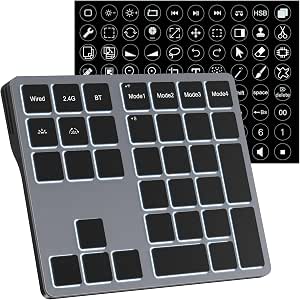 | Best for Windows Developers Who Need Multiple Layouts | Number of keys: 25 | Connectivity: Bluetooth 5.0, 2.4 GHz wireless, and wired | Operating system compatibility: Windows | VIEW LATEST PRICE | See Our Full Breakdown |
| PCsensor 6-Key Programmable Mechanical Macro Keypad with RGB Backlighting |  | Best Compact Mechanical Pick for Coding | Number of keys: 6 | Switches: Cherry MX Blue clicky mechanical | Connectivity: USB | VIEW LATEST PRICE | See Our Full Breakdown |
| HUION Keydial Mini Bluetooth Programmable Keypad with Dial |  | Best for Coding Plus Dial-Based Controls | Shortcut keys: 18 programmable keys | Dial: Up to 3 functions | Connectivity: Bluetooth 5.0 | VIEW LATEST PRICE | See Our Full Breakdown |
| VSD M18 Macro Pad Programmable Keypad |  | Best Visual Macro Deck for Coding and App Workflows | Total controls: 18: 15 LCD visual keys and 3 physical buttons | Connectivity: USB-C | Power: USB powered | VIEW LATEST PRICE | See Our Full Breakdown |
| programmable macro pads for coding | Connectivity | Switches | Number of keys |
|---|---|---|---|
| MOSHOU 12-Key Programmable Mac | USB-C wired, Bluetooth, and 2.4 GHz wireless | Hot-swappable mechanical | — |
| Vaydeer One-Handed Mechanical | USB-A | — | — |
| Logitech MX Keypad | USB-C | — | — |
| SIKAI CASE 6-Key Programmable | USB-C | Hot-swappable mechanical, Cherry MX model | — |
| PCsensor 3-Key Wireless Progra | Bluetooth; USB-C cable for charging or wired connection | Clicky mechanical, Cherry MX Blue | — |
| SayoDevice Mini 8-Key Programm | USB-C | Mechanical, hot-swappable | 8 |
| BTXETUEL Mini 4-Key Programmab | USB-C cable; plug and play | — | 4 |
| KEEBMONKEY Megalodon 16-Key Pr | Wired USB-C | Hot-swappable; Gateron Yellow model listed | 16 |
| 12-Key Programmable Mechanical | USB-C wired or wireless receiver | — | 12 |
| MOSHOU 2-Key Programmable Back | — | Mechanical, hot-swappable | 2 |
| Doohoeek 25-Key Tri-Mode Progr | Bluetooth 5.0, 2.4 GHz wireless, and wired | — | 25 |
| PCsensor 6-Key Programmable Me | USB | Cherry MX Blue clicky mechanical | 6 |
| HUION Keydial Mini Bluetooth P | Bluetooth 5.0 | — | — |
| VSD M18 Macro Pad Programmable | USB-C | — | — |
More Details on Our Top Picks
MOSHOU 12-Key Programmable Macro Pad with Dual Knobs, RGB Lighting, and Tri-Mode Connectivity
The MOSHOU 12-Key is the most adaptable pick here for developers who want both shortcut keys and hands-on controls for scrolling, zooming, or adjusting audio. Its two programmable knobs and three macro layers give it more room for distinct coding workflows than the six-key SIKAI CASE, while the 12 keys remain manageable beside a standard keyboard. Wired, Bluetooth, and 2.4 GHz connections also make it easier to move between desk setups. The tradeoff is that custom settings must be configured and saved while wired, and its RGB modes are wired-only, so wireless use is less flexible than the connection list may suggest. Hot-swappable switches add repair and feel options, but the acrylic enclosure and short stated warranty are worth weighing. This is my strongest all-round choice when knobs matter as much as macros.
Pros:- Two configurable knobs support rotation and press actions, adding useful controls beyond key assignments.
- Three macro layers let developers separate commands by app or task.
- USB-C, Bluetooth, and 2.4 GHz connectivity support several workstation arrangements.
- Hot-swappable mechanical switches allow switch replacement or customization.
Cons:- Custom settings must be configured and saved in wired mode before wireless use.
- RGB lighting modes are available only while wired.
- The stated warranty is three months.
Best for: Developers who want programmable shortcuts, two rotary controls, and the option to use the pad across wired and wireless desk setups.
Not ideal for: Buyers who want to configure everything wirelessly, need lighting in wireless mode, or prefer a clearly stated long warranty.
- Keys:12 programmable mechanical keys
- Knobs:2 programmable knobs
- Macro layers:3
- Connectivity:USB-C wired, Bluetooth, and 2.4 GHz wireless
- Switches:Hot-swappable mechanical
- Lighting:RGB with 6 modes; wired mode only
- Compatibility:Windows 10 or later, macOS 10.12 or later, Ubuntu 20.04 or later
- Enclosure:Acrylic
Our verdict“Choose the MOSHOU if you want a well-rounded coding pad with layers, knobs, and flexible connectivity, and can accept wired-only setup and lighting.”
Vaydeer One-Handed Mechanical Keyboard Support NKRO, Hotkeys, One-Click Start, 9 Fully Programmable Keys with Floating Window and Macro Multifunctional Keypad for iOS,Windows, Gift Idea for Him/Her
The Vaydeer’s strongest coding advantage is not its nine keys alone, but its six functional layers and ability to change profiles based on the active application. That can keep one layout focused on an IDE and another on terminal, browser, or communication shortcuts. Its floating window can also show current assignments, a useful aid when switching profiles. Compared with the MOSHOU 12-Key, it offers fewer physical controls and no knobs, but its app-aware switching and setting export/import are better suited to developers moving between software contexts. There are caveats: the supplied details specify USB-A and Windows 10, despite broad references to iOS, and setup requires flashing the keyboard after assignments. I’d pick it for a Windows-centered workflow, not for a plug-and-play multi-platform desk.
Pros:- Six functional layers provide room for separate IDE, terminal, browser, and office layouts.
- Application-based profile switching can surface relevant commands as the active program changes.
- Floating-window display helps identify assigned functions while changing layers.
- Settings can be exported and imported for backup or reuse on another computer.
Cons:- The listed connection is USB-A, so it may need an adapter on newer laptops.
- Product information gives Windows 10 as the required operating system, leaving broader platform support unclear.
- Assignments require configuration and a keyboard flash step before use.
Best for: Windows developers who use several apps daily and want six shortcut layers, app-linked profiles, and a visible reminder of current key assignments.
Not ideal for: Mac or Linux developers seeking clearly documented native support, or buyers who want a simple setup without a configuration and flash process.
- Keys:9 programmable keys
- Functional layers:6
- Key rollover:NKRO
- Connectivity:USB-A
- Connection type:Corded
- Required operating system:Windows 10
- Features:Macros, hotkeys, media controls, one-click launch, floating window
- Layout and orientation:QWERTY; ambidextrous
Our verdict“Pick the Vaydeer for Windows coding across multiple apps if profile switching matters more than knobs or a straightforward setup.”
Logitech MX Keypad, Programmable Macro Pad for Developers – Graphite
For a developer who wants a macro pad organized around software rather than generic key combinations, the Logitech MX Keypad is the most specialized option in this group. Its nine full-color LCD keys can show custom icons, while app-aware profiles and native integrations for VS Code, IntelliJ, and GitHub Copilot tie actions to coding tools. That makes it more legible and IDE-focused than the Vaydeer, whose floating window and layers serve broader programmable workflows. Logitech also supports custom plugins through its Actions SDK, giving technically inclined users room to extend the device. The tradeoffs are its wired-only USB-C connection, reliance on Logi Options+ for customization, and stated Windows/macOS focus. Some AI functions require an internet connection and third-party account. I’d rank it first for integration, not for platform breadth or hardware simplicity.
Pros:- Full-color LCD keys can display custom icons, making assigned coding actions easier to recognize.
- App-aware profiles can change key layouts as the developer switches between supported applications.
- Native integrations support VS Code, IntelliJ, and GitHub Copilot workflows.
- Logi Actions SDK and marketplace content provide options for adding or building integrations.
Cons:- USB-C is the only listed connection method, so the keypad is wired-only.
- Customization requires Logi Options+ on supported Windows or macOS versions.
- AI features depend on internet access and accounts with the relevant third-party providers.
Best for: Windows or macOS developers who work in supported IDEs and value labeled LCD controls, app-aware layouts, and extensible software integrations.
Not ideal for: Linux users, developers who want wireless operation, or buyers who prefer a macro pad that does not depend on companion software.
- Keys:9 customizable full-color LCD keys
- Connectivity:USB-C
- Compatible systems:Windows and macOS
- Minimum operating systems:Windows 10; macOS 10.13 High Sierra
- Supported developer integrations:VS Code, IntelliJ, and GitHub Copilot
- Customization software:Logi Options+
- Developer extension:Logi Actions SDK
- Enclosure material:Plastic
Our verdict“Choose the MX Keypad if supported IDE integrations and readable LCD actions outweigh wireless use and broader operating-system support.”
SIKAI CASE 6-Key Programmable Macro Mechanical Keypad with Custom Knob
The SIKAI CASE suits coders who need a small bank of dependable commands rather than a large, layered control surface. Its six hot-swappable mechanical keys can hold shortcuts, text snippets, launches, or media controls, and onboard memory lets saved assignments travel to another compatible computer. That cross-computer use is a practical contrast with the Vaydeer’s more elaborate software features and Windows-focused setup. The compact wired design also takes little desk space beside a full keyboard. Its limits are unusually relevant for coding: programming the pad requires Windows, and each macro is capped at five characters, which restricts longer text snippets and sequences. The product title mentions a custom knob, but the supplied specifications do not describe its behavior, so I would not choose it primarily for rotary control. This is best for basic, portable shortcuts.
Pros:- Six keys cover a focused set of coding shortcuts without taking much desk space.
- Onboard memory retains six custom shortcuts for use on compatible computers.
- Hot-swappable mechanical switches allow replacement or switch changes.
- Assignments can include shortcuts, text snippets, app launches, and multimedia controls.
Cons:- Macro configuration requires a Windows computer.
- Each macro is limited to five characters, restricting longer snippets and command strings.
- The connection is wired USB-C, with no wireless option listed.
Best for: Developers who want six frequently used shortcuts on a compact wired pad and can configure them on a Windows computer.
Not ideal for: Mac- or Linux-only buyers who need to configure macros locally, or anyone planning long text expansions and complex sequences.
- Keys:6
- Switches:Hot-swappable mechanical, Cherry MX model
- Connectivity:USB-C
- Onboard memory:Stores six custom shortcuts
- Maximum macro length:5 characters
- Setup requirement:Windows computer required for macro configuration
- Compatible systems:Windows, Mac, Linux, and Vista
- Orientation:Ambidextrous
Our verdict“Choose the SIKAI CASE for a compact set of portable, basic coding shortcuts, but skip it if you need long macros or non-Windows configuration.”
PCsensor 3-Key Wireless Programmable Mechanical Macro Keypad with RGB
The PCsensor is the smallest, most focused choice here: three programmable keys for commands a developer reaches for constantly, such as building, opening a terminal, or inserting a short key combination. Bluetooth operation and a rechargeable battery make it easier to place away from the main keyboard than the wired SIKAI CASE, though the SIKAI’s six keys offer twice the physical shortcut capacity. PCsensor also includes a USB-C cable for charging or wired connection and supports several desktop and mobile operating systems after initial setup on Windows or macOS. The central compromise is obvious: three keys leave little room for a broad IDE layout, and setup on another platform is not fully independent. Its clicky Cherry MX Blue switches may also be distracting in a quiet shared workspace. This makes sense as a tiny companion, not a standalone command center.
Pros:- Three-key footprint is easy to place beside a laptop or carry between work areas.
- Bluetooth and a rechargeable battery support wireless placement.
- USB-C cable allows charging or wired use.
- Listed compatibility includes Windows, Linux, macOS, Android, and iOS after initial setup.
Cons:- Only three keys are available, limiting the number of immediately accessible coding actions.
- Initial configuration requires Windows or macOS before use with other listed systems.
- Clicky Cherry MX Blue switches can be loud in shared or quiet workspaces.
Best for: Developers with a short list of high-frequency commands who want a small Bluetooth pad that can move between desk and mobile setups.
Not ideal for: Coders who need more than a few mapped actions, quiet switches, or setup without access to Windows or macOS.
- Keys:3 programmable keys
- Connectivity:Bluetooth; USB-C cable for charging or wired connection
- Switches:Clicky mechanical, Cherry MX Blue
- Backlighting:RGB
- Battery:Rechargeable; stated charge time of 2 hours
- Compatible systems:Windows, Linux, macOS, Android, and iOS after setup
- Dimensions:3 x 1.5 x 0.5 inches
- Material:ABS
Our verdict“Pick the PCsensor if portability and three frequently used commands matter more than a larger shortcut bank or quiet typing.”
SayoDevice Mini 8-Key Programmable Mechanical Keyboard
The SayoDevice Mini is a good fit for developers who want a small bank of programmable actions without dedicating much desk space to a keypad. Its eight mechanical, hot-swappable keys can handle combinations, media controls, and custom scripts, giving it more room for coding workflows than the two-key MOSHOU 2-Key. The tradeoff is capacity: developers who want separate controls for several applications or layered workflows may find eight keys restrictive compared with the 16-key KEEBMONKEY Megalodon. Configuration runs through the SayoDevice website, rather than a stated local app, so setup depends on using that service. USB-C, a five-foot cable, and replacement keycaps make it easy to place beside a main keyboard, while customizable RGB helps distinguish shortcut groups.
Pros:- Supports programmable key combinations and custom scripts for coding actions.
- Eight hot-swappable mechanical keys offer more capacity than a two- or four-key pad.
- Media controls can be assigned alongside coding shortcuts.
- USB-C connection, included five-foot cable, and replacement keycaps support flexible desk placement.
Cons:- Eight keys may not provide enough dedicated controls for complex, multi-app workflows.
- Configuration requires the SayoDevice website.
- The listed compatibility covers Windows and Mac OS, not Linux.
Best for: Developers who want a portable set of custom script and media shortcuts beside a full-size keyboard.
Not ideal for: Programmers who need many dedicated commands or prefer configuring their keypad without a website.
- Number of keys:8
- Switches:Mechanical, hot-swappable
- Connectivity:USB-C
- Compatible operating systems:Windows, Mac OS
- Lighting:Customizable RGB
- Included accessories:5-foot USB cable and 8 replacement keycaps
- Color:Black
- Warranty:1 year
Our verdict“Choose the SayoDevice Mini if you want script-capable shortcuts in a compact eight-key layout and are comfortable configuring them through its website.”
BTXETUEL Mini 4-Key Programmable Macro Pad, Black
The BTXETUEL Mini 4-Key keeps its job simple: it arrives with select all, cut, copy, and paste assigned, so a programmer can start with familiar editing actions rather than building a layout from scratch. That makes it a more approachable pick for basic text-editing shortcuts than the SayoDevice Mini, which offers twice as many keys and custom scripts. Its four-key footprint also suits crowded desks where a larger pad like the KEEBMONKEY Megalodon would take up more space. Website programming is listed for Windows, macOS, and Linux, but the separate software works only on Windows. The settings are stored on the device for use when changing computers. Clicky switches provide tactile feedback, though they may be distracting in a quiet shared workspace.
Pros:- Preconfigured select-all, cut, copy, and paste shortcuts offer a useful starting layout.
- Compact four-key design fits alongside a full-size coding keyboard.
- Can be programmed through a website on Windows, macOS, and Linux.
- Stores programming on the device for use when changing computers.
Cons:- Four keys limit the number of dedicated shortcuts available at once.
- The separate software is Windows-only; other listed systems use the website.
- The keypad is not water resistant, and clicky switches may be noisy in shared spaces.
Best for: Coders who mainly want dedicated cut, copy, paste, and select-all keys in a compact pad beside their regular keyboard.
Not ideal for: Developers who need many macros, quiet switches, or a water-resistant keypad for a spill-prone desk.
- Number of keys:4
- Dimensions:3.5 × 1.1 × 1.1 inches
- Connectivity:USB-C cable; plug and play
- Programming:Website on Windows, macOS, and Linux; software on Windows
- Switch:Clicky; Outemu Red model listed
- Backlighting:Customizable RGB
- Included accessories:USB-C data cable, two sets of keycaps, and instructions
- Water resistance:Not water resistant
Our verdict“Pick the BTXETUEL if you want a tiny, ready-to-use set of everyday editing shortcuts rather than a larger macro workspace.”
KEEBMONKEY Megalodon 16-Key Programmable Macro Pad with Triple Knobs
For developers who want more than a handful of one-tap commands, the KEEBMONKEY Megalodon offers the most expansive control layout in this batch: 16 keys, three clickable programmable knobs, and four layers. That space can separate editor actions, terminal commands, and system controls without relying on a four-key pad such as the BTXETUEL. The knobs add another kind of input for tasks like adjusting values or scrolling, while the OLED can help surface changing information. VIA programming and hot-swappable switches give users room to customize the setup. The tradeoff is a more involved, wired arrangement, and the listed compatibility is Windows only; the SayoDevice Mini is a simpler alternative for users who want Windows or Mac OS support and fewer controls. Its 320 g body is compact, but not the lightest carry-around option.
Pros:- Sixteen keys and four layers support distinct shortcut sets for different coding tasks.
- Three programmable clickable knobs add controls beyond key presses.
- VIA compatibility and hot-swappable switches support customization.
- OLED display and RGB backlighting provide visual feedback and customization.
Cons:- Wired USB-C is the only listed connection mode.
- Listed operating system compatibility is limited to Windows.
- The extra keys, knobs, and layers may be more setup than users with a few common shortcuts need.
Best for: Windows developers who want multiple layers of dedicated shortcuts plus rotary controls for coding and system tasks.
Not ideal for: Mac or Linux users, wireless-first buyers, and anyone seeking a very small, simple shortcut pad.
- Number of keys:16
- Knobs:3 programmable clickable knobs
- Display:0.91-inch OLED
- Programming and layers:VIA compatible; 4 layers
- Connectivity:Wired USB-C
- Switches:Hot-swappable; Gateron Yellow model listed
- Body material:Aluminum alloy and acrylic
- Dimensions and weight:5.61 × 3.79 × 1.3 inches; 320 g
- Listed operating system:Windows
Our verdict“Choose the Megalodon if you use Windows and want a layered coding control surface with both keys and programmable knobs.”
12-Key Programmable Mechanical Macro Pad with RGB Backlighting and Dual Knobs
This 12-key macro pad with dual knobs is the lineup’s wireless-minded middle ground: it offers more dedicated keys and two rotary controls than the SayoDevice Mini, while avoiding the Megalodon’s wired-only setup. For a coding desk, the combination can keep common commands on keys and assign continuous adjustments or other controls to the knobs. It also lists compatibility with Windows, Mac OS, Linux, and Raspberry Pi, making it a broader platform fit than the Windows-only Megalodon. The setup has a catch: configuration starts on Windows, and the software must be extracted from the included USB drive before opening. That initial hurdle matters if your main computer runs another system. Clicky switches may also be less suitable for quiet offices, and the product data does not specify battery runtime.
Pros:- Twelve programmable keys provide room for a broader shortcut set than four- or eight-key pads.
- Two programmable knobs add controls beyond standard key assignments.
- Wireless receiver and USB-C wired modes allow flexible placement.
- Listed compatibility includes Windows, Mac OS, Linux, and Raspberry Pi.
Cons:- Initial configuration is performed on Windows.
- Software must be extracted from the included USB drive before use.
- Clicky switches may be noisy, and battery runtime is not specified in the supplied data.
Best for: Developers who want wireless placement, two programmable knobs, and a keypad listed for Windows, Mac OS, Linux, and Raspberry Pi.
Not ideal for: Buyers who need effortless setup on a non-Windows computer or want quiet switches and documented battery runtime.
- Number of keys:12
- Knobs:2 programmable knobs
- Switch type:Clicky
- Connectivity:USB-C wired or wireless receiver
- Backlighting:Adjustable RGB
- Compatible operating systems:Windows, Mac OS, Linux, Raspberry Pi
- Power source:Battery powered
- Included cable:1 m USB-C cable
- Color:Black
Our verdict“Choose this 12-key pad if wireless placement and broad listed OS support matter more than a frictionless first setup.”
MOSHOU 2-Key Programmable Backlit Macro Pad
The MOSHOU 2-Key is for developers who can name the two actions they repeat most and want those commands within reach without adding another full control panel. Its hot-swappable mechanical switches and adjustable-color backlight bring some customization to a very small footprint, while listed compatibility spans Windows, macOS, iOS, Android, and HarmonyOS. That broad device list sets it apart from the Windows-focused KEEBMONKEY Megalodon, but it does not change the main limitation: two keys mean two readily available assignments. Compared with the BTXETUEL Mini 4-Key, this MOSHOU takes up less space but gives up half the direct shortcut capacity. The supplied information does not specify connection type or programming software, so buyers should not assume a particular setup method. It makes more sense as a focused pair of coding triggers than as a general macro dashboard.
Pros:- Two programmable keys suit a tightly focused pair of frequently used shortcuts.
- Hot-swappable mechanical switches allow switch replacement.
- Adjustable-color backlighting can distinguish the pad visually.
- Listed compatibility spans Windows, macOS, iOS, Android, and HarmonyOS.
Cons:- Only two keys are available, far fewer than the BTXETUEL Mini 4-Key or 12-key alternatives.
- The supplied product data does not specify connectivity or configuration software.
- A two-key layout is a poor fit for developers who need multiple commands available at once.
Best for: Developers with one or two high-frequency commands who need an exceptionally small, customizable pad for a crowded desk.
Not ideal for: Programmers who want a broad shortcut bank, layered controls, or clearly documented connectivity and programming details.
- Number of keys:2
- Switches:Mechanical, hot-swappable
- Backlight:Adjustable-color
- Compatible devices:Android, HarmonyOS, Windows, iOS, macOS
- Hand orientation:Ambidextrous
- Unit count:1
- Brand:MOSHOU
Our verdict“Pick the MOSHOU 2-Key only if two carefully chosen shortcuts are enough and minimizing desk space is your priority.”
Doohoeek 25-Key Tri-Mode Programmable Macro Keypad for Windows
The Doohoeek earns its place for coders who want more dedicated shortcuts than a small pad can offer. Its 25 keys and four onboard layouts can separate editor commands, terminal actions, and spreadsheet or communication shortcuts without requiring a different device for each task. Compared with the HUION Keydial Mini, it gives you more keys and stored layouts, but HUION adds a dial and supports Mac as well as Windows. The Doohoeek’s Bluetooth, 2.4 GHz, and wired modes make it easier to move between compatible Windows devices; however, programming requires a wired connection and configuration software, so wireless convenience does not extend to setup. Its main limitation is platform lock-in: Mac and Linux developers should choose a cross-platform option instead.
Pros:- 25 programmable keys provide room for many editor shortcuts, macros, and text snippets.
- Four configurable layouts are stored in onboard memory for task-specific setups.
- Bluetooth 5.0, 2.4 GHz wireless, and wired connectivity support use with up to three devices.
- Adjustable seven-color backlighting helps distinguish the keypad in dim workspaces.
Cons:- Compatibility is limited to Windows devices.
- Key customization requires a wired connection and configuration software.
Best for: Windows developers who want separate onboard shortcut layouts for coding, terminal work, and other desktop tasks.
Not ideal for: Mac or Linux developers, and anyone expecting to edit macros wirelessly without connecting the keypad by cable.
- Number of keys:25
- Connectivity:Bluetooth 5.0, 2.4 GHz wireless, and wired
- Operating system compatibility:Windows
- Configurable layouts:4
- Programming mode:Wired connection required
- Memory:Onboard
- Backlighting:7 colors with high, medium, and low brightness
- Included accessories:Wireless dongle and shortcut stickers
Our verdict“Choose the Doohoeek if you code on Windows and value 25 keys plus stored task layouts more than cross-platform support or wireless setup.”
PCsensor 6-Key Programmable Mechanical Macro Keypad with RGB Backlighting
This PCsensor is a straightforward way to put a handful of frequently used coding actions under dedicated keys. Its six clicky Cherry MX Blue switches give each press a distinct feel, which may suit shortcuts you trigger often, while its small footprint leaves most of the desk free for a full keyboard and mouse. Unlike the Doohoeek 25-Key, it is wired and offers far fewer keys, so it cannot organize a broad library of commands across several layouts. Its advantage is broader operating-system compatibility: after setup on Windows or macOS, it is listed for use with Linux and mobile platforms too. The tradeoffs are USB-only operation and audible switches, which can be distracting in a quiet office. Choose it for a short, stable command set, not a whole coding workflow.
Pros:- Six programmable keys can trigger macros, shortcuts, and media controls.
- Compact dimensions take up little desk space beside a main keyboard.
- Cherry MX Blue switches provide tactile, audible feedback.
- Listed compatibility includes Windows, macOS, Linux, Android, and iOS after initial setup on Windows or macOS.
Cons:- Six keys limit how many coding commands can stay dedicated and readily available.
- USB connectivity means it cannot be used wirelessly.
- Clicky switches may be noisy in quiet workspaces or during calls.
Best for: Developers who want six frequently used macros in a compact wired pad and can set them up on Windows or macOS.
Not ideal for: Coders who need many shortcuts, wireless operation, or quiet keys for shared offices and calls.
- Number of keys:6
- Switches:Cherry MX Blue clicky mechanical
- Connectivity:USB
- USB connector:USB-C
- Operating system compatibility:Windows, Linux, macOS, Android, and iOS; initial setup on Windows or macOS
- Enclosure:ABS
- Dimensions:2.9 x 2.3 x 1.1 inches
- Switch durability:Rated for up to 50 million keystrokes
Our verdict“Pick this PCsensor for a small, wired set of tactile coding shortcuts, but choose a larger pad if you want a broader macro bank.”
HUION Keydial Mini Bluetooth Programmable Keypad with Dial
The HUION Keydial Mini is a better fit for developers whose shortcuts share desk space with creative tools or workflows that benefit from a dial. It combines 18 programmable keys with a three-function dial, letting the pad handle commands while the dial takes on supported controls such as scrolling or adjustment. Compared with the PCsensor 6-Key, it offers more shortcut positions and Bluetooth rather than a USB tether; compared with the 25-key Doohoeek, it trades key count and multiple layouts for a dial and Mac compatibility. Custom actions depend on the HUION driver and the software being controlled, so its usefulness for coding varies by editor and setup. Five-key anti-ghosting also limits simultaneous input compared with pads designed for heavier multi-key sequences. Treat it as a flexible shortcut accessory, not a guaranteed universal coding controller.
Pros:- Eighteen programmable keys provide more shortcut positions than a six-key pad.
- Dial supports up to three functions for controls suited to rotary adjustment.
- Bluetooth 5.0 offers a wireless connection with a stated range of up to 10 meters.
- Setting preview and ambidextrous design help with checking assignments and choosing placement.
Cons:- Custom shortcuts require the HUION driver and support from the target software.
- Anti-ghosting supports up to five simultaneous keys.
- Mac and Windows are the listed computer operating systems, limiting its fit for Linux developers.
Best for: Mac or Windows developers who also use creative software and want programmable shortcuts plus a dial in a compact wireless pad.
Not ideal for: Coders who need broad editor-specific compatibility, extensive simultaneous key presses, or a pad focused solely on maximizing key count.
- Shortcut keys:18 programmable keys
- Dial:Up to 3 functions
- Connectivity:Bluetooth 5.0
- Wireless range:Up to 10 meters
- Operating system compatibility:Mac OS 10.12 Sierra or later; Windows 7 or later
- Anti-ghosting:Up to 5 keys
- Battery life:Up to 70 hours
- Dimensions:5.74 x 3.65 x 0.42 inches
Our verdict“Choose the Keydial Mini if your coding setup can use its dial and supported shortcuts; skip it if you need assured compatibility across editors or platforms.”
VSD M18 Macro Pad Programmable Keypad
The VSD M18 takes a different approach from simple shortcut pads: 15 LCD visual keys can show icons or animations, making it easier to identify commands at a glance, while three physical buttons add more controls. For coding, that can help separate actions such as opening tools, inserting text, or running supported sequences, though the listing emphasizes streaming and creative apps rather than specific code editors. Compared with the HUION Keydial Mini, the VSD offers labeled visual keys and multi-step actions instead of a dial and wireless operation. Its USB-C connection keeps the setup wired, and the listed operating system requirements are Windows 11 or newer and macOS 11 or newer; native Linux plug-and-play is not supported. I would choose it for a visual, app-based desk workflow, not for portability or Linux use.
Pros:- Fifteen LCD keys can display JPG, PNG, or GIF visuals to identify assigned actions.
- Three physical buttons supplement the visual keys.
- Supports single actions and multi-step shortcut sequences, including text entry and app or file launching.
- USB-C connection and listed compatibility with Windows 11 or newer and macOS 11 or newer suit newer desktop setups.
Cons:- Wired USB-C operation does not offer wireless placement or device switching.
- Native Linux plug-and-play support is not available.
- The product information emphasizes streaming and general desktop apps rather than specific coding-editor integrations.
Best for: Windows 11 or newer and macOS 11 or newer developers who want visual labels for app shortcuts and multi-step desktop actions.
Not ideal for: Linux developers, people who need a wireless pad, or buyers seeking confirmed native integrations with a particular code editor.
- Total controls:18: 15 LCD visual keys and 3 physical buttons
- Connectivity:USB-C
- Power:USB powered
- Visual key formats:JPG, PNG, and GIF images or animations
- Macro actions:Single actions and multi-step sequences
- Operating system compatibility:Windows 11 or newer; macOS 11.0 or newer
- Linux support:Native plug-and-play support not available
- Lighting:RGB surround light ring
Our verdict“Choose the VSD M18 if visual key labels and multi-step actions suit your coding and desktop apps, but check editor support and OS requirements before buying.”
How We Picked
I judged these programmable macro pads for coding by how well their advertised layouts support repeatable developer tasks: launching tools, entering snippets, switching applications, and controlling actions with keys or dials. I also weighed connection options, physical footprint, feedback from mechanical or backlit keys, and whether the product description gives a clear path to customizing controls. A large key count can support more dedicated actions, but it does not outrank a smaller pad if the extra controls add setup burden without helping a focused workflow.
The ranking favors products with a useful balance of programmable controls, coding-relevant flexibility, and clear practical fit. Models with knobs, wireless modes, LCD keys, or app-specific features earn attention when those features solve a real workflow need; they rank lower when their broader purpose or setup requirements may distract from coding shortcuts. Since software compatibility and configuration details can vary, buyers should confirm support for their operating system and intended apps before choosing.
| programmable macro pads for coding | Switches |
|---|---|
| MOSHOU 12-Key Programmable Mac | Hot-swappable mechanical |
| Vaydeer One-Handed Mechanical | — |
| Logitech MX Keypad | — |
| SIKAI CASE 6-Key Programmable | Hot-swappable mechanical, Cherry MX model |
| PCsensor 3-Key Wireless Progra | Clicky mechanical, Cherry MX Blue |
| SayoDevice Mini 8-Key Programm | Mechanical, hot-swappable |
| BTXETUEL Mini 4-Key Programmab | — |
| KEEBMONKEY Megalodon 16-Key Pr | Hot-swappable; Gateron Yellow model listed |
| 12-Key Programmable Mechanical | — |
| MOSHOU 2-Key Programmable Back | Mechanical, hot-swappable |
| Doohoeek 25-Key Tri-Mode Progr | — |
| PCsensor 6-Key Programmable Me | Cherry MX Blue clicky mechanical |
| HUION Keydial Mini Bluetooth P | — |
| VSD M18 Macro Pad Programmable | — |
Factors to Consider When Choosing Programmable Macro Pads For Coding
Choosing a pad is less about collecting the most controls and more about deciding which actions you want to make effortless. I would start with your actual daily repetitions, then check whether the hardware and software can reproduce them reliably across the apps you use.
Map Repeated Actions Before Choosing a Key Count
Write down the commands you repeat often, such as inserting a code fragment, opening a terminal, or switching between project windows. Group related actions into layers only if you can remember how to access them; hidden functions are easy to forget when a deadline is close. A small pad can be enough for a handful of high-frequency commands, while a larger layout suits people who want separate keys for several tools or projects. Avoid buying extra keys on the assumption that you will later invent uses for them. The tradeoff is simple: dedicated keys are easier to recognize, but they consume more desk space and require more deliberate mapping.
Check Configuration Software and Operating-System Support
Programmability is only useful if the setup utility can assign the actions you need on your computer. Check whether the software supports your operating system, whether profiles can be tied to specific applications, and whether macros can include text, delays, or key combinations. A listing that says “programmable” may not clarify whether remapping happens through an app, onboard memory, or a web interface. That difference matters if you switch machines or work on a computer where installing utilities is restricted. Before purchase, confirm the setup process and look for clear documentation rather than assuming every pad handles macros the same way.
Treat Knobs as Workflow Controls, Not Extra Decoration
A dial is useful when an action benefits from gradual adjustment, such as scrolling through a long file or controlling a timeline in a development or media tool. It is less helpful for commands that are naturally one-step actions, where a key is usually faster and easier to identify. Multiple knobs can serve separate functions, but only if the configuration software lets you assign them in a way that remains consistent. Check whether each knob also clicks, supports direction-specific actions, or has limits on what it can control. Paying for dials makes sense when you already have a repeatable control task, not just because the feature looks versatile.
Choose Connectivity Around Your Desk and Devices
Wired models avoid charging and pairing steps, which can make them a sensible choice for a fixed workstation. Wireless or tri-mode options can reduce cable clutter or move between devices, but buyers should verify supported connection types and how profile switching works. A Bluetooth label alone does not tell you whether switching between computers is quick or whether the pad can stay paired to multiple systems. Also check whether a wireless model depends on a particular configuration app to retain its mappings. Pick the connection that fits your work setup rather than treating wireless as an automatic upgrade.
Account for Footprint, Key Feedback, and Desk Placement
A macro pad should be reachable without forcing your hand into an awkward position or competing with your main keyboard and mouse. Compact models can sit beside a keyboard or travel more easily, while larger units need a stable spot where every control remains accessible. Mechanical switches may provide clear tactile feedback, though switch feel and noise can be a poor match for shared workspaces. RGB lighting and backlighting can help locate controls, but they do not replace labels or a memorable layout. Check the pad’s dimensions and placement options before choosing by key count alone.
Decide Whether You Need Physical Keys or LCD Actions
Physical keys offer a consistent press and can suit shortcuts that you want to learn by position. LCD keys can show labels or visual identities, which may help when actions change between profiles, but they introduce a different setup and interaction style. Do not assume that a screen-based controller will integrate with every coding app simply because it supports action triggers for streaming software. Confirm what its software can control and whether custom labels or icons are practical to maintain. Choose a display-based pad when changing, visible actions are central to your workflow; choose physical keys when you want a direct, stable shortcut surface.
Frequently Asked Questions
How many macro keys do I need for coding?
Start with the number of actions you repeat often enough to justify moving them off the main keyboard. A compact four- or six-key pad can cover a focused set of commands, while a 16- or 25-key layout suits workflows that need many dedicated actions or separate project groups. If you are unsure, a smaller layout helps you test whether macros become part of your routine before committing more desk space. Also check whether the software supports layers or profiles, since those can expand a small pad’s uses. More controls help only when you can remember what each one does.
Will a programmable macro pad work with my coding tools and operating system?
Compatibility depends on the pad’s configuration software and the actions it can send, not just on the fact that it is programmable. Verify support for your operating system and check whether your editor, terminal, or other target app accepts standard keyboard shortcuts or requires a special integration. For text snippets and multi-step macros, confirm that the software supports the needed input types and timing. If you switch computers, find out whether profiles are stored on the pad or must be recreated through an installed utility. Product descriptions may not answer every software question, so consult the maker’s documentation before buying.
Should I choose a macro pad with knobs for programming?
Choose knobs when you can name a repeated task that benefits from continuous adjustment, such as scrolling, changing a value, or controlling a supported timeline. For launching commands, entering snippets, and switching tools, keys are usually the more direct control. Knobs also take physical space and can add configuration work, so a dual- or triple-knob design is not automatically more useful than a simpler keypad. Check whether the controls can be assigned to your actual apps and whether their functions are easy to remember. If you do not already have a dial-based task in mind, a key-only pad may be the clearer fit.
Is a wireless macro pad a good choice for a coding desk?
Wireless is useful when you want a cleaner desk, move the pad between devices, or need placement flexibility. A wired model may be easier for a permanent workstation because it avoids pairing and charging routines. Before choosing wireless, verify which connection modes are supported, how device switching works, and whether your macros remain available without the setup app running. The MOSHOU 12-Key is a standout here because it advertises tri-mode connectivity, but buyers should still confirm the details that matter for their computers. Choose based on your desk and device habits rather than wireless capability alone.
Are LCD-key macro pads better than physical-key pads for coding?
Neither style is inherently better; they serve different preferences. Physical keys provide a fixed layout that can become familiar through repeated use, while LCD keys can show changing labels or icons when actions vary by profile. A display can be helpful if you expect to switch between many workflows, but it also depends on software support and may require more upkeep than a simple key layout. Check that the LCD model supports the applications and action types you plan to use, rather than assuming its streaming features map directly to coding. For stable, frequent editor shortcuts, physical keys may be easier to learn; for changing visible actions, a screen can be more useful.
Conclusion
For a balanced coding setup, I recommend the KEEBMONKEY Megalodon 16-Key as the best overall choice for buyers who want many dedicated controls and multiple knobs. The best value depends on how many actions you need: a compact pad such as the BTXETUEL Mini 4-Key avoids paying for space and controls you may not use, while the best premium-style pick is the VSD M18 for people who specifically want customizable LCD keys and action triggers. For beginners, I would start with a simpler, smaller model like the SIKAI CASE 6-Key and learn which shortcuts earn a permanent place on the pad. Choose the MOSHOU 12-Key Dual-Knob if flexible connectivity and dial controls fit your desk, or the HUION Keydial Mini if a compact Bluetooth keypad with a dial better matches your setup. Before deciding, check software support for your operating system and coding apps; that compatibility can matter more than the number of keys.