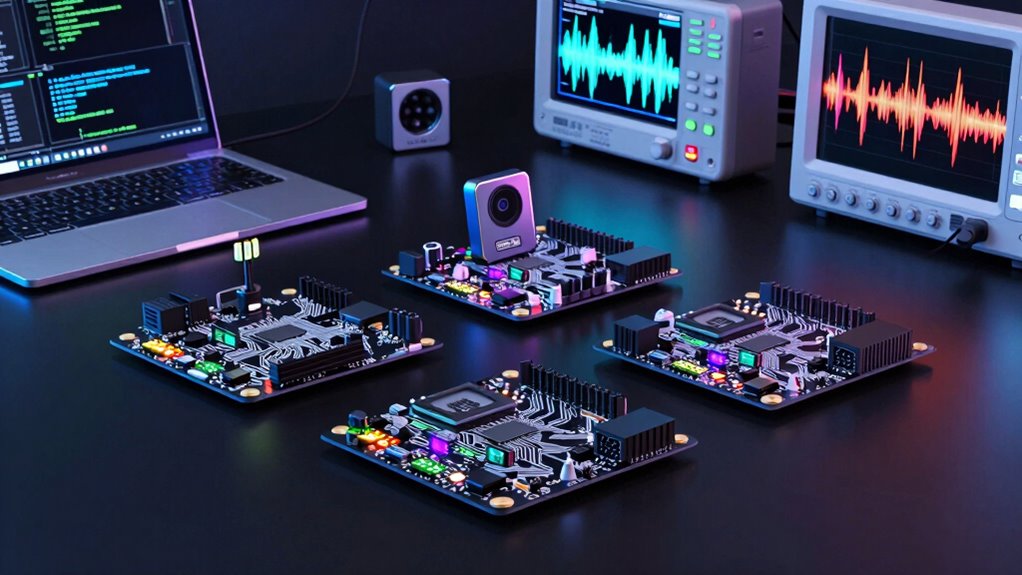

Choosing the right development board for computer vision projects depends on your specific needs, technical skill level, and project complexity. The Youyeetoo CanMV-K230 stands out for intensive vision applications with multiple 4K camera inputs and powerful AI acceleration. Meanwhile, the Seeed Studio XIAO ESP32 S3 Sense offers a compact, IoT-friendly option with integrated sensors, ideal for embedded, low-power projects. Both have distinct strengths and tradeoffs, which I’ll explore in detail to help you decide.

Get business pricing on monitors, keyboards and dev gear
- Business-only prices and quantity discounts
- Tax-exempt purchasing
- Multiple users, one account, clear invoices
Key Takeaways
- The CanMV-K230 excels in multi-camera, high-performance AI tasks but demands more setup expertise.
- The XIAO ESP32 S3 Sense favors space-constrained projects with integrated sensors but offers limited processing power.
- Both boards support Wi-Fi, but only the CanMV-K230 includes Ethernet and extensive interfaces.
- The choice hinges on whether your focus is on advanced vision processing or compact IoT integration.
- Tradeoffs include complexity versus simplicity, and high-end capabilities versus embedded features.
| Youyeetoo CanMV-K230 AI Development Board with 16GB TF Card |  | Best Overall for High-Performance Vision Projects | SoC: Kendryte K230 dual-core RISC-V | Processor Speed: 1.6GHz | Memory: 512MB LPDDR3 | VIEW ON AMAZON | See Our Full Breakdown |
| Seeed Studio XIAO ESP32 S3 Sense |  | Best for Compact Embedded and IoT Vision Projects | Processor: ESP32 S3 32-bit dual-core | Clock Speed: 240 MHz | Memory: 8MB PSRAM, 8MB Flash | VIEW ON AMAZON | See Our Full Breakdown |
| dev board for computer vision project | Memory | Dimensions | SoC | Processor Speed |
|---|---|---|---|---|
| Youyeetoo CanMV-K230 AI Develo | 512MB LPDDR3 | 85 x 56 mm | Kendryte K230 dual-core RISC-V | 1.6GHz |
| Seeed Studio XIAO ESP32 S3 Sen | 8MB PSRAM, 8MB Flash | 21 x 17.5mm | — | — |
More Details on Our Top Picks
Youyeetoo CanMV-K230 AI Development Board with 16GB TF Card
The CanMV-K230 is designed for demanding computer vision applications, supporting three 4K camera inputs and boasting a robust dual-core RISC-V processor. Its high-performance AI acceleration with a dedicated KPU makes it suitable for real-time image analysis, object detection, and multi-camera setups. Compared with the XIAO ESP32 S3, it offers more raw processing power and extensive interface options, such as HDMI, Ethernet, and Bluetooth, making it ideal for advanced projects. However, it also introduces complexity: setup can be challenging, especially without detailed instructions, and onboard storage is limited to microSD, requiring external cards. This pick makes the most sense for users with technical experience seeking a versatile, high-capacity vision platform.
Pros:- Supports three 4K camera inputs for multi-view applications
- Powerful AI acceleration with built-in KPU
- Extensive interfaces including HDMI, Ethernet, WiFi, Bluetooth, GPIO
Cons:- Complex setup may require advanced technical skills
- Limited onboard storage, relies on microSD cards
- No detailed user manual included
Best for: Developers working on complex, multi-camera vision systems requiring substantial AI processing.
Not ideal for: Beginners or those needing a simple, plug-and-play solution.
- SoC:Kendryte K230 dual-core RISC-V
- Processor Speed:1.6GHz
- Memory:512MB LPDDR3
- Storage:microSD, QSPI flash
- Camera Inputs:3x 4K HD
- Display:HDMI, MIPI DSI 1080p60
- Networking:Ethernet, WiFi 4, Bluetooth 4.0
- Audio:3.5mm jack
- Dimensions:85 x 56 mm
Our verdict“A highly capable platform for serious vision projects that demand multiple high-res cameras and AI acceleration, better suited for experienced developers.”
Seeed Studio XIAO ESP32 S3 Sense
The XIAO ESP32 S3 Sense offers a small footprint with integrated sensors, making it a prime choice for space-limited or IoT-focused vision projects. Its dual-core ESP32 S3 processor runs at 240 MHz, supporting basic AI tasks and multimedia processing. The detachable OV2640 camera combined with a digital microphone enables multimedia sensing, while Wi-Fi and BLE connectivity facilitate IoT integrations. Unlike the CanMV-K230, it prioritizes size, power efficiency, and ease of use, but this comes with limited processing capacity—more appropriate for simple object detection or sensor-based applications. It’s less suited to real-time, high-resolution multi-camera vision but excels in embedded, networked environments.
Pros:- Compact size (21 x 17.5mm) ideal for space-constrained projects
- Supports Wi-Fi and BLE for IoT applications
- Includes integrated camera and microphone for multimedia projects
- SD card slot for external memory
Cons:- Limited to 2.4GHz Wi-Fi, no dual-band support
- Lower processing power limits complex vision analysis
- Requires familiarity with microcontroller programming
Best for: IoT developers needing a small, integrated camera and microphone setup for basic vision tasks.
Not ideal for: Projects requiring intensive image processing or multiple high-res cameras.
- Processor:ESP32 S3 32-bit dual-core
- Clock Speed:240 MHz
- Memory:8MB PSRAM, 8MB Flash
- Camera Sensor:OV2640 (detachable)
- Wireless:Wi-Fi 2.4GHz, BLE 5.0
- Additional Features:Digital microphone, SD card slot
- Dimensions:21 x 17.5mm
Our verdict“A practical choice for IoT and embedded vision projects where size, connectivity, and basic multimedia sensing are priorities over raw processing power.”
How We Picked
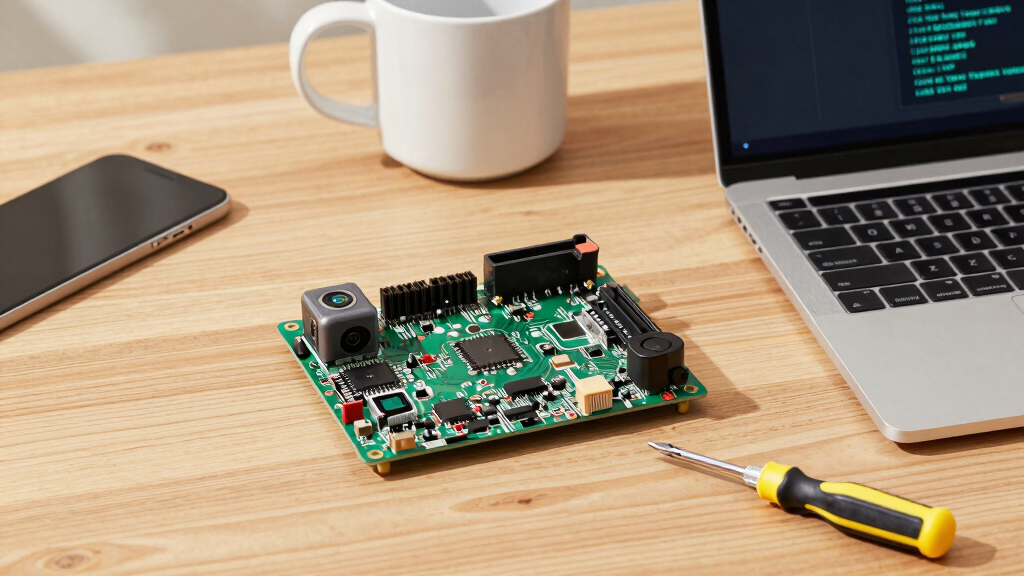
To select these dev boards, I prioritized hardware suited for computer vision, considering processing power, camera support, and connectivity options. I evaluated user interfaces, ease of development, and the potential for scaling or complex algorithms. Cost, size, and community support also played roles, ensuring these picks balance performance and practicality for different types of AI and vision projects.
Factors to Consider When Choosing Dev Board For Computer Vision Projects
Selecting the right dev board for computer vision hinges on understanding your project scope, processing requirements, and deployment environment. Here, I break down key factors to consider, helping you find a balance between power, size, and ease of use to match your specific use case.Processing Power and Camera Support
High-end vision projects with multiple 4K cameras or real-time processing needs will benefit from boards like the CanMV-K230, which offer dedicated AI accelerators and extensive I/O options. For simpler tasks or prototype development, boards like the XIAO ESP32 S3 provide sufficient processing with a smaller footprint, ideal for embedded IoT applications.
Connectivity and Expansion
Consider whether your project requires Ethernet, Wi-Fi, or Bluetooth. The CanMV-K230 supports Ethernet and Wi-Fi, making it more versatile for complex networked applications. The XIAO ESP32 S3 is limited to Wi-Fi and BLE, suitable for lightweight, wireless IoT setups.
Ease of Use and Development Ecosystem
Boards with extensive documentation, community support, and straightforward setup reduce development time. The XIAO ESP32 S3 benefits from the familiar ESP-IDF environment, while the CanMV-K230’s setup can be more involved, requiring advanced skills for configuration.
Size and Power Constraints
If your project is space-sensitive or battery-powered, the compact XIAO board is advantageous. Larger, more capable boards like the CanMV-K230 demand more power and space but deliver higher performance for demanding vision tasks.
Frequently Asked Questions
What type of camera support do these dev boards offer?
The CanMV-K230 supports three 4K HD camera inputs, suitable for multi-angle or high-resolution vision systems. The XIAO ESP32 S3 features a detachable OV2640 camera, which is suitable for basic image capture but limited in resolution and frame rate, making it ideal for simple sensing or embedded applications.
Which board is better for real-time, high-resolution vision processing?
The CanMV-K230 is better suited for high-resolution, real-time processing thanks to its dedicated AI acceleration and multiple camera inputs. The XIAO ESP32 S3, while capable of basic tasks, lacks the processing power needed for demanding vision algorithms and high frame rate video processing.
Are these boards suitable for beginners?
The XIAO ESP32 S3 is more accessible for beginners due to its smaller size, integrated sensors, and more straightforward development environment. The CanMV-K230, with its complex setup and advanced features, is better for experienced developers comfortable with hardware configuration and software integration.
Can I expand the storage or add peripherals easily?
The CanMV-K230 offers microSD and QSPI flash options but may require technical skill to set up. The XIAO ESP32 S3 includes an SD card slot and is generally easier to expand with external memory or peripherals, thanks to its well-documented ecosystem and smaller form factor.
Which board offers better connectivity options?
The CanMV-K230 includes Ethernet, Wi-Fi, and Bluetooth, making it more versatile for networked applications. The XIAO ESP32 S3 supports Wi-Fi and BLE, which are sufficient for most IoT projects but lack Ethernet support, limiting options in some industrial or high-bandwidth environments.
Conclusion
If your focus is on developing advanced, multi-camera computer vision systems with high processing demands, the CanMV-K230 is the clear choice despite its complexity. For space-limited, IoT, or beginner-friendly projects with basic vision needs, the XIAO ESP32 S3 Sense offers a more accessible and compact solution. Your decision should reflect your project scope, technical skills, and environment constraints.
Fall Picks
fall essentials
As an affiliate, we earn on qualifying purchases.