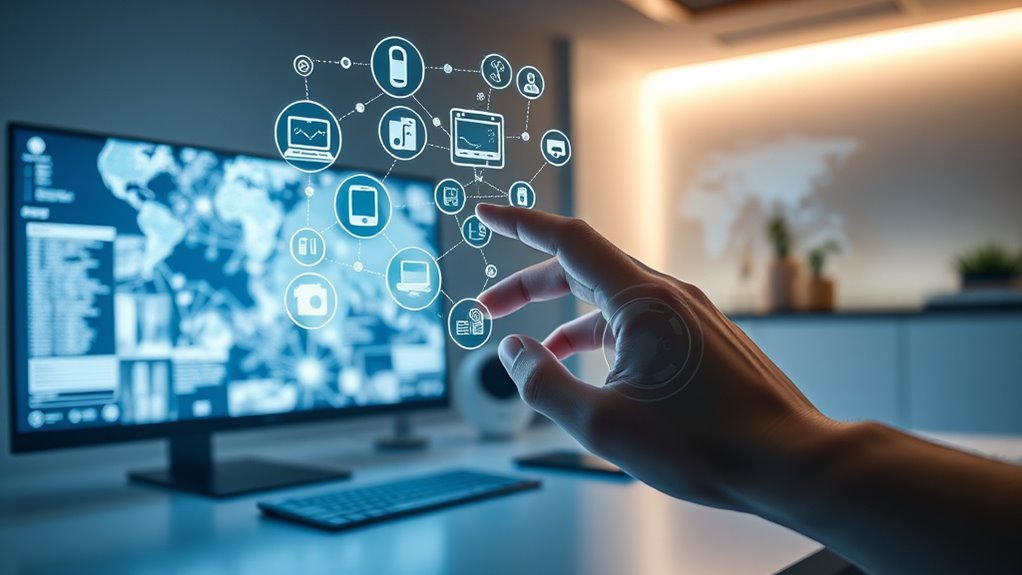

The Internet of Things (IoT) connects everyday devices to the internet, allowing them to communicate, share data, and act automatically without your involvement. Think of smart home gadgets, wearable health devices, and security cameras that work together seamlessly. IoT makes your life more convenient, safe, and personalized by automating tasks and providing real-time information. If you want to know how these devices improve daily routines and what’s next, you’ll find plenty more to discover.
Open a free Amazon Business account
Business pricing, bulk buying and tax-exempt orders.
As an affiliate, we earn on qualifying purchases.
Key Takeaways
- IoT refers to a network of interconnected devices that collect, share, and act on data without human intervention.
- It includes devices like smart home gadgets, wearables, and security systems that enhance convenience and automation.
- IoT enables real-time responses, improved safety, energy savings, and personalized experiences in daily life.
- Devices communicate via networks, transmitting data to cloud services for analysis and decision-making.
- The future of IoT involves smarter, more integrated devices that expand into various aspects of daily routines.

Have you ever wondered how everyday devices connect and communicate seamlessly? This is the magic of the Internet of Things, or IoT. It’s all about a network of devices that gather, share, and act on data without requiring constant human intervention. Imagine a smart home where your thermostat adjusts itself based on your habits, your lights turn off when you leave a room, and your security cameras send alerts straight to your phone. These are just a few examples of how IoT makes daily life more convenient, efficient, and interconnected.
At its core, IoT involves physical objects embedded with sensors, software, and network connectivity. These objects, known as “smart” devices, can collect data from their environment or user inputs and transmit that data to other devices or cloud services for processing. For example, in a smart home, a smart lock communicates with your smartphone to grant access remotely or alert you if someone tries to break in. Wearable devices like fitness trackers and smartwatches continuously monitor your health metrics, syncing with your phone or health apps to give you insights and reminders. These devices work together in a web of interconnected systems, enabling automation and real-time responses that weren’t possible before.
Smart devices with sensors and connectivity share data for automation and real-time responses.
Your everyday life is increasingly influenced by IoT because of the proliferation of smart home gadgets and wearable devices. These devices are designed to make your routines easier, safer, and more personalized. With a smart home, you can control everything from your coffee maker to your security system through a single app, often using voice commands or automation rules. Wearable devices, on the other hand, keep track of your activity levels, sleep patterns, and even heart rate, providing data that can motivate healthier habits or alert you to potential health issues. Because these devices are connected, they can share data effortlessly — your fitness tracker might sync with your health records, or your smart fridge could notify you when groceries are running low.
The power of IoT lies in its ability to create a network where devices communicate autonomously, making decisions based on data. This connectivity not only enhances convenience but also opens up possibilities for energy savings, improved security, and better health management. You become part of a larger ecosystem where your devices work together to simplify tasks and provide personalized experiences. As IoT continues to grow, expect your smart home and wearable gadgets to become even smarter, more intuitive, and more integrated into your daily routine. Understanding how these devices connect and collaborate is the first step in harnessing the full potential of the Internet of Things.
Furthermore, advancements in home automation technology are making IoT devices more user-friendly and accessible for everyone, encouraging wider adoption and integration into daily life.
As an affiliate, we earn on qualifying purchases.
Frequently Asked Questions
How Secure Is Iot Data From Cyber Threats?
IoT data’s security varies depending on the measures you use. Encryption protocols help protect your data during transmission, making it harder for hackers to access sensitive information. However, IoT devices can still be vulnerable to data breaches if security isn’t prioritized. You should regularly update firmware, use strong passwords, and implement robust encryption to minimize risks and keep your IoT data safer from cyber threats.
What Are the Main Challenges in Iot Implementation?
Imagine a puzzle missing key pieces—you face challenges like device interoperability and data standardization. These obstacles hinder smooth IoT implementation, making integration complex. You need to guarantee devices communicate seamlessly and data flows correctly across platforms. Overcoming these hurdles requires adopting universal standards and adaptable systems. By addressing these challenges head-on, you’ll create a cohesive IoT environment where everything works harmoniously, unblocking the technology’s full potential.
How Does Iot Impact Everyday Privacy?
You might notice that IoT impacts your everyday privacy through privacy concerns and data protection issues. As devices collect and share personal information, you risk exposure if data isn’t properly secured. You need to stay aware of what data is being gathered and guarantee your devices have strong security measures. By managing device settings and using secure networks, you can better protect your privacy in an increasingly connected world.
What Industries Benefit Most From Iot?
You’ll find that industries like healthcare and manufacturing benefit most from IoT. In smart healthcare, IoT devices monitor patient health in real-time, improving outcomes and efficiency. Industrial automation uses IoT to streamline production, reduce costs, and enhance safety. These applications allow you to optimize operations, deliver better services, and stay competitive. IoT’s ability to connect devices and gather data transforms how these industries operate daily, making processes smarter and more responsive.
How Can I Start Developing Iot Projects at Home?
Imagine building your own smart castle, and you start by exploring DIY sensors and open source platforms like Arduino or Raspberry Pi. You can begin developing IoT projects at home by choosing simple devices, learning coding basics, and experimenting with sensors for temperature, humidity, or motion. Follow online tutorials, join maker communities, and gradually expand your setup. This hands-on approach transforms your home into a personalized IoT playground.
As an affiliate, we earn on qualifying purchases.
Conclusion
Now that you understand what IoT is, how it connects devices, and how it impacts daily life, you’re ready to explore its endless possibilities. Whether you’re automating your home, improving your health, or transforming your business, IoT empowers you to innovate, simplify, and stay connected. Embrace the technology, harness its potential, and step confidently into the world of the Internet of Things. The future is yours to shape, one connected device at a time.
As an affiliate, we earn on qualifying purchases.
As an affiliate, we earn on qualifying purchases.
Fall Picks
fall essentials
As an affiliate, we earn on qualifying purchases.