
Static analysis scans your source code early, quickly finding common issues like security flaws and bugs without running the program. In contrast, symbolic execution simulates program execution with symbolic inputs, exploring complex paths to uncover deep vulnerabilities and runtime errors. Both methods work together to improve software quality: static analysis offers speed and broad coverage, while symbolic execution provides detailed insights into runtime behavior. Keep exploring to understand how combining these approaches can give you a more complete bug hunt.

Get business pricing on monitors, keyboards and dev gear
- Business-only prices and quantity discounts
- Tax-exempt purchasing
- Multiple users, one account, clear invoices
Key Takeaways
- Static analysis scans code without execution to identify potential issues early, while symbolic execution simulates runtime behavior to find deep bugs.
- Static analysis is faster and scalable, suitable for broad coverage; symbolic execution provides detailed insights into specific execution paths.
- Static analysis excels at detecting common security flaws and coding errors; symbolic execution uncovers subtle vulnerabilities behind complex logic.
- Combining static analysis and symbolic execution offers comprehensive bug detection, leveraging speed and depth of analysis.
- Static analysis is ideal for early development, whereas symbolic execution is more effective for thorough runtime scenario testing.
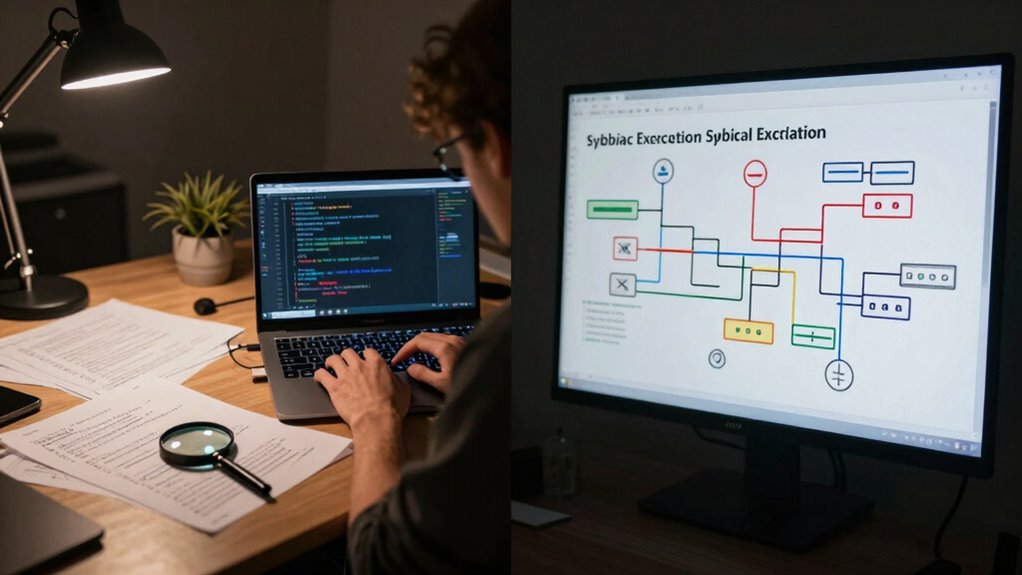
Have you ever wondered how developers identify bugs and vulnerabilities in software before they cause real damage? Two common approaches are static analysis and symbolic execution, each offering unique strengths in bug detection. Static analysis uses automated code review tools to scan your source code without executing it. These tools analyze the code structure, syntax, and patterns to spot potential issues like security flaws, coding errors, or violations of best practices. Because static analysis runs early in the development process, it helps you catch problems before your software even runs, saving time and reducing costly fixes down the line. This method is especially effective at identifying common issues, such as buffer overflows or injection vulnerabilities, by examining code paths and data flows without executing the program. It’s fast, scalable, and can be integrated into your continuous integration pipelines, providing instant feedback on code quality. Incorporating early detection techniques like static analysis can significantly improve overall software quality and security. Additionally, advancements in automated tools are making static analysis even more accessible for developers at all skill levels. Moreover, ongoing research into software testing continues to enhance static analysis capabilities, making it an increasingly vital component of modern development workflows.
Recent developments in machine learning are also being integrated into static analysis tools to improve their accuracy and reduce false positives, further empowering developers to maintain high-quality code.
On the other hand, symbolic execution takes a different route by simulating the execution of your program with symbolic inputs instead of concrete values. Think of it as exploring all possible execution paths your code could take, which makes it particularly powerful for uncovering deep-rooted bugs and subtle vulnerabilities. Unlike static analysis, symbolic execution can mimic runtime error detection by tracing how data moves through your program, revealing issues that surface only during actual execution. It’s especially useful for testing complex logic, boundary conditions, and corner cases that static analysis might miss. Because it explores multiple paths simultaneously, symbolic execution can identify vulnerabilities that are hidden behind intricate code logic, giving you a more thorough understanding of your program’s behavior. Additionally, integrating content analysis techniques can enhance the effectiveness of both methods by ensuring compliance with security standards and requirements traceability. This combined approach helps developers address issues that could otherwise remain undetected until deployment.
While static analysis offers the advantage of speed and broad coverage at an early stage, symbolic execution provides a detailed insight into how your code behaves during runtime. Both methods complement each other well—static analysis can quickly flag obvious issues, while symbolic execution dives deeper into complex scenarios. Integrating these approaches into your development workflow ensures a more exhaustive bug hunt. By combining automated code review with runtime error detection techniques, you’re better equipped to find vulnerabilities before they reach your users. Ultimately, understanding the differences and strengths of static analysis and symbolic execution empowers you to choose the right tools for your project, making your software more secure and reliable from the start.
As an affiliate, we earn on qualifying purchases.
Frequently Asked Questions
How Do Static Analysis and Symbolic Execution Complement Each Other?
You can combine static analysis and symbolic execution to enhance bug detection. Static analysis uses heuristic approaches for quick, real-time analysis, catching common issues early. Symbolic execution then deepens the investigation by exploring specific execution paths to find complex bugs. Together, they complement each other: static analysis offers speed and broad coverage, while symbolic execution provides detailed insights, making your bug hunting more thorough and effective.
What Are the Limitations of Static Analysis?
Ever wonder if static analysis can catch every bug? Its limitations lie in false positives, which can waste your time chasing non-issues, and scalability issues, making it tough to analyze large codebases efficiently. Static analysis might miss context-specific bugs or complex vulnerabilities that require dynamic testing. So, while useful, it’s not foolproof and needs to be complemented with other methods for thorough security.
Can Symbolic Execution Find All Types of Bugs?
No, symbolic execution can’t find all types of bugs. While it excels at uncovering logical errors and security vulnerabilities through path exploration, it struggles with issues like race conditions or bugs dependent on runtime environments. To get a complete picture, you should combine symbolic execution with runtime monitoring and formal verification techniques. This integrated approach enhances bug detection coverage, ensuring more thorough software reliability and security.
How Does Performance Differ Between the Two Methods?
You’ll find that static analysis generally offers faster performance benchmarks because it reviews code without executing it, making it more scalable for large projects. Symbolic execution, however, faces scalability challenges due to its detailed path exploration, which can slow down analysis as code complexity increases. While static analysis is quicker, symbolic execution provides more in-depth bug detection, but at a higher performance cost.
Are There Specific Programming Languages Better Suited for Each Technique?
Certain programming languages are better suited for each technique due to language compatibility and tool integration. Static analysis works well with statically typed languages like C and Java, which have strong tool support and clear syntax. Symbolic execution often suits languages with rich runtime information, like Python, because of better dynamic analysis capabilities. Your choice depends on the language’s features and how easily the analysis tools integrate with your development environment.
As an affiliate, we earn on qualifying purchases.
Conclusion
In the end, understanding the strengths of static analysis and symbolic execution helps you choose the right bug-hunting tool. Static analysis catches common issues early, while symbolic execution dives deeper into complex bugs. Notably, studies show static analysis tools detect up to 70% of bugs in large codebases, highlighting their efficiency. By leveraging both methods, you can considerably improve your software’s security and reliability, making your bug hunts more effective and thorough.
As an affiliate, we earn on qualifying purchases.
static and symbolic analysis for developers
As an affiliate, we earn on qualifying purchases.
As an affiliate, we earn on qualifying purchases.
Fall Picks
fall essentials
As an affiliate, we earn on qualifying purchases.