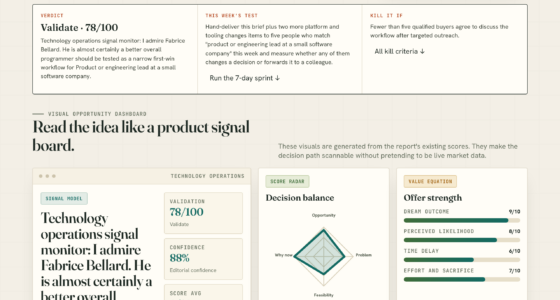

📊 Full opportunity report: Sovereignty Is A Pipe, Not A Passport on ThorstenMeyerAI.com — validation score, market gap, and execution plan.
TL;DR
Mistral AI claims sovereignty by hosting models on European infrastructure, but reliance on American cloud providers complicates legal jurisdiction. The core issue is whether data sovereignty is about physical location or legal control.
Mistral AI has built a $14 billion company based on the promise of providing European AI models that are not subject to US legal reach. The company emphasizes hosting models within European infrastructure to ensure data sovereignty, but its reliance on American cloud providers complicates this claim, revealing a fundamental legal challenge.
While Mistral’s models can be run on-premise within European data centers, most enterprise customers access these models through US-based cloud platforms such as Microsoft Azure, Google Cloud, and Amazon Web Services. This creates a jurisdictional vulnerability because the US CLOUD Act allows authorities to compel US-headquartered providers to release data, regardless of physical location.
The core issue is that legal jurisdiction follows the company’s domicile, not the physical servers. Even if data resides in European data centers, hosting the models via American cloud services exposes it to US legal authority. This undermines the premise that European hosting alone guarantees sovereignty.
However, Mistral’s sovereignty claim holds true when models are self-hosted within European infrastructure, never phoning home, and operated on local hardware. Such deployment can be fully outside US jurisdiction, and European certifications like SecNumCloud and BSI C5 favor these setups. The company’s recent €830 million debt financing for its Paris data center further underscores its commitment to sovereignty at the infrastructure level.
Sovereignty is a pipe, not a passport
Mistral sells European data sovereignty — then distributes its models through Azure, Bedrock & Google Cloud, the American infrastructure it tells customers to flee. A French passport on the lab doesn’t travel down an American wire.
Mistral-direct
hyperscaler
The CLOUD Act lets US authorities compel a US-headquartered provider to hand over data wherever it physically sits. Picking the “EU region” in AWS or Azure doesn’t resolve it — jurisdiction follows the company’s HQ, not the server’s location. Schrems II established the same from the EU side.
Mistral isn’t selling a lie — it’s selling a conditional truth, and the condition is the part the marketing skips. Sovereignty holds on Mistral’s own iron; it leaks the moment convenience routes the model through the American cloud. The deeper lesson cuts at Brussels: sovereignty is an end-to-end property of the whole stack — model, cloud, chips, supply chain — that Europe owns at no layer except the model itself. As Mensch put it: you “cannot regulate your way to computing supremacy.”
Implications of Jurisdictional Control Over Data
This analysis underscores that true data sovereignty depends on legal jurisdiction rather than physical location. For enterprises, relying solely on European data centers does not guarantee protection from US legal authority if models are accessed through American cloud platforms. The distinction is critical for organizations handling sensitive data, such as healthcare or government information, where sovereignty is a strategic priority.
The reliance on American infrastructure by European AI companies exposes a fundamental vulnerability in sovereignty claims, influencing procurement decisions, regulatory compliance, and national security considerations. European regulators and buyers must scrutinize not just where data is stored, but who has control over the underlying infrastructure and legal compliance.
European data center server hardware
As an affiliate, we earn on qualifying purchases.
As an affiliate, we earn on qualifying purchases.
Legal and Industry Frameworks Shaping Data Sovereignty
The 2018 US CLOUD Act allows US authorities to access data held by American companies or those operating within US jurisdiction, regardless of data location. The 2020 Schrems II ruling invalidated the EU-US Privacy Shield, highlighting the conflict between US law and European privacy standards, and prompting European regulators to scrutinize data flows more carefully.
European initiatives like France’s Health Data Hub and certifications such as SecNumCloud aim to reinforce sovereignty, but the reliance on U.S. hardware and cloud services remains a challenge. The industry is increasingly aware that sovereignty is a matter of legal control, not just physical infrastructure, complicating efforts to create fully independent European cloud ecosystems.
“Our self-hosted models in European data centers are fully sovereign, but most customers prefer managed services, which reintroduce jurisdictional risks.”
— Mistral AI spokesperson

Local AI Engineering with Ollama: Run, understand, customize, fine-tune, and build agentic apps on your own hardware
As an affiliate, we earn on qualifying purchases.
As an affiliate, we earn on qualifying purchases.
Extent of US Legal Reach Through Cloud Platforms
It remains unclear how European regulators will address the jurisdictional risks posed by US cloud providers in practice. While legal principles are well established, enforcement and compliance nuances, especially with emerging cloud boundary controls like Microsoft’s EU Data Boundary, are still evolving. The effectiveness of these measures in fully protecting European data sovereignty is yet to be proven.

Securing the Cloud: Cloud Computer Security Techniques and Tactics
As an affiliate, we earn on qualifying purchases.
As an affiliate, we earn on qualifying purchases.
Future Regulatory and Industry Responses to Jurisdictional Risks
European regulators are likely to intensify scrutiny of cloud service providers and enforce stricter controls over jurisdictional exposure. Enterprises may increasingly favor self-hosted or European-only cloud solutions to mitigate legal risks. Additionally, ongoing legal debates and potential new legislation could redefine the boundaries of sovereignty, making the issue an evolving priority for policymakers and industry leaders.
As an affiliate, we earn on qualifying purchases.
Key Questions
Does hosting models in European data centers guarantee sovereignty?
Not necessarily. Sovereignty depends on legal jurisdiction and control over the data, not just physical location. Using American cloud services can still expose data to US legal reach.
How does US law affect European data hosted on American cloud platforms?
The US CLOUD Act enables US authorities to compel cloud providers to produce data, regardless of where servers are physically located, if the company is US-based or operates under US jurisdiction.
Can European companies avoid jurisdictional risks by self-hosting?
Yes, deploying models within European infrastructure and hardware can fully insulate data from US jurisdiction, but it requires significant investment and compliance with local standards.
Are European regulations like SecNumCloud sufficient to ensure sovereignty?
They help establish standards for secure, sovereign cloud services, but legal jurisdiction depends on the company’s domicile and operational control, not just certification.
What is the main challenge for European AI sovereignty?
The dependency on US hardware, cloud platforms, and legal frameworks that extend beyond physical infrastructure creates a complex legal landscape that complicates true sovereignty.
Source: ThorstenMeyerAI.com