If you’re troubleshooting digital protocols or digital system interactions, a logic analyzer is your best choice because it decodes multiple digital signals, identifies protocol errors, and shows relationships over time. For analyzing high-speed analog signals, waveform shape, and power issues, an oscilloscope provides detailed visualizations. Each tool solves different problems; understanding their strengths helps you pick the right one. Keep exploring to discover how combining both tools can give you a complete diagnostic edge.

Get business pricing on monitors, keyboards and dev gear
- Business-only prices and quantity discounts
- Tax-exempt purchasing
- Multiple users, one account, clear invoices
Key Takeaways
- Oscilloscopes excel at visualizing high-speed analog signals, waveform shape, and timing issues in real time.
- Logic analyzers decode digital protocols, troubleshoot communication errors, and analyze multiple digital signals simultaneously.
- Use oscilloscopes for power analysis, waveform integrity, and analog circuit troubleshooting; use logic analyzers for digital protocol verification.
- Combining both tools provides comprehensive diagnostics for analog signals, digital data, and system interactions.
- Select oscilloscopes for waveform detail and high-frequency analysis; choose logic analyzers for multi-channel digital protocol decoding.
digital oscilloscope for high-speed signals
As an affiliate, we earn on qualifying purchases.
As an affiliate, we earn on qualifying purchases.
Understanding Logic Analyzers and Oscilloscopes: What’s the Difference?

While both logic analyzers and oscilloscopes are essential tools for electronic testing, they serve different purposes and display different types of data. Oscilloscopes excel at visualizing analog signals, allowing you to see voltage changes over time. You can easily analyze waveform shape, amplitude, and timing, making them perfect for troubleshooting circuits and measuring frequency. Logic analyzers, on the other hand, focus on digital signals, capturing multiple data channels simultaneously. They’re ideal for decoding complex digital protocols and understanding how digital components communicate. When it comes to frequency measurement, oscilloscopes are your go-to because they display real-time waveforms, enabling precise analysis. Additionally, high refresh rates in oscilloscopes improve the accuracy of capturing rapid signal changes, which is crucial for detailed analysis. Understanding these distinctions helps you choose the right tool based on whether you’re working with analog signals or digital data, especially considering the signal types involved.
logic analyzer for digital protocol decoding
As an affiliate, we earn on qualifying purchases.
As an affiliate, we earn on qualifying purchases.
When Should You Use a Logic Analyzer for Troubleshooting?

You should consider using a logic analyzer when you need to analyze complex digital signals or monitor multiple signals simultaneously. It’s especially helpful for debugging digital protocols and identifying timing issues. If your troubleshooting involves detailed digital communication, a logic analyzer is the right tool. Additionally, understanding the must-see destinations related to digital troubleshooting can help you optimize your setup and workflow. Recognizing the importance of digital signal analysis can further enhance your ability to resolve intricate issues effectively. Being familiar with measurement accuracy and proper calibration techniques can also ensure more reliable diagnostics. Incorporating landscape landscaping principles can aid in creating an organized and efficient workspace for your testing setup.
Complex Signal Analysis
Complex signal analysis is essential when troubleshooting digital systems that involve multiple data lines, high-speed signals, or intricate timing relationships. You should consider a logic analyzer when dealing with signals related to quantum entanglement or complex signal encryption, where timing precision is critical. Use a logic analyzer if:
- You need to decode multiple digital channels simultaneously.
- You’re analyzing signals with tight timing constraints or subtle protocol violations.
- You must identify interference affecting data integrity.
- You’re troubleshooting systems involving cryptography or quantum technologies where signals are heavily encoded.
Unlike oscilloscopes, logic analyzers excel at capturing and correlating multiple digital signals over time, making them perfect for complex scenarios. They help you visualize the relationships between signals, revealing issues that might be invisible with traditional tools.
Multiple Signal Monitoring
When troubleshooting digital systems with multiple data lines, monitoring several signals simultaneously becomes essential for pinpointing issues. A logic analyzer allows you to observe multiple signals at once, making it ideal for diagnosing complex problems like power supply fluctuations or EMI troubleshooting. If you’re experiencing inconsistent digital communication or suspect interference affecting multiple lines, a logic analyzer helps identify timing issues, signal corruption, or noise coupling efficiently. It provides a thorough view of the digital environment, enabling you to correlate signals across various channels instantly. This capability is vital when troubleshooting systems where the root cause spans multiple signals or components, providing a clear picture of how signals interact and revealing issues that might be missed with a single-channel instrument.
Digital Protocol Debugging
Digital protocol debugging becomes essential when analyzing communication standards like I2C, SPI, UART, or CAN, especially if issues arise intermittently or under specific conditions. A logic analyzer helps you decode digital signals, making it easier to identify protocol errors or timing issues. Use a logic analyzer when:
- You need to interpret complex digital signals and protocols.
- Troubleshooting intermittent communication failures.
- Analyzing digital signals alongside analog signals for power measurement.
- Debugging issues caused by signal timing or protocol violations.
While oscilloscopes excel at capturing analog signals and power measurement, a logic analyzer provides detailed digital protocol insights. This makes it the ideal tool for troubleshooting digital communication problems efficiently.
oscilloscope for waveform analysis
As an affiliate, we earn on qualifying purchases.
As an affiliate, we earn on qualifying purchases.
In Which Scenarios Is an Oscilloscope the Better Choice?

Oscilloscopes excel in scenarios where detailed, real-time analysis of electrical signals is essential. If you need to examine analog signals, they provide a clear, continuous view of voltage changes over time, making them ideal for troubleshooting circuitry. When performing power analysis, oscilloscopes allow you to visualize voltage and current waveforms, helping you identify issues like noise, distortion, or transient faults. They’re especially useful in testing and debugging analog circuits, as well as monitoring signal integrity in high-speed applications. Unlike digital tools, oscilloscopes give you immediate insight into waveform shape, amplitude, and timing. If your work involves analyzing continuous signals or complex power patterns, an oscilloscope is the better choice to get precise, real-time data. Additionally, understanding the standards and conventions used in signal measurement can improve your troubleshooting accuracy. Mastering these measurement techniques can significantly enhance your ability to interpret complex waveforms effectively.
digital signal troubleshooting tools
As an affiliate, we earn on qualifying purchases.
As an affiliate, we earn on qualifying purchases.
Key Features to Evaluate When Choosing Between a Logic Analyzer and an Oscilloscope

When choosing between a logic analyzer and an oscilloscope, you need to take into account how well each handles complex signals, how fast they acquire data, and their visualization features. These key points determine which tool best fits your testing needs. Understanding these features helps you make a more informed decision.
Signal Complexity Handling
Handling complex signals requires tools that can accurately capture and analyze rapid or intricate variations. When evaluating your options, consider how well the device manages high-frequency signals, preserves signal integrity, and captures detailed analog waveforms. A scope excels at visualizing analog waveforms, making it ideal for analyzing signal integrity in real time. Conversely, a logic analyzer breaks down digital signals into logic states, but may struggle with high-speed, complex analog signals. To evaluate signal complexity handling, keep in mind:
- Ability to capture high-frequency signals without distortion
- Precision in maintaining signal integrity during analysis
- Capacity to display detailed analog waveforms for complex signals
- Effectiveness in analyzing intricate digital and mixed signals
Choosing the right tool depends on your signal complexity and the level of detail needed.
Data Acquisition Speed
The speed at which data can be acquired directly impacts how effectively you can analyze signals, especially when dealing with rapid or complex events. Oscilloscopes excel here, capturing high-speed analog signals and providing real-time waveform updates critical for detailed analysis. This is essential for power measurement, where quick fluctuations matter. Logic analyzers, on the other hand, focus on digital signals and often have slower acquisition rates, but they excel in capturing multiple channels over extended periods, useful for debugging digital systems. If your work involves analyzing fast analog signals or power fluctuations, an oscilloscope’s high acquisition speed is necessary. Conversely, for digital signal integrity and long-term data collection, a logic analyzer offers the required data throughput.
Visualization Capabilities
Choosing between a logic analyzer and an oscilloscope often hinges on their visualization capabilities, which are essential for interpreting signals accurately. Oscilloscopes excel at displaying analog signals visually, allowing you to see waveform shapes, amplitude, and timing details. Logic analyzers, on the other hand, focus on digital signals and timing relationships, often presenting multiple channels simultaneously. Key visualization features include:
- Real-time waveform display for analog signals and detailed time measurements.
- Multi-channel views to compare digital signals side-by-side.
- Power analysis tools that visualize power consumption patterns.
- Zoom and cursors for precise analysis of signal transitions and anomalies.
- Roles in AI development often require precise signal interpretation to ensure proper functioning and security.
These features help you quickly identify issues, interpret complex data, and make informed decisions during troubleshooting.
How Do Logic Analyzers Help Debug Digital Communication Protocols?

Logic analyzers are vital tools for debugging digital communication protocols because they can capture and display multiple signals simultaneously, making it easier to identify where issues occur. Unlike oscilloscopes, they analyze digital data streams rather than just analog signals, focusing on protocols like I2C, UART, or SPI. They decode complex sequences, helping you spot timing errors, lost packets, or protocol violations. Their ability to filter, trigger, and display data based on specific protocol conditions streamlines troubleshooting. While analog signals and frequency response are indispensable for analog analysis, logic analyzers excel in revealing the digital communication patterns behind the scenes. This targeted approach simplifies debugging digital protocols, saving you time and ensuring data integrity in your systems.
What Are the Limitations of Oscilloscopes for Digital Signal Analysis?
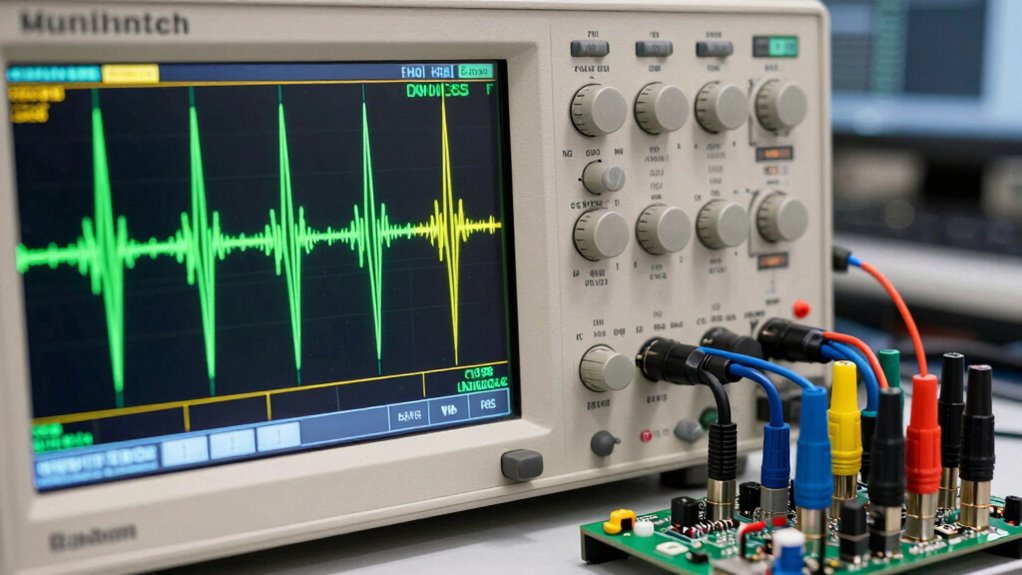
Oscilloscopes are excellent tools for visualizing analog signals, but they have notable limitations when it comes to analyzing digital signals. These limitations include:
- Analog limitations: Oscilloscopes primarily display continuous waveforms, making it harder to interpret digital signals with rapid transitions.
- Bandwidth constraints: Limited bandwidth can distort high-speed digital signals, leading to inaccurate readings.
- Limited decoding capabilities: Standard oscilloscopes often lack advanced digital protocol decoding features, which are essential for complex digital analysis.
- Triggering challenges: Precise triggering on digital events can be difficult, especially at high frequencies, reducing visibility into specific signal states.
These factors can hinder your ability to accurately analyze fast digital signals and protocols.
Tips for Picking the Right Testing Tool for Your Circuit

Selecting the right testing tool depends on understanding your specific circuit needs and the signals you’re working with. If your circuit involves high-speed digital signals, an oscilloscope is ideal for analyzing signal attenuation and capturing real-time waveforms. Consider the power consumption of your device; if it’s low-power, choose a tool that minimizes additional load or interference. For digital signal analysis involving protocol decoding or multiple signals, a logic analyzer might be more effective. Think about your project’s complexity and whether you need detailed timing information or broader signal insights. Matching your needs with the tool’s capabilities ensures more accurate diagnostics and efficient troubleshooting. Ultimately, evaluating factors like signal attenuation and power consumption will guide you towards the most suitable testing instrument. Additionally, understanding the design aesthetics of your setup can influence your choice of equipment, especially if space and presentation are important for your workspace.
Common Mistakes to Avoid When Using Logic Analyzers and Oscilloscopes

When you’re new to using these testing tools, it’s easy to make simple mistakes that can lead to inaccurate readings or missed signals. To avoid common pitfalls:
- Don’t ignore proper grounding; poor grounding can distort analog signals.
- Be cautious with signal filtering—over-filtering can hide important details, while under-filtering introduces noise.
- Avoid probing directly into high-frequency or sensitive circuits without proper attenuation.
- Always verify your probe connections, ensuring they’re secure and correctly matched to the device, especially when testing analog signals.
How Combining Both Tools Can Improve Your Circuit Diagnostics

Combining both logic analyzers and oscilloscopes allows you to gain a complete view of your circuit’s behavior, making diagnostics more effective. An oscilloscope excels at analyzing analog signals, helping you visualize waveforms, measure voltage levels, and troubleshoot timing issues. Meanwhile, a logic analyzer captures digital signals and protocols, revealing data exchanges and state changes. Using both tools together enhances power measurement accuracy, as oscilloscopes can monitor voltage and current fluctuations, while logic analyzers confirm digital communication integrity. This integrated approach helps identify complex issues that might go unnoticed when relying on just one device. Additionally, understanding the digital communication protocols involved can further streamline troubleshooting efforts. Recognizing the different functions of each tool is essential for comprehensive diagnostics. By combining their strengths, you get a thorough understanding of your circuit—covering analog signals, digital data, and power consumption—ultimately improving your troubleshooting efficiency.
Frequently Asked Questions
Can a Single Device Function as Both a Logic Analyzer and an Oscilloscope?
Yes, a single device can function as both a logic analyzer and an oscilloscope thanks to its multi-function capabilities. These devices integrate multiple measurement tools, allowing you to analyze digital signals and view analog waveforms with ease. By combining device integration, you save space and money while gaining versatile functionality, making it ideal for troubleshooting complex electronic circuits without needing separate instruments.
What Are the Cost Differences Between Logic Analyzers and Oscilloscopes?
Think of cost differences like choosing between a trusted steed and a racehorse. Logic analyzers tend to be more affordable, focusing on digital signal sampling and trigger sensitivity for complex data analysis. Oscilloscopes, especially high-end models, can be pricier due to their advanced analog features and precise waveform visualization. Your choice depends on your needs, but generally, logic analyzers cost less, making them a budget-friendly option for digital troubleshooting.
Are Portable Versions Available for Both Testing Tools?
Yes, portable options are available for both testing tools, enhancing device versatility. Portable oscilloscopes are compact, battery-powered, and easy to carry, making them ideal for field testing and on-the-go troubleshooting. Likewise, portable logic analyzers offer flexibility for debugging embedded systems outside the lab. These devices provide the convenience you need without sacrificing essential features, allowing you to perform accurate testing wherever your work takes you.
How Does Bandwidth Affect the Performance of Oscilloscopes?
Bandwidth directly impacts your oscilloscope’s ability to accurately measure high-frequency signals. If bandwidth limitations exist, your readings may suffer from poor signal integrity, leading to distorted or incomplete waveforms. To guarantee precise measurements, choose an oscilloscope with sufficient bandwidth for your signals. This prevents signal attenuation and preserves detail, especially when analyzing fast digital signals, ensuring your data remains reliable and meaningful.
What Training Is Recommended to Operate These Tools Effectively?
To operate these tools effectively, you should undergo thorough training that covers signal integrity and data interpretation. Hands-on workshops and online courses can help you understand how to set up equipment correctly and analyze signals accurately. Focus on learning how to interpret waveforms, troubleshoot issues, and guarantee accurate measurements. Gaining practical experience with real-world scenarios will boost your confidence and proficiency in using oscilloscopes and logic analyzers effectively.
Conclusion
Choosing the right tool depends on your specific needs—whether it’s analyzing digital protocols or capturing analog signals. Did you know that over 60% of engineers find combining oscilloscopes and logic analyzers boosts troubleshooting efficiency? By understanding each tool’s strengths and limitations, you can make smarter decisions, streamline diagnostics, and guarantee your circuits perform effectively. Don’t overlook the power of integrating both devices for thorough testing and faster problem resolution.
Fall Picks
fall essentials
As an affiliate, we earn on qualifying purchases.