

Duolingo personalizes your learning by analyzing your strengths, weaknesses, and engagement to adjust lessons, focus on difficult topics, and space out review sessions for better retention. It tracks your mistakes and progress to create a tailored experience that keeps you motivated and challenged at the right level. The platform also experiments with question formats and gamification to find what works best for you. If you keep exploring, you’ll discover how these strategies make learning more effective.

Get business pricing on monitors, keyboards and dev gear
- Business-only prices and quantity discounts
- Tax-exempt purchasing
- Multiple users, one account, clear invoices
Key Takeaways
- Duolingo collects user data from lesson performance to tailor future content and adjust difficulty levels.
- It targets learners’ specific struggles, such as verb conjugations, through focused drills and reinforcement.
- The platform conducts A/B testing on teaching techniques to identify the most effective methods for retention and engagement.
- Spaced repetition and predictive analytics optimize vocabulary retention by scheduling reviews at ideal intervals.
- Duolingo creates a dynamic, adaptive environment that transforms passive lessons into active, personalized learning experiences.
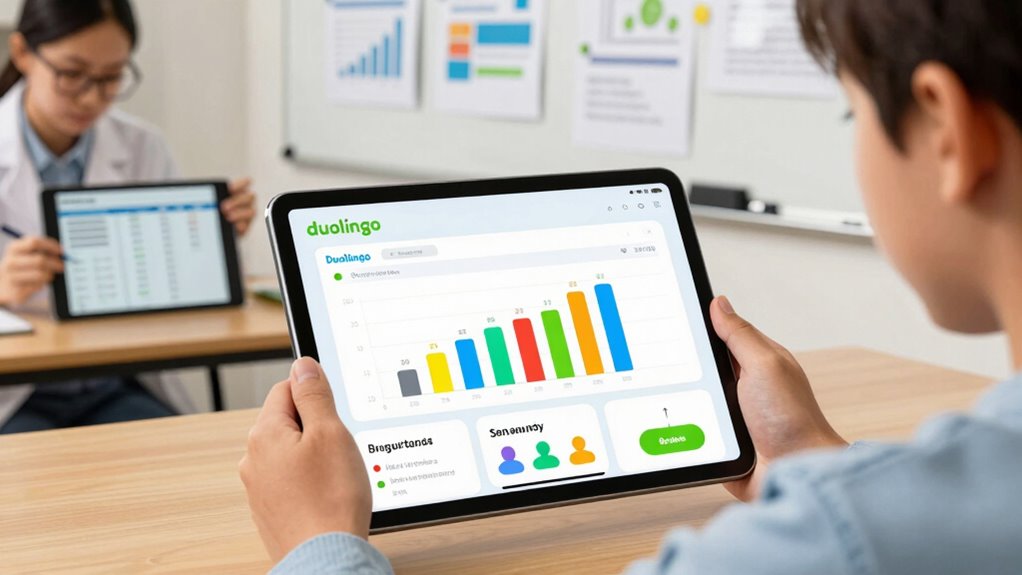
Duolingo has revolutionized language learning by personalizing the experience to meet each learner’s unique needs. This approach taps into how you acquire new languages, making the process more effective and engaging. Instead of a one-size-fits-all method, Duolingo uses data to understand your strengths, weaknesses, and learning pace. Every time you complete a lesson or make a mistake, the platform collects information that shapes your future sessions. This continuous feedback loop makes your learning journey more tailored, helping you progress faster and with greater confidence.
The core of Duolingo’s personalization lies in its ability to analyze user engagement. When you actively participate—whether by practicing vocabulary, completing exercises, or revisiting challenging concepts—the app tracks your interactions. If you tend to struggle with verb conjugations, for example, Duolingo will introduce more focused drills on that topic. This targeted reinforcement keeps you motivated because you’re tackling your specific difficulties rather than wasting time on material you already master. As a result, user engagement increases, and you’re more likely to stick with your language goals over time. Additionally, understanding the contrast ratio helps the platform optimize visual clarity, ensuring that the interface remains accessible and easy to read regardless of your device or environment.
Duolingo also experiments with different teaching techniques to see what resonates best with learners like you. These A/B tests involve trying out various question formats, gamification elements, or review strategies to gauge their impact on your learning. If a certain approach boosts your retention or encourages more frequent practice, the platform adopts it universally. This iterative process ensures that the lessons stay fresh, effective, and aligned with how you learn best. It’s like having a personal tutor who constantly adapts to your evolving needs.
Data-driven insights allow Duolingo to predict when you’re likely to forget certain words or concepts, prompting timely reviews. This spaced repetition optimizes your language acquisition, embedding new vocabulary into your long-term memory. By adjusting content based on your performance, the app keeps you challenged without overwhelming you, which sustains your interest and curiosity. This personalized balance between difficulty and support ensures that learning remains enjoyable and productive.
Ultimately, Duolingo’s commitment to personalization through data and experiments transforms the way you learn a new language. Instead of passive consumption, you become an active participant in a dynamic, responsive learning environment. Your progress depends less on generic lessons and more on a system that adapts to your unique learning style, keeping you engaged and motivated every step of the way. Digital content formats and research techniques play a crucial role in shaping this adaptive learning experience.
As an affiliate, we earn on qualifying purchases.
Frequently Asked Questions
How Does Duolingo Collect User Data Ethically?
Duolingo collects your data ethically by prioritizing user consent and implementing data anonymization. You’re informed about what data is collected, and you actively agree through clear consent prompts. The company anonymizes your personal information to protect your privacy, ensuring your data isn’t linked back to you personally. This approach respects your rights, maintains transparency, and adheres to privacy standards, making your learning experience both effective and ethically responsible.
What Algorithms Drive Duolingo’s Personalized Content?
You’re driven by algorithms that prioritize efficiency and content diversity, ensuring personalized learning. Duolingo uses machine learning models that analyze your progress, adjusting difficulty levels and introducing varied exercises to keep you engaged. These algorithms efficiently identify your strengths and weaknesses, tailoring lessons to maximize retention. By balancing content diversity, they prevent monotony, helping you stay motivated and learn effectively through a dynamic, customized experience.
How Does User Feedback Influence Learning Adjustments?
You influence your learning by providing motivational feedback, which Duolingo uses to tailor your experience. When you rate exercises or indicate difficulty, the platform adjusts adaptive difficulty levels, ensuring tasks match your skill. This feedback helps identify areas needing more focus, making lessons more engaging and effective. By actively sharing your responses, you shape a personalized journey that keeps you motivated and consistently challenged, boosting your language skills.
Are There Privacy Concerns With Data-Driven Personalization?
Yes, there are privacy concerns with data-driven personalization. You might worry about data security and how your information is protected. Duolingo addresses this by implementing strict data security measures and ensuring user consent before collecting data. Still, it’s good to stay informed about how your data is used, and always review privacy policies, so you can decide what you’re comfortable sharing to personalize your learning experience safely.
How Quickly Does Duolingo Adapt to User Performance Changes?
Duolingo adapts quickly to your performance changes thanks to its adaptive algorithms that monitor your engagement metrics in real-time. When you struggle or excel, the platform adjusts lesson difficulty almost instantly, often within minutes. This rapid adaptation helps keep you engaged and guarantees you’re always challenged at the right level, making your learning experience more personalized and effective.
spaced repetition vocabulary app
As an affiliate, we earn on qualifying purchases.
As an affiliate, we earn on qualifying purchases.
Conclusion
You see, Duolingo’s dedication to data-driven discovery drives delightful, dynamic, and personalized learning. By blending bold experiments with brilliant insights, it creates a customized classroom that keeps learners engaged and enthusiastic. This clever combination cultivates confidence, curiosity, and continuous growth. So, step into this smart, strategic space where science and stories synchronize, and watch your language skills soar. Duolingo’s data-driven design delivers a dynamic, delightful, and personalized learning experience just for you.
As an affiliate, we earn on qualifying purchases.
interactive language learning tools
As an affiliate, we earn on qualifying purchases.
As an affiliate, we earn on qualifying purchases.
Halloween Picks
halloween
As an affiliate, we earn on qualifying purchases.